Screen 1 of 12
Welcome back
Screen 1
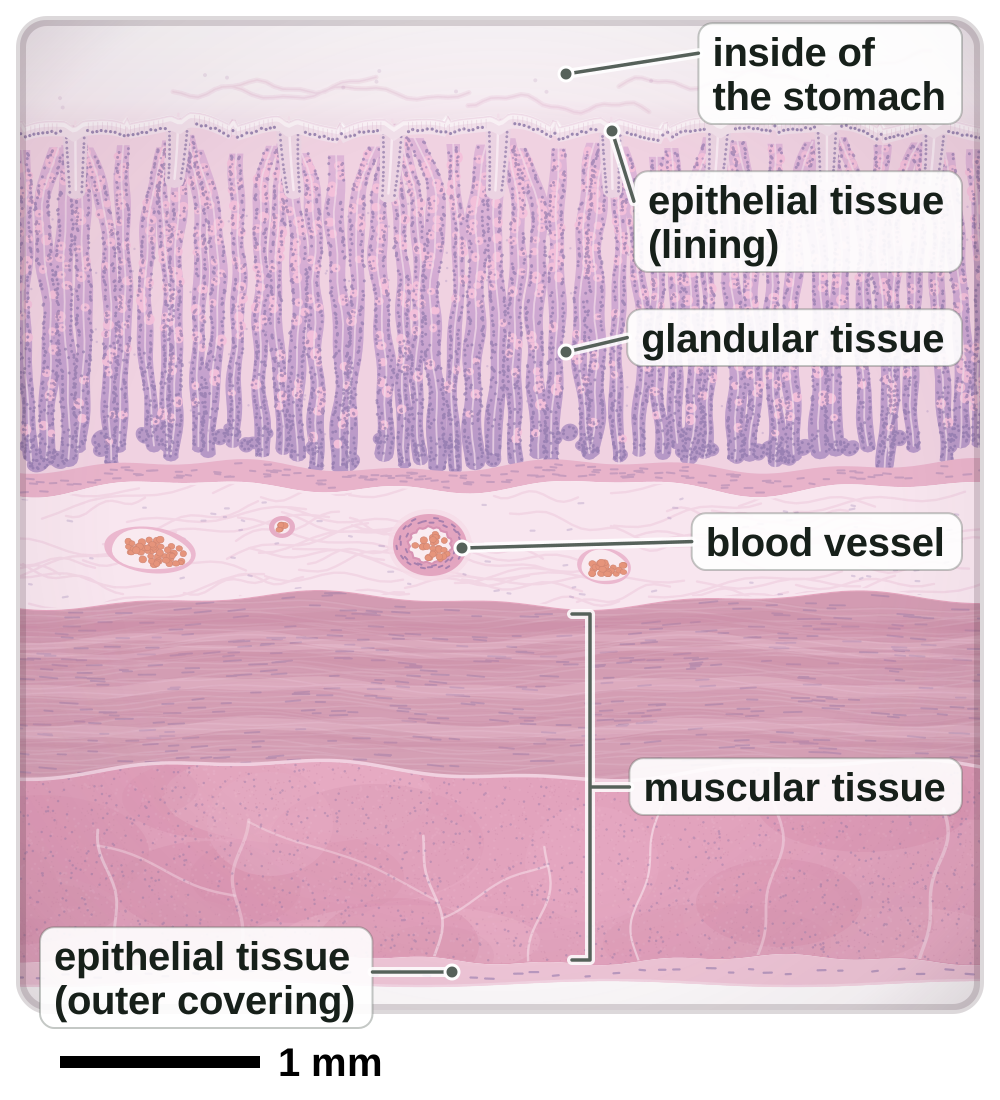
Inside the stomach wall
- All living things are made of cells.
- In the stomach wall, cells sit in layers. Each layer is a tissue.
- This is a painting of a thin slice of stomach wall, seen through a microscope.
Screen 2
A real stomach wall and a diagram
- A real stained slice is pink and purple, with tiny cells packed together.
- A diagram is simplified on purpose: a few big cells and one flat colour for each tissue.
- Stains colour the cells; real tissue is mostly pale.
Tap a difference to see it on both pictures.
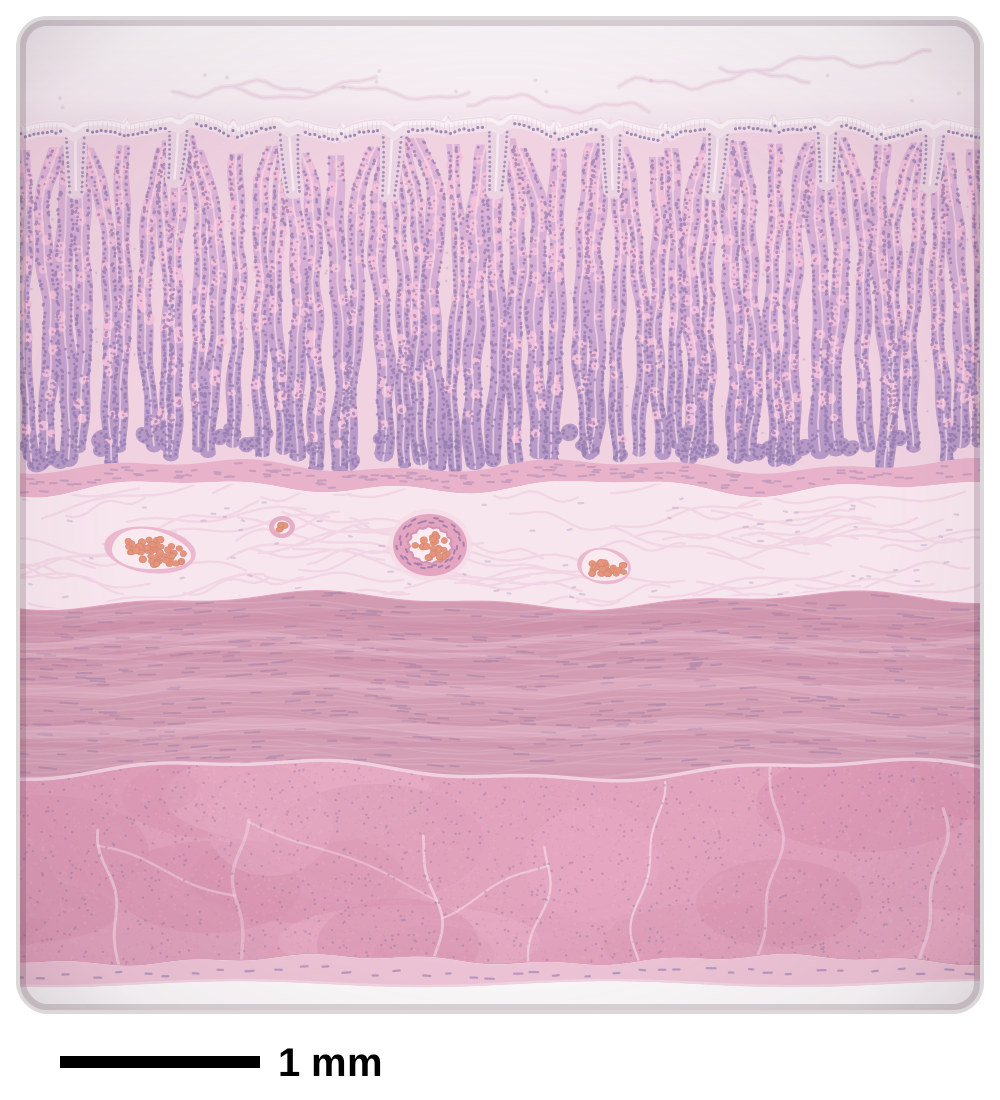
A real stomach wall
inside at the top · outside at the bottom
A diagram
inside at the top · outside at the bottom
Screen 3
Cells make tissues
- In large organisms, cells become specialised: each type has a structure that suits its job (B1 Cell biology).
- A tissue is a group of cells with a similar structure and function.
- Muscle cells make muscular tissue. Gland cells make glandular tissue. Epithelial cells make epithelial tissue.
Tap a tissue to build it from its cells.
Screen 4
The stomach: three tissues, one organ
- An organ is a group of different tissues working together to do a job.
- The stomach is an organ. Its job is to digest food.
- Press Next step to see each tissue at work.
Screen 5
Checkpoint 1 of 3
Quick check on screens 1 to 4. Tap an answer.
1.In a micrograph of the stomach wall, the layers are pink and purple. Why?
2.What is a tissue?
3.Which tissue in the stomach makes digestive juices?
Screen 6
Five levels of organisation
- Cell → tissue → organ → organ system → organism.
- Each level is made of the level before it.
- The order is by size, smallest first. It is not an order of importance.
Screen 7
From micrometres to metres
- Cells are measured in micrometres (µm). 1 mm = 1000 µm.
- Organs are measured in centimetres. Organ systems and organisms are measured in metres.
- Worked example: a muscle cell is 200 µm long. 200 ÷ 1000 = 0.2 mm.
| Level | Example | About how big |
|---|---|---|
| cell | a muscle cell in the stomach wall | 0.2 mm (200 µm) long |
| tissue | the muscular tissue in the stomach wall | 2 mm thick |
| organ | the stomach | 25 cm (250 mm) long |
| organ system | the digestive system | fits inside the body (the gut is several metres long, but coiled up) |
| organism | an adult human | 1.7 m tall |
Screen 8
Checkpoint 2 of 3
Quick check on screens 6 and 7. Tap an answer.
1.Which list puts the levels in order of size, smallest first?
2.The stomach is an organ. Which organ system is it part of?
3.A cell is 40 µm long. How long is it in millimetres? (1 mm = 1000 µm)
Screen 9
Organ systems work together
- In an organism, the organ systems work together.
- The digestive system absorbs glucose from food into the blood. The breathing system takes oxygen into the blood.
- The circulatory system carries both to every cell. Cells use them in respiration, which releases energy.
Every cell needs glucose and oxygen for respiration, which releases energy. Three organ systems work together to deliver them.
Screen 10
Which level is it?
- Tap a card, then choose its level.
- Watch out: one cell is never a tissue. An organ always has more than one type of tissue.
Tap a card to start.
Smallest level on the left, biggest on the right.
Screen 11
Plants are organised too
- Plants have the same levels of organisation as animals.
- A leaf is a plant organ: different tissues working together to do a job (B2 L12).
- The roots, stem and leaves work together as an organ system that transports substances around the plant (B2 L13).
Screen 12
Checkpoint 3 of 3
Quick check on screens 9 to 11. Tap an answer.
1.Which organ system carries glucose and oxygen to every cell in the body?
2.Which one of these is an organ?
3.A leaf has several different tissues working together. What is a leaf?
Quiz
Quiz: B2 L1 Cells, tissues and organs
10 questions. Tap an answer. Your first answer counts towards your score.
What is the basic building block of all living things?
Why does a diagram of the stomach wall show only a few big cells?
Which of these is a tissue?
What does the epithelial tissue in the stomach do?
What makes the stomach an organ?
What is the order of the levels of organisation based on?
A layer of tissue is 0.5 mm thick. Each cell in it is 25 µm thick. How many cells thick is the layer? (1 mm = 1000 µm)
Glucose from food reaches the muscle cells in your legs. Which two organ systems work together to do this?
Is your skin a tissue, an organ or an organ system?
The roots, stem and leaves of a plant work together to transport water and sugars. What are they together?
Exam questions
The same five questions as the B2 L1 Exam questions worksheet. 20 marks.
Write your answer, then open the mark scheme and tick each point you made.
01Figure 1 shows a section through the wall of the human stomach.
01.1Complete Figure 1.
Choose answers from the box.
01.2What is the job of the muscular tissue in the stomach wall?
Tick (✓) one box.
Mark scheme
- (1)
- (1)
- (1)
- (1)
01.1: 1 mark for each correct label. If more than one word from the box is written on one line, do not give that mark. allow "muscle tissue" for 3. do not accept "muscle cell".
01.2: If more than one box is ticked, give 0 marks.
Model answer01.1 1 epithelial tissue; 2 glandular tissue; 3 muscular tissue. 01.2 It churns the food and mixes it with digestive juices.
02Table 1 shows five structures in the human body.
| Structure |
|---|
| digestive system |
| human |
| muscle cell |
| muscular tissue |
| stomach |
02.1Write the five structures from Table 1 in order of size.
Start with the smallest.
02.2A cell from the stomach lining is 0.02 mm long.
1 mm = 1000 µm
Calculate the length of the cell in micrometres (µm).
02.3The stomach is 250 mm long.
Calculate how many times longer the stomach is than the cell from the stomach lining.
Mark scheme
- (1)
- (1)
- (1)
- (1)
- (1)
02.1: 2 marks for all five in the correct order. 1 mark if only two neighbouring structures are the wrong way round. do not accept the order reversed (largest first).
02.3: allow 250 000 ÷ 20 for the first mark. allow their 02.2 answer used correctly: 250 000 ÷ their 02.2. Correct answer with no working = 2 marks. ignore units.
Model answer02.1 muscle cell → muscular tissue → stomach → digestive system → human. 02.2 0.02 × 1000 = 20 µm. 02.3 250 ÷ 0.02 = 12 500 times.
03Describe the difference between a tissue and an organ.
Mark scheme
- (1)
- (1)
allow "a tissue is made of (similar) cells and an organ is made of (different) tissues" for 1 mark only. do not accept "a tissue is one cell".
Model answerA tissue is a group of cells with a similar structure and function. An organ is a group of different tissues working together to do a job.
04Muscle cells in the leg need glucose.
Explain how the digestive system and the circulatory system work together to supply muscle cells with glucose.
Mark scheme
- (1)
- (1)
- (1)
max 3. ignore references to respiration. do not accept "energy is made / produced" (that statement scores 0, others can still score).
Model answerThe digestive system breaks food down into small molecules such as glucose. The glucose is absorbed into the blood in the small intestine. The circulatory system then carries it: the heart pumps the blood through blood vessels to the muscle cells.
05The stomach is an organ in the human digestive system.
Describe how the stomach is organised, from cells to the organ system it is part of.
Explain how the tissues in the stomach work together to digest food.
Mark scheme
Level of response. Read your answer, choose the level that fits best, then pick your mark.
| Level | Marks | Descriptor |
|---|---|---|
| 3 | 5–6 | A detailed and coherent answer. The levels are given in the correct order from cells to the organ system, with correct meanings, and all three stomach tissues are named with their jobs, linked to how they work together to digest food. |
| 2 | 3–4 | Some levels are described correctly, and at least two stomach tissues are named with a job. Some links to digestion are made, but they may be incomplete. |
| 1 | 1–2 | Simple statements, such as "the stomach has muscle" or "cells make tissues", with little or no link between them. |
| 0 | 0 | No relevant content. |
Indicative content
- cells are the basic building blocks of the stomach
- the stomach contains specialised cells: muscle cells, gland cells and epithelial cells
- similar cells are grouped into tissues: a tissue is a group of cells with a similar structure and function
- muscular tissue contracts to churn the food / mixes food with digestive juices
- glandular tissue makes and releases digestive juices (containing enzymes / acid) that digest the food
- epithelial tissue covers / lines the inside and outside of the stomach
- different tissues working together to do a job make the stomach an organ
- the tissues work together: churning mixes the juices with the food, so the food is digested
- the stomach works with other organs (such as the oesophagus, small intestine, liver and pancreas) in the digestive system, an organ system
- organ systems work together in the organism
Your mark:
Model answer (Level 3)The stomach is made of cells, the basic building blocks. Its cells are specialised: muscle cells, gland cells and epithelial cells. Similar cells are grouped into tissues. Muscular tissue contracts to churn the food. Glandular tissue makes digestive juices that digest the food. Epithelial tissue covers the inside and outside of the stomach. These different tissues work together to do one job, digesting food, so the stomach is an organ: the churning mixes the juices with the food so it is digested. The stomach works with other organs, such as the small intestine, in the digestive system, which is an organ system.
Total: 0 out of 20
Printable copy: the B2 L1 Exam questions worksheet and its mark scheme (PDF) are in .