Screen 1 of 12
Welcome back
Screen 1
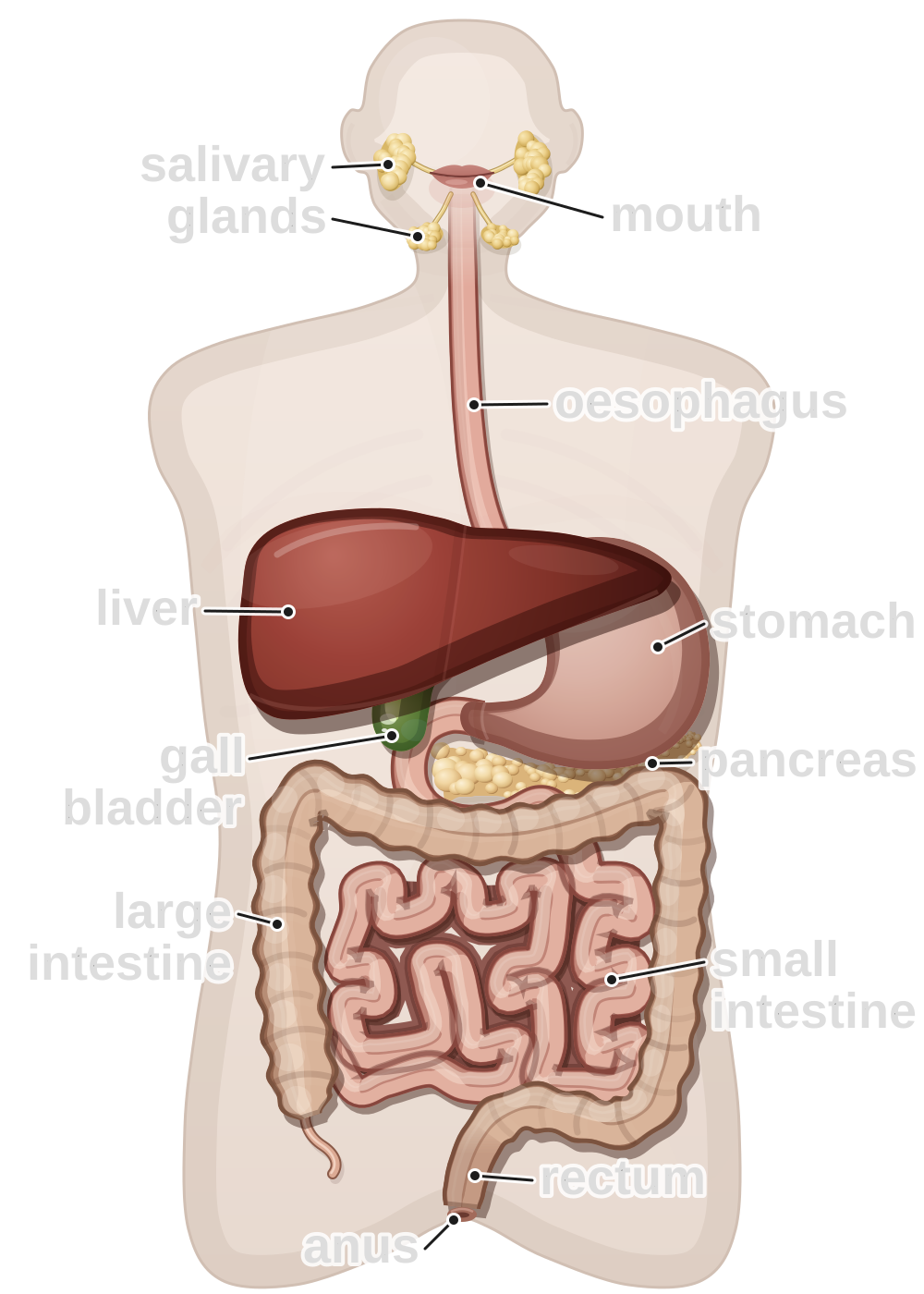
The digestive system: an organ system
- The digestive system is an organ system: a group of organs working together to do a job.
- Its job is to digest food and absorb it into the blood.
- Food passes along one long tube, the gut, from the mouth to the anus.
Screen 2
Real organs and a diagram
- Real organs are packed tightly together, and the small intestine is coiled up.
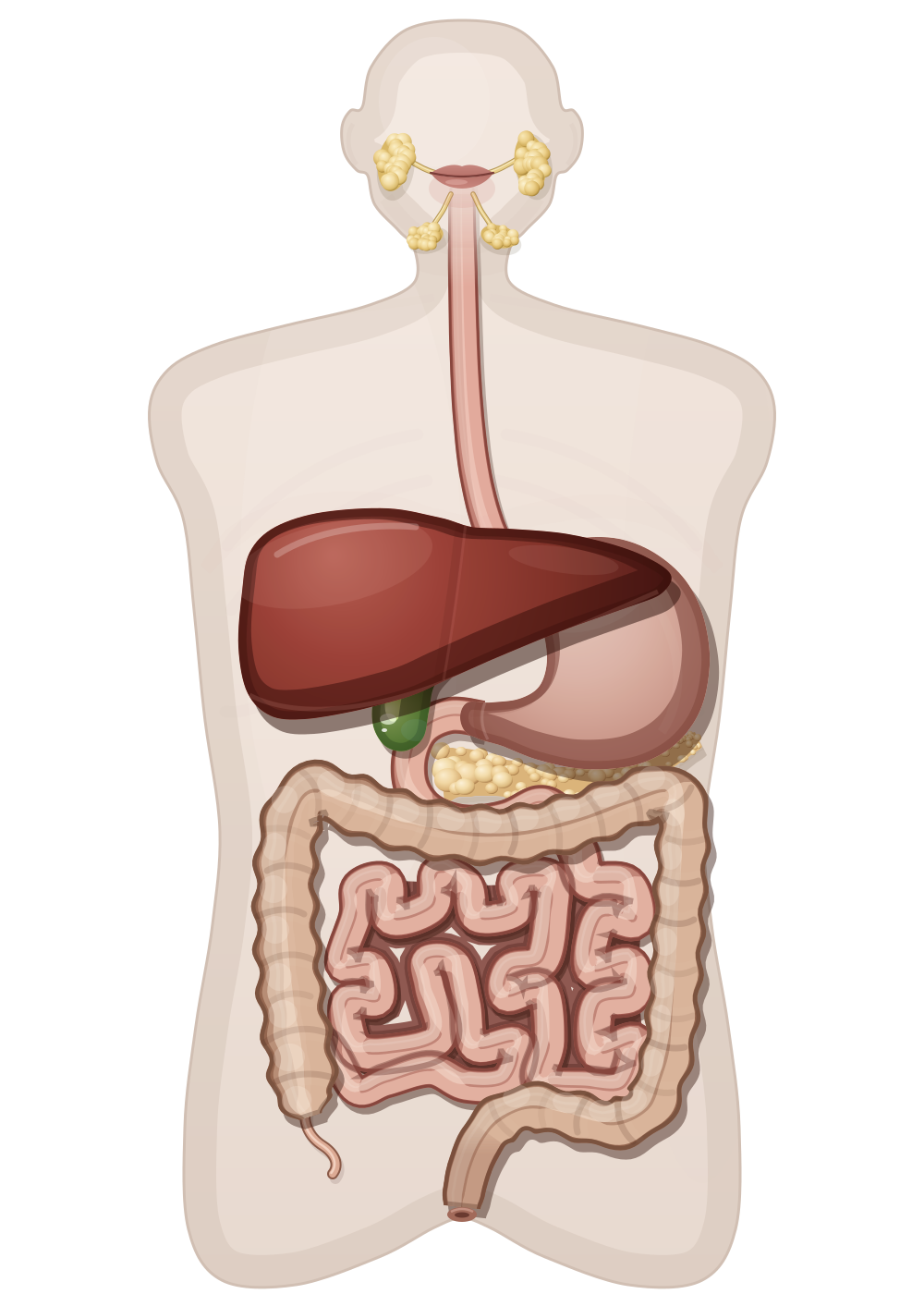
- A diagram spreads them out so you can see each one. It is simplified on purpose.
- Both are front views: the liver is on the body's right, which is your left.
Tap a difference to see it on both pictures.
The real organs
← body's right
A diagram
← body's right
Screen 3
The gut: the tube food passes through
- Food passes along the gut in this order: mouth → oesophagus → stomach → small intestine → large intestine → rectum → anus.
- Most digestion and almost all absorption of food happen in the small intestine.
- The large intestine absorbs water. It does not digest food.
Tap an organ to see its job.
Faded: organs that make juices (screen 4).
Screen 4
Organs that make juices
- The salivary glands, liver, gall bladder and pancreas make or store juices.
- The juices flow along small tubes into the gut. Food never passes through these organs.
- The liver makes bile, and the gall bladder stores it. The pancreas makes enzymes. Both flow into the small intestine.
Juices flow into the gut along small tubes. Food never goes into the salivary glands, liver, gall bladder or pancreas.
Screen 5
Checkpoint 1 of 3
Quick check on screens 1 to 4. Tap an answer.
1.Why is the digestive system called an organ system?
2.In a diagram of the digestive system, where is the liver drawn?
3.Which of these organs does food pass through?
Screen 6
Digestion and absorption
- Digestion: large, insoluble food molecules are broken down into small, soluble molecules.
- Absorption: the small molecules pass through the wall of the small intestine into the blood.
- Large molecules are too big to pass into the blood. That is why food must be digested first.
Food molecules are far too small to see. The beads are a model.
Screen 7
Follow the food
- Follow a mouthful of food through the gut, one step at a time.
- At each step, notice what happens to it: digestion, absorption, or just moving along.
Screen 8
Checkpoint 2 of 3
Quick check on screens 6 and 7. Tap an answer.
1.What is digestion?
2.Where are most of the small food molecules absorbed into the blood?
3.What does the large intestine do?
Screen 9
The small intestine: built to absorb
- The inside wall of the small intestine has many folds, covered in millions of tiny villi (one villus). You met villi in B1 Cell biology.
- Villi give a huge surface area, a thin wall and a good blood supply, so food molecules are absorbed quickly.
Screen 10
The gut in numbers
- The gut of an adult is about 8 m long, from mouth to anus.
- The small intestine is about 4 times as long as the large intestine. "Small" means narrower, not shorter.
- Food takes about 1 to 3 days to pass right through.
| Part of the gut | Length | Time there |
|---|---|---|
| Oesophagus | 25 cm | about 10 seconds |
| Stomach | 25 cm | 2 to 4 hours |
| Small intestine | 6 m | 3 to 5 hours |
| Large intestine | 1.5 m | 1 to 2 days |
| Rectum | 12 cm | until it is emptied |
6 m ÷ 1.5 m = 4, so the small intestine is about 4 times as long as the large intestine.
Total so far: 8.1 m
Screen 11
Apply it: when one part goes wrong
- If one organ cannot do its job, digestion or absorption is affected.
- Use the job of the organ to explain what happens. Tap a case.
Tap a case. Then say: which organ, what is its job, and what happens if the job is not done?
Screen 12
Checkpoint 3 of 3
Quick check on screens 9 to 11. Tap an answer.
1.How do villi help the small intestine absorb food?
2.The small intestine is 6 m long. The large intestine is 1.5 m long. How many times longer is the small intestine?
3.A gallstone blocks the tube that carries bile into the small intestine. What happens?
Quiz
Quiz: B2 L2 The digestive system
10 questions. Tap an answer. Your first answer counts towards your score.
Which is true of the real organs, but NOT of a diagram of the digestive system?
What is the job of the oesophagus?
The stomach makes a substance that kills most microorganisms in food. What is it?
Which organ stores bile and then squeezes it into the small intestine?
Food does NOT pass through one of these organs. Which one?
Why must food be digested before it can be absorbed?
In which order does food pass through these organs?
Which feature of a villus helps food molecules pass into the blood quickly?
The whole gut is about 8 m long. The small intestine is about 6 m long. About what fraction of the gut is small intestine?
A person's large intestine absorbs less water than normal. What will happen?
Exam questions
The same five questions as the B2 L2 Exam questions worksheet. 20 marks.
Write your answer, then open the mark scheme and tick each point you made.
01Figure 1 shows the human digestive system.
01.1Complete Figure 1.
Choose answers from the box.
01.2Which statement about the large intestine is correct?
Tick (✓) one box.
Mark scheme
- (1)
- (1)
- (1)
- (1)
01.1: 1 mark for each correct label. If more than one word from the box is written on a line, do not give that mark.
Model answer01.1 liver; pancreas; large intestine. 01.2 It absorbs water from undigested food.
02Table 1 shows the length of each part of the gut in one adult.
| Part of the gut | Length in cm |
|---|---|
| Oesophagus | 25 |
| Stomach | 20 |
| Small intestine | 650 |
| Large intestine | 140 |
| Rectum | 12 |
02.1Calculate the total length of the gut.
Give your answer in metres.
02.2The small intestine is longer than the large intestine.
Suggest why it is called the 'small' intestine.
02.3Suggest two reasons why a long small intestine is an advantage.
Mark scheme
- (1)
- (1)
- (1)
02.3 any two from:
- (1)
- (1)
- (1)
02.1: allow 8.5 (m). Correct answer with no working = 2 marks. allow 847 cm, not converted, for 1 mark. allow an addition error carried forward correctly into metres for the second mark.
02.2: do not accept "it is shorter". ignore "it is smaller" with no further detail.
02.3: max 2. allow "room for more villi" for a larger surface area. allow "more food is absorbed" / "food is absorbed faster" for 1 mark only if neither of the "more time" points scores.
Model answer02.1 25 + 20 + 650 + 140 + 12 = 847 cm. 847 ÷ 100 = 8.47 m. 02.2 It is narrower than the large intestine. 02.3 Food has more time to be digested and absorbed, and there is a larger surface area for absorption.
03The digestive system is an organ system.
What is meant by an organ system?
Use the digestive system as an example in your answer.
Mark scheme
- (1)
- (1)
allow "the stomach and the small intestine work together to digest and absorb food" for 2 marks. do not accept "a group of tissues" (that is an organ) or "a group of cells".
Model answerAn organ system is a group of organs working together to do a job. In the digestive system, organs such as the stomach and the small intestine work together to digest food and absorb it into the blood.
04Coeliac disease damages the villi in the small intestine.
Figure 2 shows the villi of two people.
Person A does not have coeliac disease. Person B has coeliac disease.
Person B eats the same amount of food as before.
But Person B has lost body mass and often feels tired.
Explain why.
Mark scheme
- (1)
- (1)
- (1)
allow "less glucose absorbed" for the second mark. do not accept "less food is digested" for the second mark. do not accept "less energy is made / produced / created" (that point scores 0; others can still score). ignore "Person B eats less".
Model answerPerson B's villi are flattened, so the small intestine has a smaller surface area. Less digested food is absorbed into the blood. So less glucose reaches the cells for respiration and less energy is released. The body uses up its stores, so Person B loses body mass and feels tired.
05Describe how food is digested and absorbed as it passes through the digestive system.
Include the jobs of the liver and the pancreas in your answer.
Mark scheme
Level of response. Read your answer, choose the level that fits best, then pick your mark.
| Level | Marks | Descriptor |
|---|---|---|
| 3 | 5–6 | A clear, detailed and correct description in a logical order, from the mouth to the anus. Most organs of the gut are named in order, with what happens to the food in each. The jobs of the liver (bile) and the pancreas (enzymes) are given, and digestion and absorption are both clearly described. |
| 2 | 3–4 | A mostly correct description. Several organs are named in order, with some of their jobs. There may be one error in the order, or the liver and pancreas are named without their jobs, or digestion and absorption are not clearly told apart. |
| 1 | 1–2 | Simple separate statements, such as "the stomach digests food" or "food goes to the intestines". The order may be unclear. |
| 0 | 0 | No relevant content. |
An answer that says food passes through the liver or the pancreas cannot reach Level 3.
Indicative content
- teeth in the mouth chew food into smaller pieces
- the salivary glands make saliva, which wets the food and starts to digest starch
- the oesophagus carries food to the stomach; muscles in its wall squeeze the food down
- the stomach churns the food with hydrochloric acid, which kills microorganisms; protein digestion starts
- the liver makes bile, which is stored in the gall bladder and flows into the small intestine; bile helps digest fats
- the pancreas makes enzymes, which flow into the small intestine
- food does not pass through the liver or the pancreas; only their juices enter the gut
- digestion finishes in the small intestine: large, insoluble molecules are broken into small, soluble molecules
- the small, soluble molecules are absorbed through the wall of the small intestine / the villi into the blood
- villi give a large surface area, a thin wall and a good blood supply for fast absorption
- the large intestine absorbs water from the undigested food
- faeces are stored in the rectum and leave the body through the anus
Your mark:
Model answer (Level 3)In the mouth, teeth chew the food into smaller pieces, and saliva from the salivary glands wets it and starts to digest starch. The oesophagus carries the food down to the stomach. The stomach churns the food with hydrochloric acid, which kills microorganisms, and protein starts to be digested. In the small intestine, bile and enzymes are added. The liver makes bile, which is stored in the gall bladder and helps digest fats. The pancreas makes enzymes, which flow into the small intestine. Food does not pass through the liver or the pancreas: only their juices do. Digestion finishes in the small intestine, where large, insoluble molecules have been broken into small, soluble molecules. These are absorbed through the villi into the blood. The large intestine then absorbs water from the undigested food, and the faeces are stored in the rectum before they leave through the anus.
Total: 0 out of 20
Printable copy: the B2 L2 Exam questions worksheet and its mark scheme (PDF) are in .