Screen 1 of 12
Welcome back
Screen 1
Enzymes: biological catalysts
- Enzymes are biological catalysts: they speed up reactions without being used up.
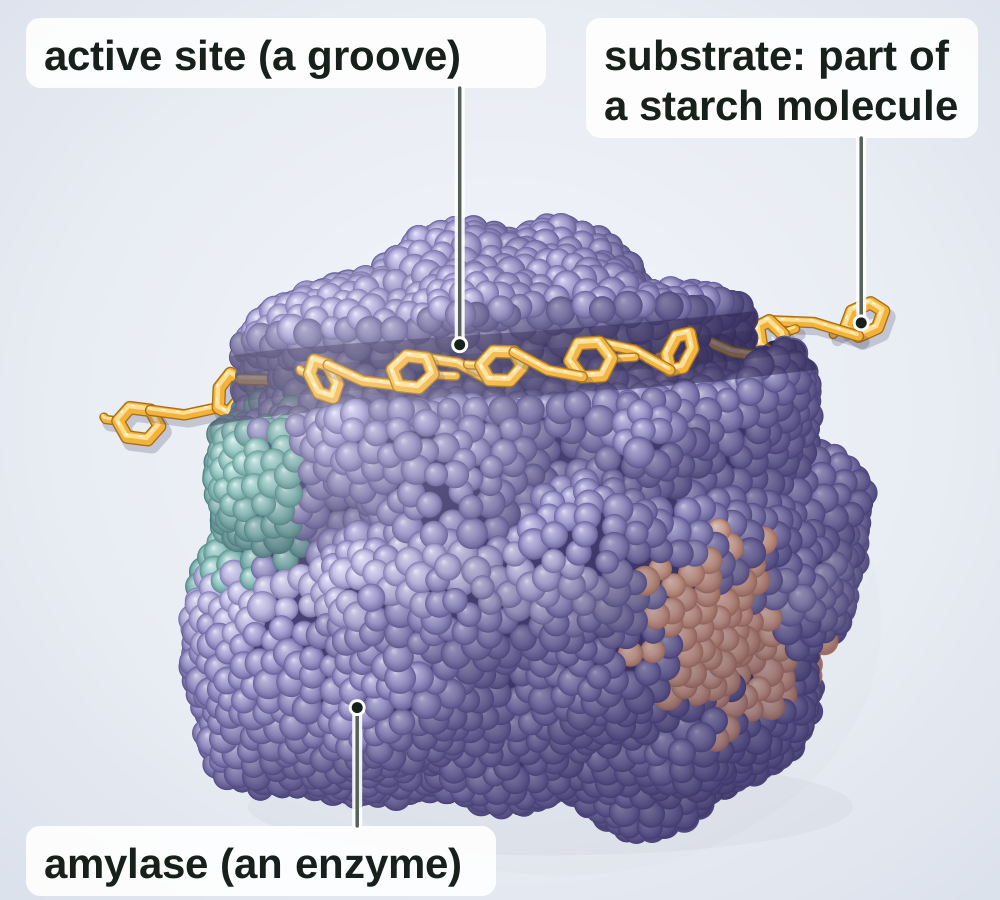
- Enzymes are proteins. Each one has an active site with a special shape.
- This is a painting of a computer model of amylase, an enzyme in your saliva. Real enzymes are far too small to see.
Screen 2
A real enzyme and a diagram
- Enzymes are far too small to see. Scientists use computer models to show their real shape.
- A diagram is simplified on purpose: a flat shape with a notch for the active site.
- Both show the one idea that matters: the shape of the active site fits the substrate.
Tap a difference to see it on both pictures.
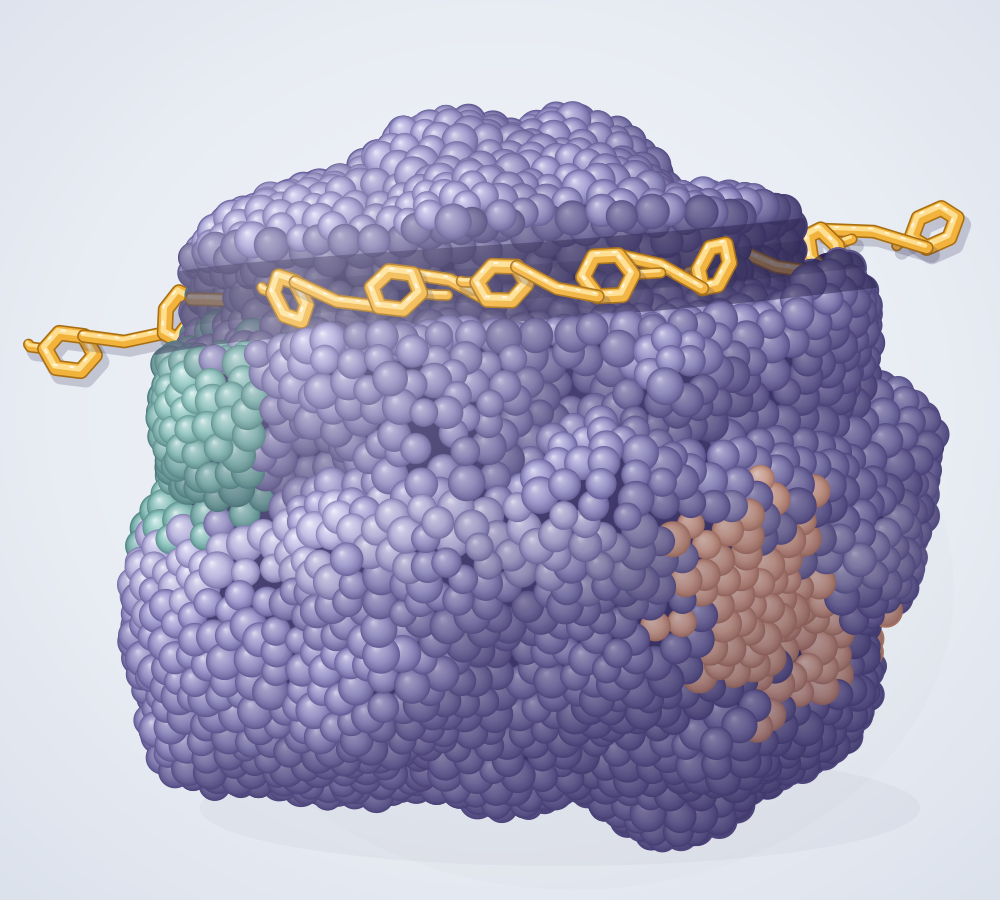
A computer model
A diagram
Screen 3
The lock and key model
- The substrate fits into the active site, like a key fits a lock.
- The enzyme breaks the substrate down into products. The enzyme is not changed, so it is used again and again.
- Only one substrate fits each active site, so each enzyme is specific.
Screen 4
Three types of digestive enzyme
- Food has big molecules: starch, proteins and lipids (fats and oils), too big to pass into the blood.
- Digestive enzymes break them down into small, soluble molecules that can be absorbed into the blood.
- The body uses these to build new carbohydrates, lipids and proteins. Some glucose (a sugar) is used in respiration.
Amylase is a carbohydrase: it breaks down starch into simple sugars.
Screen 5
Checkpoint 1 of 3
Quick check on screens 1 to 4. Tap an answer.
1.Which statement about enzymes is correct?
2.In the lock and key model, why does an enzyme work on only one substrate?
3.Lipase breaks down lipids. What are the products?
Screen 6
Temperature and enzymes
- Warmer: molecules move faster and collide more often, so the rate goes up.
- The optimum temperature is where the enzyme works fastest: about 37 °C for many human enzymes.
- Too hot: the active site changes shape. The enzyme is denatured.
- Cold only slows enzymes down. It does not denature them.
Near the optimum (about 37 °C): the fastest rate. The active site still fits the substrate.
Screen 7
Working out the rate
- Amylase broke down starch at different temperatures.
- A shorter time means a faster rate: rate = 1 ÷ time.
- The highest point is the optimum.
| Temperature in °C | Time for the starch to be broken down in s | Rate = 1 ÷ time, per second |
|---|---|---|
| 200 | 0.005 | |
| 100 | 0.01 | |
| 50 | 0.02 | |
| 25 | 0.04 | |
| 100 | 0.01 | |
| not broken down | 0 |
At 40 °C: rate = 1 ÷ 25 s = 0.04 per second.
Try it
Screen 8
Checkpoint 2 of 3
Quick check on screens 6 and 7. Tap an answer.
1.What happens to an enzyme at a temperature well above its optimum?
2.An enzyme is kept at 5 °C. What happens to it?
3.Amylase breaks down all the starch in 20 seconds. Use rate = 1 ÷ time. What is the rate?
Screen 9
pH and enzymes
- Each enzyme has an optimum pH, where it works fastest.
- The protease made in the stomach works best in acid, at about pH 2. Enzymes in the small intestine work best in slightly alkaline conditions, about pH 8.
- Too far from its optimum pH, an enzyme's active site changes shape: the enzyme is denatured.
pH 7: amylase works fastest. The stomach protease is denatured.
Screen 10
Where digestive enzymes are made
- Amylase is made in the salivary glands, the pancreas and the small intestine.
- Proteases are made in the stomach, the pancreas and the small intestine.
- Lipases are made in the pancreas and the small intestine. Bile is made in the liver.
Tap an enzyme to see where it is made.
Screen 11
Bile helps lipase
- Bile is made in the liver and stored in the gall bladder. It is released into the small intestine.
- Bile is alkaline: it neutralises the hydrochloric acid from the stomach.
- Bile emulsifies fat into small droplets. This gives a larger surface area for lipase.
- Bile is not an enzyme. Lipase digests the fat. Bile helps lipase work faster.
Screen 12
Checkpoint 3 of 3
Quick check on screens 9 to 11. Tap an answer.
1.Why does the protease made in the stomach work well there?
2.Which of these organs makes amylase, proteases and lipases?
3.What does bile do to fat?
Quiz
Quiz: B2 L3 Enzymes and digestion
10 questions. Tap an answer. Your first answer counts towards your score.
Enzymes are catalysts. What does a catalyst do?
Why do scientists use computer models to show the shape of an enzyme?
In the lock and key model, which part is the "key"?
Why must starch be digested before it can be absorbed into the blood?
Which enzyme breaks down proteins into amino acids?
Why does the rate of an enzyme reaction go up from 10 °C to 30 °C?
At 30 °C, the starch took 50 seconds to be broken down. Use rate = 1 ÷ time. What was the rate?
Amylase from saliva works best at about pH 7. It is swallowed and reaches the stomach, at about pH 2. What happens to it?
Bile is made in one organ and stored in another. Which pair is correct?
Bile is alkaline. How does this help digestion in the small intestine?
Exam questions
The same five questions as the B2 L3 Exam questions worksheet. 20 marks.
Write your answer, then open the mark scheme and tick each point you made.
01Figure 1 shows how an enzyme works.
01.1Complete Figure 1.
Choose answers from the box.
01.2What type of molecule is an enzyme?
Tick (✓) one box.
Mark scheme
- (1)
- (1)
- (1)
01.1: 1 mark for each correct label. If more than one word from the box is written on one line, do not give that mark.
01.2: If more than one box is ticked, give 0 marks.
Model answer01.1 1 substrate; 2 active site. 01.2 Protein.
02A student investigated the effect of temperature on a protease.
Skimmed milk is cloudy because it contains a protein.
When the protease breaks down the protein, the milk goes clear.
The student timed how long the milk took to go clear at different temperatures.
Table 1 shows the results.
| Temperature in °C | Time for the milk to go clear in seconds |
|---|---|
| 20 | 200 |
| 30 | 80 |
| 40 | 40 |
| 50 | 100 |
| 60 | did not go clear |
02.1Give the temperature in Table 1 at which the protease worked fastest.
02.2The rate of reaction can be calculated using this equation:
rate = 1 ÷ time
Calculate the rate of reaction at 40 °C.
02.3The milk did not go clear at 60 °C.
Explain why.
Mark scheme
- (1)
- (1)
- (1)
- (1)
- (1)
02.2: allow 1/40 for the first mark. Correct answer with no working = 2 marks. ignore units.
02.3: allow "the enzyme changed shape, so the protein / substrate no longer fits" for the second mark. do not accept "the enzyme was killed / died" for the first mark. ignore "the enzyme was used up".
Model answer02.1 40 °C. 02.2 1 ÷ 40 = 0.025 per second. 02.3 The protease was denatured. The high temperature changed the shape of its active site, so the protein no longer fitted and was not broken down.
03Figure 2 shows how pH affects the rate of reaction of two enzymes, A and B.
03.1Give the optimum pH of enzyme B.
03.2One of the enzymes is made in the stomach.
Which enzyme, A or B? Give a reason for your answer.
Mark scheme
- (1)
- (1)
- (1)
03.1: allow 7.5 to 8.5.
03.2: the reason mark can only be given if A is chosen. allow "A works best in acid".
Model answer03.1 pH 8. 03.2 Enzyme A, because the stomach contains acid and enzyme A works best at a low pH (about pH 2).
04Bile is released into the small intestine.
04.1Where is bile made?
Tick (✓) one box.
04.2Bile emulsifies fat.
Explain how this helps lipase to digest fat more quickly.
Mark scheme
- (1)
- (1)
- (1)
04.1: If more than one box is ticked, give 0 marks.
04.2: do not accept "bile breaks down / digests the fat" for the first mark. allow "more fat is exposed to lipase" for the second mark. ignore references to neutralising acid.
Model answer04.1 Liver. 04.2 Bile breaks the fat into many small droplets. This gives a much larger surface area for lipase to work on.
05A cheese sandwich contains starch, protein and fat.
Describe how the starch, protein and fat are digested in the human digestive system.
In your answer, name the enzymes, where they are made and the products.
Mark scheme
Level of response. Read your answer, choose the level that fits best, then pick your mark.
| Level | Marks | Descriptor |
|---|---|---|
| 3 | 5–6 | A detailed and coherent description of the digestion of all three foods. For each food, the correct enzyme, at least one correct place where it is made and the correct products are given. Extra detail, such as the role of bile or the absorption of the products, may be included but is not needed for Level 3. |
| 2 | 3–4 | The digestion of at least two foods is described, with the enzymes and products mostly correct. Some places where the enzymes are made are given. There may be some errors. |
| 1 | 1–2 | Simple statements, such as "enzymes break down the food" or "amylase digests starch", with few or no products or places. |
| 0 | 0 | No relevant content. |
Indicative content
- starch is digested by amylase (a carbohydrase)
- amylase is made in the salivary glands, the pancreas and the small intestine
- starch is broken down into (simple) sugars
- protein is digested by proteases
- proteases are made in the stomach, the pancreas and the small intestine
- protein is broken down into amino acids
- the stomach protease works best in the acid of the stomach
- fat is digested by lipases
- lipases are made in the pancreas and the small intestine
- fat (lipid) is broken down into glycerol and fatty acids
- bile is made in the liver and stored in the gall bladder
- bile emulsifies the fat into small droplets, giving a larger surface area for lipase
- bile is alkaline and neutralises the stomach acid, giving the pH that the small intestine enzymes need
- the products are small, soluble molecules, absorbed into the blood in the small intestine
ignore chemical formulae and symbol equations.
Your mark:
Model answer (Level 3)The starch is digested by amylase, a carbohydrase made in the salivary glands, the pancreas and the small intestine. Amylase breaks the starch down into sugars. The protein is digested by proteases, made in the stomach, the pancreas and the small intestine. They break the protein down into amino acids. The stomach protease works best in the acid made by the stomach. The fat is digested by lipases, made in the pancreas and the small intestine, which break it down into glycerol and fatty acids. Bile, made in the liver and stored in the gall bladder, emulsifies the fat into small droplets, giving lipase a larger surface area, and neutralises the stomach acid. The small, soluble products are absorbed into the blood in the small intestine.
Total: 0 out of 20
Printable copy: the B2 L3 Exam questions worksheet and its mark scheme (PDF) are in .