Screen 1 of 12
Welcome back
Screen 1
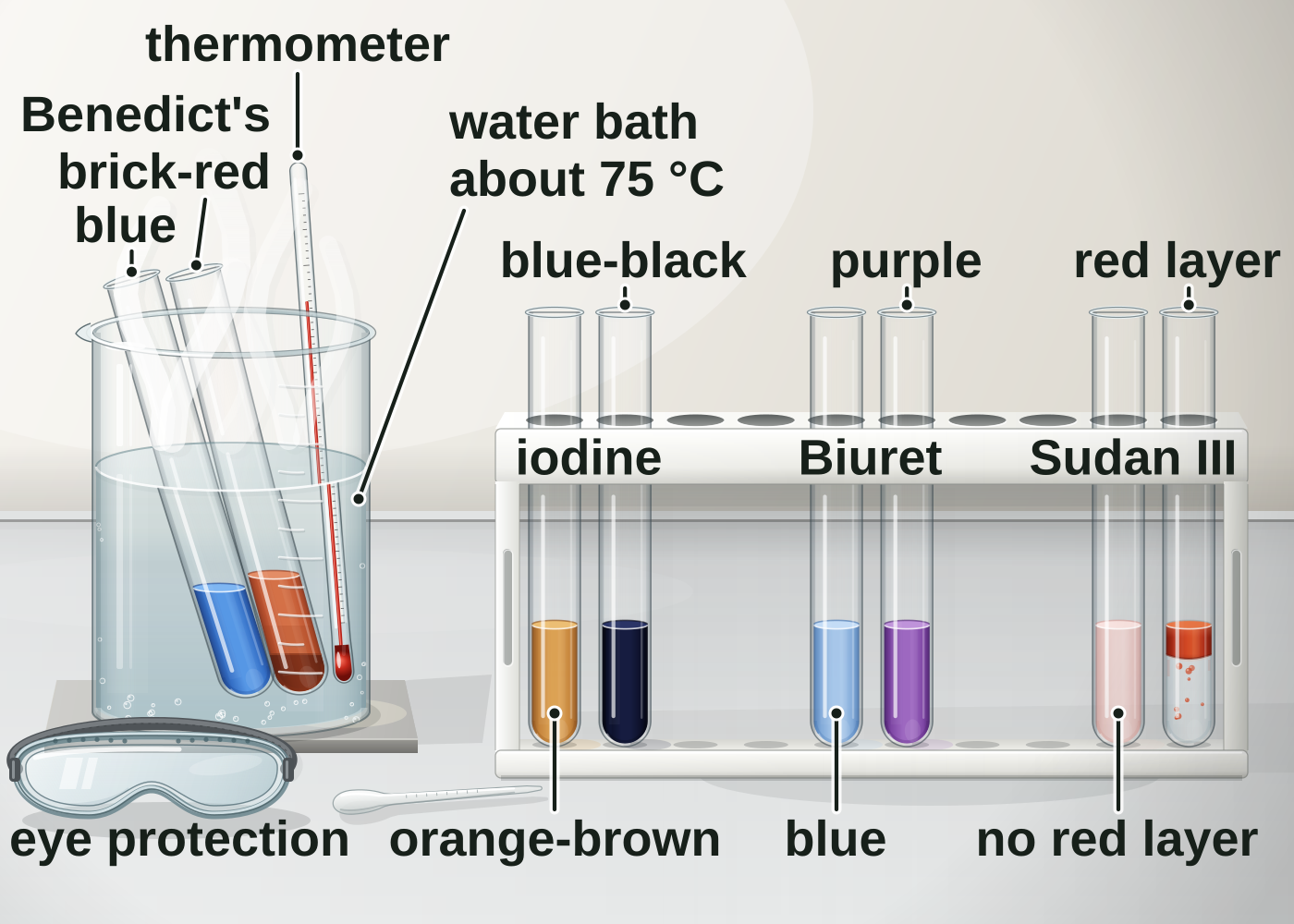
Four food tests
- Food contains nutrients: carbohydrates (sugars and starch), proteins and lipids (fats and oils).
- Each nutrient has its own test. A reagent changes colour if the nutrient is there.
- Always write the colour name of the result.
Screen 2
Real food tests and a diagram
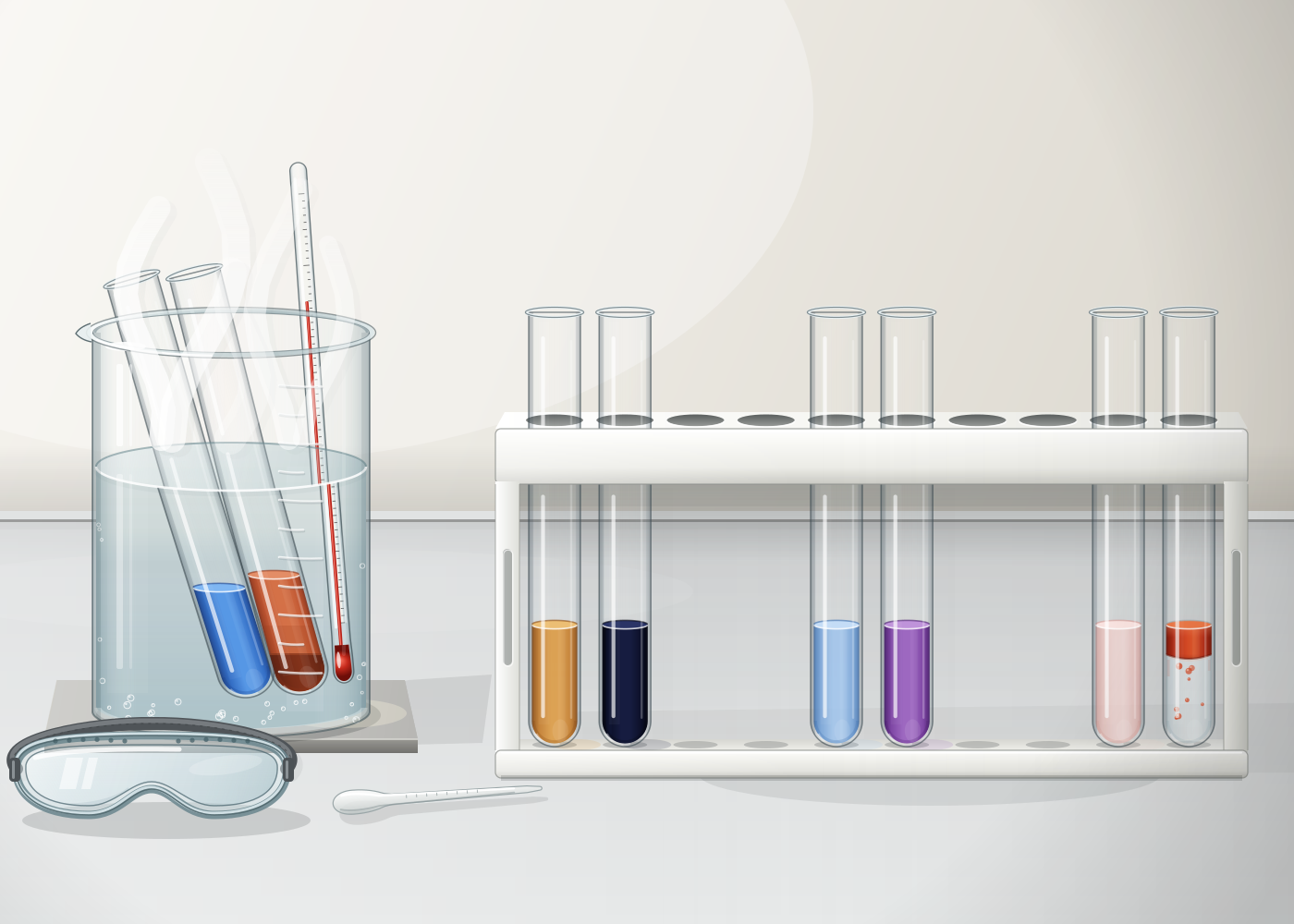
- Real tubes show colours. An exam diagram is black and white.
- So in an exam, a result is a word: always write the colour name.
- Tap a difference to see it on both pictures.
Tap a difference to see it on both pictures.
Real food tests
hot water, about 75 °C
An exam diagram
hot water, about 75 °C
Always write the colour name: an exam diagram is black and white.
Screen 3
Preparing a food sample
- Grind the food with distilled water, then filter it.
- Put about 2 cm³ of the liquid in a clean test tube for each test.
Screen 4
Testing for sugars: the Benedict's test
- Add Benedict's solution (blue). Heat in a water bath at about 75 °C for about 5 minutes.
- Reducing sugar turns it green, yellow, orange or brick-red. More sugar, further along the scale.
- No reducing sugar: it stays blue. Table sugar (sucrose) is not a reducing sugar.
Reducing sugar in the food:
Lots of reducing sugar: brick-red. A solid, the precipitate, settles at the bottom.
Screen 5
Checkpoint 1 of 3
Quick check on screens 1 to 4. Tap an answer.
1.An exam diagram of a food test is black and white. How should you give a positive Benedict's result?
2.What do you do to a solid food before you test it?
3.A student adds Benedict's solution to a glucose solution. It stays blue. What did she forget to do?
Screen 6
Testing for starch: the iodine test
- Add a few drops of iodine solution (orange-brown). No heat is needed.
- Starch turns it blue-black, not "black". No starch: it stays orange-brown.
Tap a food to see its result.
Screen 7
Testing for protein: the Biuret test
- Add Biuret reagent (blue) and shake gently. No heat is needed.
- Protein turns it purple. No protein: it stays blue.
- Biuret reagent is corrosive: wear eye protection.
Food in tube A:
Screen 8
Testing for lipids: two tests
- Lipids (fats and oils) have two tests.
- Sudan III stain: add a few drops to the food in water and shake gently. A red-stained oily layer floats on top.
- Ethanol emulsion test: shake the food with ethanol, then pour it into water. Lipid makes it cloudy white.
- Ethanol is flammable: no flames nearby.
Screen 9
Checkpoint 2 of 3
Quick check on screens 6 to 8. Tap an answer.
1.Iodine solution is added to some potato. Which colour shows that starch is there?
2.A food sample turns purple with Biuret reagent. What does the food contain?
3.Which result shows that a food contains lipid in the Sudan III test?
Screen 10
Reading the results
- Record each result as a colour name, in a table.
- A negative result is still a result: write "stays blue" or "stays orange-brown".
- The tests are qualitative: they show if a nutrient is there, not how much.
Test a food:
Milk contains reducing sugar, protein and lipid. No starch.
| Food | Benedict's | Iodine | Biuret | Sudan III |
|---|---|---|---|---|
| Glucose solution | – | – | – | – |
| Starch solution | – | – | – | – |
| Cooking oil | – | – | – | – |
| Milk | – | – | – | – |
| Table sugar | – | – | – | – |
| Distilled water | – | – | – | – |
Screen 11
Method, controls and safety
- Use the same volume of food solution and of reagent in every tube.
- Negative control: distilled water. Positive control: a food known to contain the nutrient.
- Wear eye protection. Keep ethanol away from flames.
Tap a number to spot each risk.
Try it yourself: the virtual lab for this required practical.
Screen 12
Checkpoint 3 of 3
Quick check on screens 10 and 11. Tap an answer.
1.Milk gives these results: Benedict's orange, iodine orange-brown, Biuret purple, Sudan III red layer. Which nutrient is NOT in the milk?
2.Table sugar (sucrose) is heated with Benedict's solution. It stays blue. Why?
3.Why does a student also test a tube of distilled water with each reagent?
Quiz
Quiz: B2 L4 Food tests
10 questions. Tap an answer. Your first answer counts towards your score.
Which Benedict's result shows the most reducing sugar?
What temperature should the water bath be for the Benedict's test?
Why is the ground-up food filtered before it is tested?
A student writes: "The iodine turned black." What should she write?
Iodine solution is added to a food that has no starch in it. What colour is the result?
Why should you wear eye protection for the Biuret test?
In the ethanol emulsion test, what shows that a lipid is there?
Why must there be no flames near the ethanol emulsion test?
Food X gives these results: Benedict's blue, iodine blue-black, Biuret blue, Sudan III no red layer. What does food X contain?
Drink 1 turns Benedict's solution green. Drink 2 turns it brick-red. What can you conclude?
Exam questions
The same five questions as the B2 L4 Exam questions worksheet. 20 marks.
Write your answer, then open the mark scheme and tick each point you made.
01Figure 1 shows a food test.
The test tube is heated in a water bath.
01.1Complete Figure 1.
Choose answers from the box.
01.2Only one food test needs heating in a water bath.
Which nutrient is this the test for?
Tick (✓) one box.
Mark scheme
- (1)
- (1)
- (1)
- (1)
01.1: 1 mark for each correct label. If more than one word from the box is written on one line, do not give that mark.
Model answer01.1 1 thermometer; 2 test tube; 3 beaker. 01.2 Reducing sugar.
02A student tested three foods, A, B and C.
Table 1 shows the results.
| Food | Benedict's test | Iodine test | Biuret test | Sudan III test |
|---|---|---|---|---|
| A | blue | blue-black | blue | red layer on top |
| B | orange | orange-brown | blue | no red layer |
| C | blue | orange-brown | purple | no red layer |
02.1Which food contains protein?
Tick (✓) one box.
02.2Name the two nutrients in food A.
02.3The student also tested a tube of distilled water with each reagent.
Give one reason why.
02.4Biuret reagent contains sodium hydroxide. Sodium hydroxide is corrosive.
Give one safety precaution the student should take.
Mark scheme
- (1)
- (1)
- (1)
- (1)
- (1)
02.2: allow fat / oil for lipid. If three or more nutrients are given, max 1.
02.3: ignore "to make it fair" on its own.
02.4: allow wear gloves. allow wash splashes off (skin) with (plenty of) water. ignore "be careful". ignore lab coat.
Model answer02.1 Food C. 02.2 Starch and lipid. 02.3 It is a control: it shows the colour of each reagent when no nutrient is there. 02.4 Wear eye protection.
03A student tested four drinks, W, X, Y and Z, with Benedict's solution.
Table 2 shows the results.
| Drink | Colour after heating |
|---|---|
| W | green |
| X | brick-red |
| Y | blue |
| Z | yellow |
03.1Put the drinks in order from the least reducing sugar to the most reducing sugar.
03.2The student used 2 cm³ of Benedict's solution in each tube.
She tested the four drinks and one tube of distilled water.
She did each test 3 times.
Calculate the total volume of Benedict's solution she used.
Mark scheme
- (1)
- (1)
- (1)
03.1: all four in the correct order for the mark.
03.2: correct answer with no working = 2 marks. allow 24 (cm³) for 1 mark (the water tube left out). allow 10 (cm³) for 1 mark (the repeats left out).
Model answer03.1 Y, W, Z, X. 03.2 5 tubes × 3 repeats × 2 cm³ = 30 cm³.
04Drink Y contains sugar. The sugar in drink Y is sucrose.
The student says:
"Drink Y contains no sugar, because the Benedict's solution stayed blue."
Explain why the student is wrong.
Mark scheme
- (1)
- (1)
do not accept "sucrose is not a sugar". ignore "it was not heated" (Table 2 gives the colour after heating).
Model answerSucrose is a sugar, but it is not a reducing sugar. Benedict's solution only changes colour with reducing sugars, so it stays blue with sucrose even though there is sugar in the drink.
05A biscuit contains starch, reducing sugar and protein.
Describe a method a student could use to test the biscuit for starch, reducing sugar and protein.
In your answer, include how to prepare the biscuit for testing, and the result of each test if the nutrient is there.
Mark scheme
Level of response. Read your answer, choose the level that fits best, then pick your mark.
| Level | Marks | Descriptor |
|---|---|---|
| 3 | 5–6 | A detailed, logical method. The biscuit is prepared correctly (for example ground with distilled water and filtered). All three tests are described with the correct reagent, heating for the Benedict's test, and the correct positive colour for each. |
| 2 | 3–4 | A method with some detail. At least two tests have the correct reagent and the correct positive colour. The preparation or the heating may be missing. |
| 1 | 1–2 | Simple statements, for example one test named, or one correct colour, with little method. |
| 0 | 0 | No relevant content. |
Indicative content
- break / cut the biscuit into small pieces
- grind it with (distilled) water using a pestle and mortar
- filter the mixture (and keep the filtrate)
- put equal volumes (about 2 cm³) of filtrate into separate (clean) test tubes
- starch: add (a few drops of) iodine solution; blue-black shows starch (stays orange-brown if no starch)
- reducing sugar: add Benedict's solution; heat in a water bath at about 75 °C (for about 5 minutes)
- green / yellow / orange / brick-red shows reducing sugar (stays blue if none); more sugar gives a colour further along
- protein: add Biuret reagent (and shake); purple shows protein (stays blue if none)
- wear eye protection (Biuret reagent is corrosive)
- test distilled water with each reagent as a control
- do not accept "iodine turns black" as a positive colour (that point scores nothing; others still score)
Your mark:
Model answer (Level 3)Cut the biscuit into small pieces and grind it with distilled water using a pestle and mortar. Filter the mixture and put about 2 cm³ of the filtrate into each of three clean test tubes. To test for starch, add a few drops of iodine solution: it turns from orange-brown to blue-black if starch is there. To test for reducing sugar, add Benedict's solution and heat the tube in a water bath at about 75 °C for 5 minutes: it turns from blue to green, yellow, orange or brick-red if reducing sugar is there. To test for protein, add Biuret reagent and shake: it turns from blue to purple if protein is there. Wear eye protection, because Biuret reagent is corrosive.
Total: 0 out of 20
Printable copy: the B2 L4 Exam questions worksheet and its mark scheme (PDF) are in .