Screen 1 of 12
Welcome back
Screen 1
The aim and the apparatus
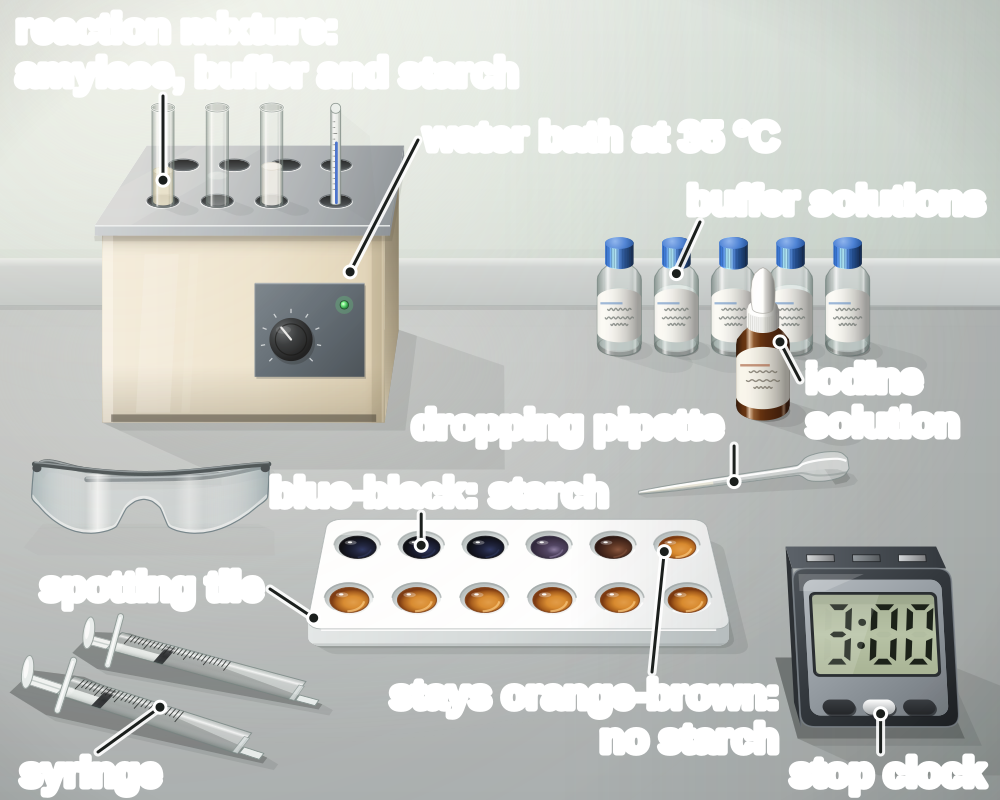
- Amylase is an enzyme. It breaks down starch into sugars.
- The aim: find out how pH affects the rate at which amylase breaks down starch.
- Iodine solution tests for starch, so it shows when the starch has gone.
Screen 2
A real practical and a diagram
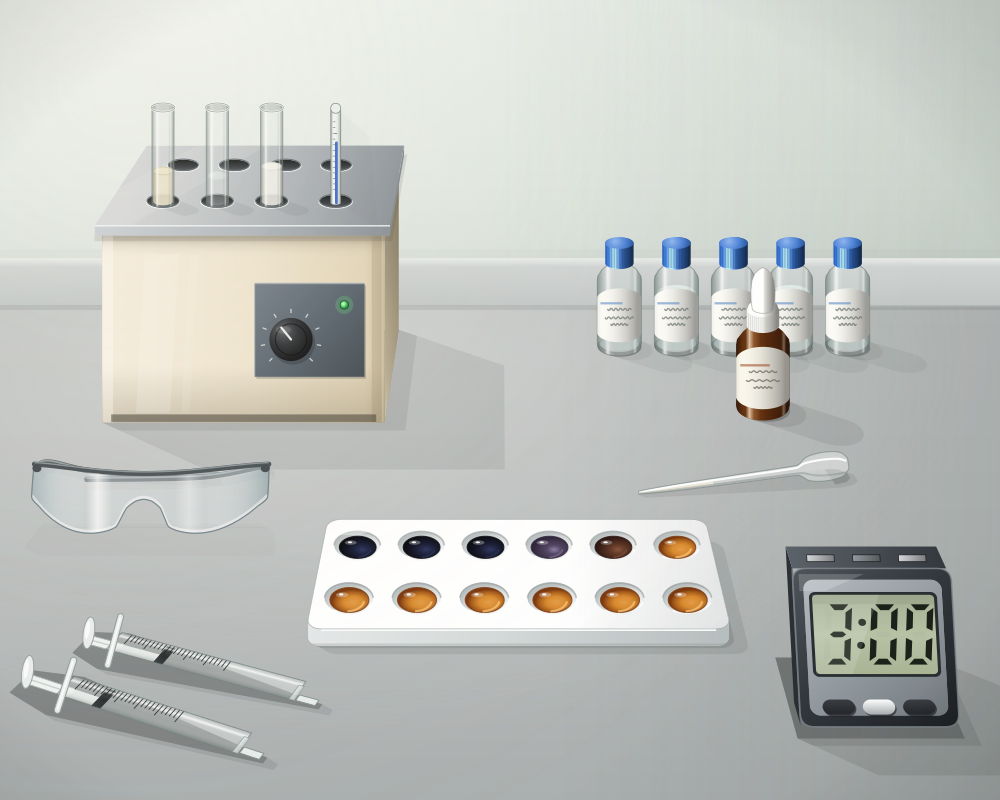
- A real bench has more apparatus, and the drops change colour little by little.
- An exam diagram shows only the key parts, with two clear colours.
Tap a difference to see it on both pictures.
A real practical
a drop every 30 s
A diagram
a drop every 30 s
Screen 3
What each piece of apparatus does
- Each piece of apparatus has a job. Tap a part to see it.
- The water bath keeps the temperature the same. The buffer solution sets the pH.
- Iodine solution on a spotting tile tests a drop of the mixture for starch.
Tap a part to see its job.
Screen 4
The method step by step
- Change only the pH. Keep everything else the same.
- Warm the solutions in the water bath first, then mix them and start the clock.
- Wear eye protection. Never put iodine in the test tube.
Try it yourself: the virtual lab for this required practical.
Screen 5
Checkpoint 1 of 3
Quick check on screens 1 to 4. Tap an answer.
1.On the spotting tile, a drop of iodine has turned blue-black. What does this show?
2.What is the job of the buffer solution?
3.Why do the tubes of amylase and starch stand in the water bath for 5 minutes before they are mixed?
Screen 6
Finding the end point
- Every 30 seconds, put a drop of the mixture on fresh iodine.
- Blue-black means starch is still there. The drops get paler as amylase breaks it down.
- The end point is the first drop where the iodine stays orange-brown. Record that time.
Screen 7
Results: from time to rate
- Do each pH three times. Leave out an anomaly (a result that does not fit), then find the mean.
- rate = 1000 ÷ time. The unit is per second (s⁻¹).
- A shorter time means a faster rate.
| pH | Test 1 (s) | Test 2 (s) | Test 3 (s) | Mean time (s) | Rate (s⁻¹) |
|---|---|---|---|---|---|
| 5 | 180 | 210 | 180 | 190 | 5.3 |
| 6 | 90 | 120 | 90 | 100 | 10.0 |
| 7 | 60 | 60 | 60 | 60 | 16.7 |
| 8 | 120 | 150 | 330 | 135 | 7.4 |
| 9 | 300 | 270 | 300 | 290 | 3.4 |
anomaly: leave it out
Screen 8
Checkpoint 2 of 3
Quick check on screens 6 and 7. Tap an answer.
1.Which drop marks the end point?
2.Three tests gave 120 s, 150 s and 120 s. What is the mean time?
3.Test X took 60 s. Test Y took 180 s. Which statement is correct?
Screen 9
The graph and the optimum pH
- Plot rate against pH. Draw a smooth curve of best fit.
- The optimum pH has the fastest rate: about pH 7 for this amylase.
- Far from the optimum, the enzyme is denatured: its active site changes shape (B2 L3 Enzymes and digestion).
Screen 10
Variables and a fair test
- Independent variable (you change it): the pH.
- Dependent variable (you measure it): the time until the iodine stays orange-brown.
- Control variables (you keep them the same): the temperature, the volumes and the concentrations.
Tap a type of variable to see it on the bench.
Why not saliva? The amount of amylase in saliva is different from person to person.
Screen 11
Evaluating the practical
- The end point is subjective (a judgement): the colour changes little by little.
- Testing every 30 s: the time can be up to 30 s too long. Test every 10 s for a more accurate time.
- Repeat each pH. Wear eye protection.
The colour changes little by little, so two people can choose different drops. Compare each drop with a drop of plain iodine, and let the same person judge every test.
Try it yourself: the virtual lab for this required practical.
Screen 12
Checkpoint 3 of 3
Quick check on screens 9 to 11. Tap an answer.
1.What is the optimum pH of an enzyme?
2.In this practical, which is a control variable?
3.Why is the end point hard to judge?
Quiz
Quiz: B2 L5 Amylase practical
10 questions. Tap an answer. Your first answer counts towards your score.
What is the aim of the amylase practical?
Why do schools use one amylase solution for every test, and not saliva?
Which step comes straight after the starch is added to the amylase and buffer?
As the test goes on, each drop on the spotting tile is paler than the one before. Why?
At the fastest pH, a student tested a drop every 10 seconds. The iodine stayed orange-brown at 40 seconds. What is the rate? Use rate = 1000 ÷ time.
Three tests at one pH gave 90 s, 240 s and 120 s. Which result is the anomaly?
Why does amylase work slowly at a very high pH?
The mean times were: pH 4, 480 s; pH 5, 180 s; pH 6, 90 s; pH 7, 120 s. Which pH is closest to the optimum?
Which is the dependent variable in the amylase practical?
How could a student get a more accurate time for the end point?
Exam questions
The same five questions as the B2 L5 Exam questions worksheet. 20 marks.
Write your answer, then open the mark scheme and tick each point you made.
01A student investigated the effect of pH on the rate of reaction of amylase.
Figure 1 shows some of the apparatus.
01.1Complete Figure 1.
Choose answers from the box.
01.2Every 30 seconds, the student put one drop of the mixture onto iodine solution.
Which colour showed that starch was still in the mixture?
Tick (✓) one box.
Mark scheme
- (1)
- (1)
- (1)
- (1)
01.1: 1 mark for each correct label. If more than one word from the box is written on one line, do not give that mark.
01.2: if more than one box is ticked, 0 marks.
Model answer01.1 1 water bath; 2 spotting tile; 3 dropping pipette. 01.2 Blue-black.
02The student did the test three times at each pH.
Table 1 shows the results.
| pH | Time for the iodine to stay orange-brown in seconds | |||
|---|---|---|---|---|
| Test 1 | Test 2 | Test 3 | Mean | |
| 4 | 270 | 300 | 300 | 290 |
| 5 | 150 | 180 | 150 | X |
| 6 | 90 | 60 | 90 | 80 |
| 7 | 90 | 90 | 210 | 90 |
| 8 | 180 | 150 | 180 | 170 |
02.1Calculate mean X.
02.2One result in Table 1 is anomalous.
Give the anomalous result.
02.3Calculate the rate of reaction at pH 6.
Use the equation:
rate = 1000 ÷ mean time
Mark scheme
- (1)
- (1)
- (1)
- (1)
02.1: (150 + 180 + 150) ÷ 3.
02.2: allow "pH 7, test 3".
02.3: allow 13. Correct answer with no working = 2 marks. do not accept 0.08 (the time divided by 1000) for the answer mark.
Model answer02.1 (150 + 180 + 150) ÷ 3 = 160 s. 02.2 210 s (pH 7, test 3). 02.3 1000 ÷ 80 = 12.5 per second.
03The optimum pH.
03.1What is the optimum pH for this amylase?
Use Table 1.
03.2The rate of reaction was slower at pH 8 than at pH 6.
Explain why.
Mark scheme
- (1)
- (1)
- (1)
- (1)
03.2: max 3. allow "pH 6 is the optimum" for the first mark. do not accept "the enzyme is killed / dies" (that point scores 0; other points can still score). ignore "the enzyme does not work".
Model answer03.1 pH 6. 03.2 pH 8 is further from the optimum pH of 6. At pH 8 the shape of the active site of the amylase changes, so starch does not fit as well. Less starch is broken down per second, so the rate is slower.
04The end point.
The teacher said that the times in Table 1 may not be the exact times when all the starch had been broken down.
Give two reasons why.
Mark scheme
Any two from:
- (1)
- (1)
- (1)
max 2. ignore "human error" or "reaction time" with no explanation.
Model answerThe mixture was only tested every 30 seconds, so the starch may have gone before the recorded time. The colour changes little by little, so it is hard to judge exactly when the iodine stays orange-brown.
05Another student wants to find the time taken for amylase to break down starch at pH 5.
Describe a method the student could use.
You should include how the student would make it a fair test.
Mark scheme
Level of response. Read your answer, choose the level that fits best, then pick your mark.
| Level | Marks | Descriptor |
|---|---|---|
| 3 | 5–6 | A detailed and coherent method in a logical order that would give valid results. It says how the starch is tested (a drop of the mixture on iodine at regular times), how the end point is found and timed, and how the temperature is controlled, with at least two other control variables or repeats. |
| 2 | 3–4 | A method with the main steps in a mostly sensible order. Some detail is missing, for example how often to test or how the temperature is kept the same. At least one control variable is given. |
| 1 | 1–2 | Simple statements about the method, for example "mix amylase and starch" or "test it with iodine". The order may be unclear, with little about making it fair. |
| 0 | 0 | No relevant content. |
Indicative content
- put a drop of iodine solution into each well of a spotting tile
- measure a volume of amylase solution (for example 2 cm³) into a test tube with a syringe
- add a volume of pH 5 buffer solution (for example 1 cm³)
- measure a volume of starch solution (for example 2 cm³) into another test tube
- stand both tubes in a water bath at a set temperature (for example 35 °C) for a few minutes, so they reach that temperature
- add the starch to the amylase and buffer, mix, and start the stop clock
- every 30 seconds, put one drop of the mixture onto a new drop of iodine
- blue-black shows that starch is still there
- record the time when the iodine stays orange-brown (the end point)
- keep the same temperature, the same volumes, the same concentrations of amylase and starch and the same time between tests
- repeat (three times) and calculate a mean
- wear eye protection
A method that adds iodine to the test tube, or gives the end point as "when the iodine turns orange-brown", is not a correct end-point method: such an answer cannot reach Level 3.
Your mark:
Model answer (Level 3)Put a drop of iodine solution into each well of a spotting tile. Use a syringe to put 2 cm³ of amylase solution into a test tube and add 1 cm³ of pH 5 buffer solution. Put 2 cm³ of starch solution into another test tube. Stand both tubes in a water bath at 35 °C for 5 minutes. Add the starch to the amylase and buffer, mix, and start the stop clock. Every 30 seconds, use a dropping pipette to put one drop of the mixture onto a new drop of iodine. Stop the clock when the iodine stays orange-brown, and record the time. Keep the temperature, the volumes and the concentrations of amylase and starch the same, so it is a fair test. Repeat three times and calculate the mean. Wear eye protection.
Total: 0 out of 20
Printable copy: the B2 L5 Exam questions worksheet and its mark scheme (PDF) are in .