Screen 1 of 12
Welcome back
Screen 1
Transpiration: water lost from leaves
- Transpiration is the loss of water vapour from the leaves of a plant.
- Water evaporates from the surfaces of the cells inside the leaf, into the air spaces.
- The water vapour then diffuses out through the stomata, from a higher concentration inside the leaf to a lower concentration outside.
Solid blue dots = liquid water. Faint dots = water vapour. Real water vapour is an invisible gas.
Screen 2
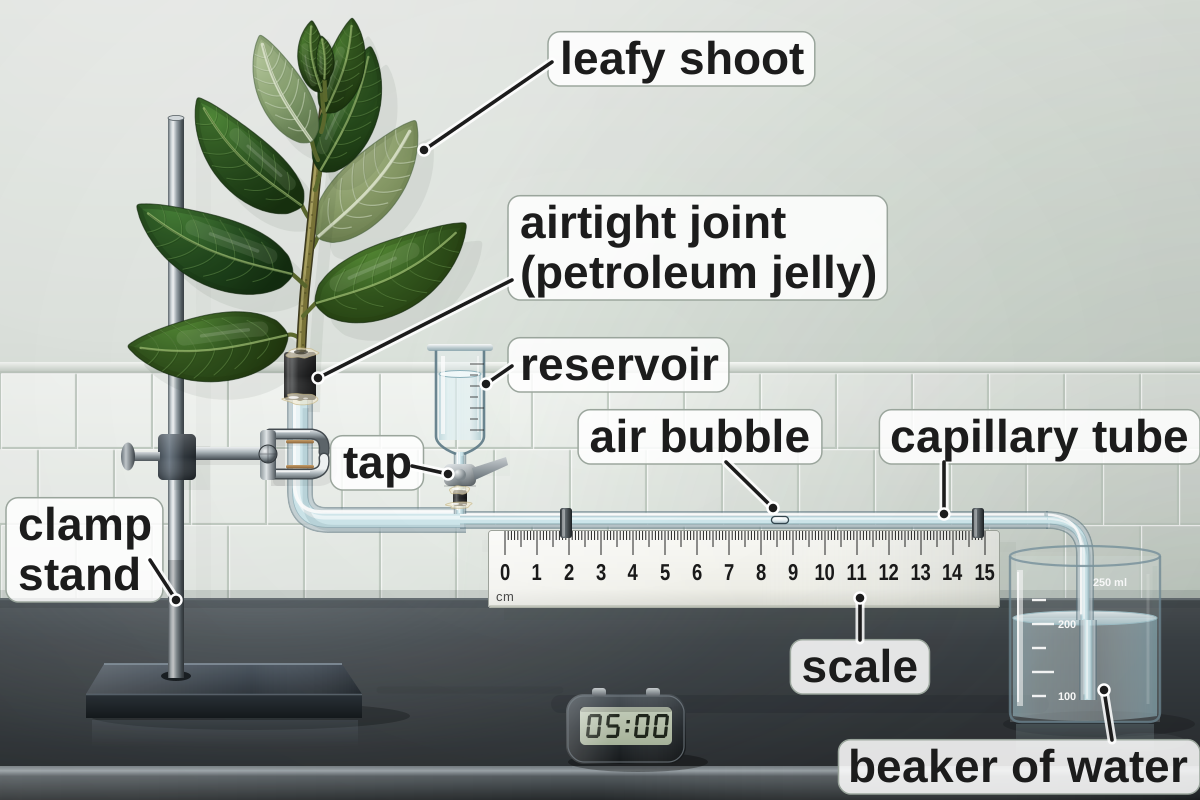
A real potometer
- A potometer measures how fast a leafy shoot takes up water.
- As the leaves lose water vapour, the shoot takes up water from the tube.
- An air bubble in the capillary tube moves towards the shoot. The faster it moves, the faster the water uptake.
Tap Find the bubble.
Screen 3
A real potometer and a diagram
- A diagram is simplified: it shows only the parts you need.
- A real potometer also has clamps, seals and a ruler with a mark every millimetre.
- In the diagram, blue = water. Real water is clear.
Tap a number to see one difference.
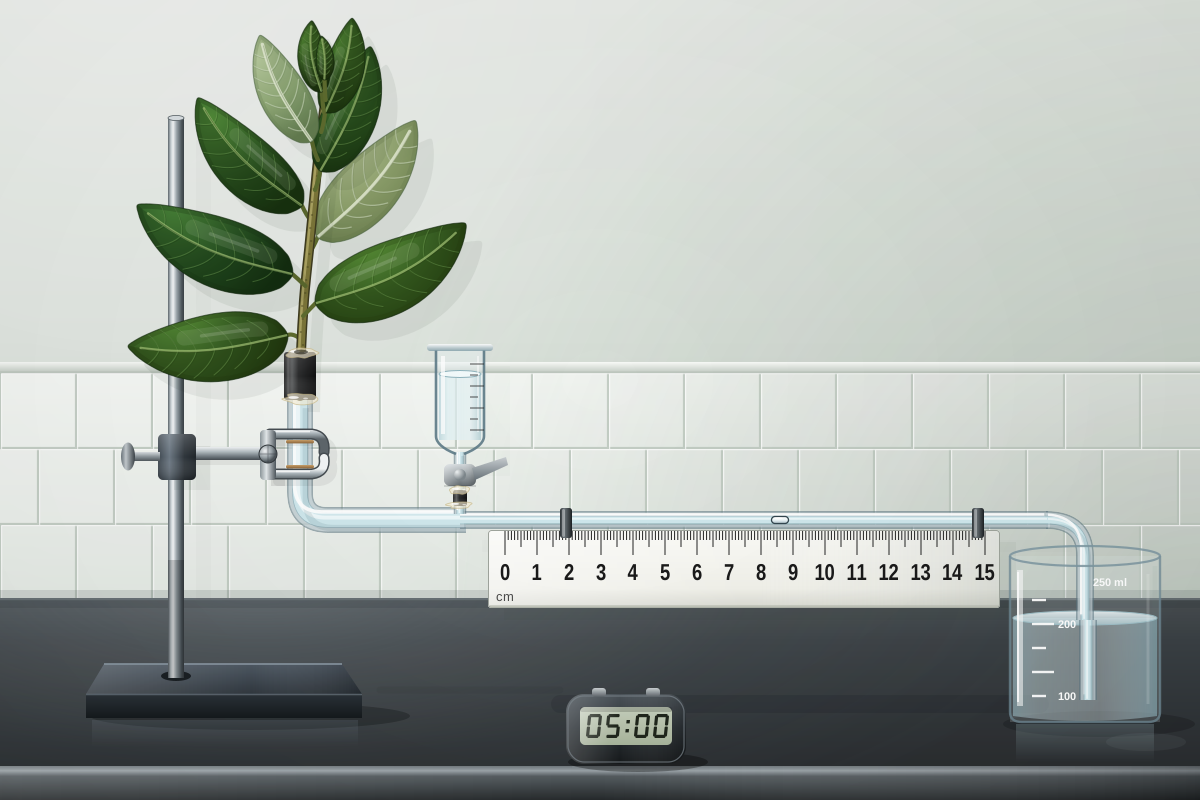
A real potometer
shoot ← tube ← beaker
A diagram
shoot ← tube ← beaker
A diagram is simplified. In the diagram, blue = water. Real water is clear.
Screen 4
Checkpoint 1 of 3
Quick check on screens 1 to 3. Tap an answer.
1.What is transpiration?
2.In a potometer, why does the air bubble move along the tube?
3.Which part of a real potometer does a diagram usually leave out?
Screen 5
Temperature and air flow
- Higher temperature → faster transpiration. Water molecules move faster, so water evaporates and diffuses faster.
- More air flow (wind) → faster transpiration. Moving air carries water vapour away from the leaf, so the difference in concentration stays big.
Cool, still air. Water vapour builds up outside the stoma, so it diffuses out slowly. Water uptake: 4 mm per minute.
Water uptake: 4 mm per minute
Example numbers from one leafy shoot in a potometer. Kept the same: dry air, bright light.
The dots show water vapour. Real water vapour is an invisible gas.
Screen 6
Humidity and light
- Higher humidity → slower transpiration. Humid air already holds lots of water vapour, so the difference in concentration is smaller and water vapour diffuses out more slowly.
- Brighter light → faster transpiration. In light, the guard cells open the stomata wider, so more water vapour diffuses out.
Dry air, bright light. The stoma is open and the outside air holds little water vapour. Water uptake: 4 mm per minute.
Water uptake: 4 mm per minute
Example numbers from one leafy shoot in a potometer. Kept the same: cool, still air.
The dots show water vapour. Real water vapour is an invisible gas.
Screen 7
Checkpoint 2 of 3
Quick check on screens 5 and 6. Tap an answer.
1.Why does a higher temperature make transpiration faster?
2.A plant is put in very humid air. What happens to its rate of transpiration?
3.Why does bright light make transpiration faster?
Screen 8
Setting up a potometer
- Set the potometer up carefully, or the results will be wrong.
- Cut and fit the shoot under water. Make every joint airtight.
- Let the shoot settle, then time the bubble. Repeat each reading.
Safety: handle glass tubes with care, and cut away from your fingers.
A diagram is simplified. In the diagram, blue = water. Real water is clear.
Screen 9
Calculating the rate
- Rate of water uptake = distance moved by the bubble ÷ time. The unit is mm per minute.
- Find the distance from the two scale readings: bigger − smaller.
- Volume of water taken up = π × r² × distance, where r is the radius of the capillary tube. The unit is mm³.
Distance moved = 50 − 10 = 40 mm in 5 minutes
Example: the bubble moves 40 mm in 5 minutes. 40 ÷ 5 = 8 mm per minute.
In the diagram, blue = water. Real water is clear.
Screen 10
Plotting the results
- Change one factor at a time. Here, a fan changes the air speed.
- Repeat each reading 3 times. Leave out any anomaly, then find the mean.
- Plot the mean rates. Choose a scale that uses more than half the grid. Draw a line of best fit.
| Air speed (m/s) | Repeats (mm) | Mean (mm) | Rate (mm/min) |
|---|---|---|---|
| 0 | 19, 21, 20 | 20 | 4 |
| 1 | 34, 36, 35 | 35 | 7 |
| 2 | 49, 51, 50 | 50 | 10 |
| 3 | 59, 61, | 60 | 12 |
| 4 | 64, 66, 65 | 65 | 13 |
Screen 11
Getting good results
- A potometer measures water uptake. A little of the water is used by the cells, so uptake is not exactly the same as loss.
- So a potometer gives an estimate of the rate of transpiration.
- For a fair test, change one factor and keep everything else the same.
Tap a problem to see how it spoils the results.
A diagram is simplified. In the diagram, blue = water. Real water is clear.
Screen 12
Checkpoint 3 of 3
Quick check on screens 8 to 11. Tap an answer.
1.Why are the joints of the potometer sealed with petroleum jelly?
2.The bubble moves 30 mm in 6 minutes. What is the rate of water uptake?
3.Why does a potometer give only an estimate of the rate of transpiration?
Quiz
Quiz: B2 L14 Transpiration and the potometer
10 questions. Tap an answer. Your first answer counts towards your score.
Where does water evaporate in a leaf?
How does water vapour move out of the leaf through the stomata?
In a potometer, which way does the air bubble move?
Why do potometer diagrams colour the water blue?
Which change makes transpiration faster?
Why does humid air slow down transpiration?
Why do you leave the shoot for 5 minutes before you start timing?
The bubble moves 28 mm in 4 minutes. What is the rate of water uptake?
A student's three readings are 52 mm, 50 mm and 81 mm. What is the best mean to use?
A student tests the effect of air flow on a shoot in a potometer. How do they make it a fair test?
Exam questions
The same five questions as the B2 L14 Exam questions worksheet. 20 marks.
Write your answer, then open the mark scheme and tick each point you made.
01Figure 1 shows a potometer. A student used it to measure the rate of water uptake by a leafy shoot.
01.1Complete Figure 1.
Choose answers from the box.
01.2The student cut the shoot under water before putting it into the potometer.
Why?
Tick (✓) one box.
Mark scheme
- (1)
- (1)
- (1)
- (1)
01.1: 1 mark for each correct label. If more than one word from the box is written on one line, do not give that mark.
Model answer01.1 1 reservoir; 2 capillary tube; 3 air bubble. 01.2 To stop air getting into the xylem.
02The student measured how far the air bubble moved in 5 minutes.
They did this three times.
Table 1 shows the results.
| Repeat | Distance moved by the air bubble in 5 minutes in mm |
|---|---|
| 1 | 34 |
| 2 | 37 |
| 3 | 31 |
02.1Calculate the mean distance moved by the air bubble.
02.2Calculate the rate of water uptake in mm per minute.
Use your answer to Question 02.1.
Use the equation:
rate of water uptake = distance moved ÷ time
02.3The capillary tube has a radius of 0.5 mm.
Calculate the volume of water taken up by the shoot in 5 minutes.
Use your answer to Question 02.1.
Use the equation:
volume = π × r² × distance
Use π = 3.14
Mark scheme
- (1)
- (1)
- (1)
- (1)
- (1)
02.1: (34 + 37 + 31) ÷ 3
02.2: allow their 02.1 ÷ 5, correctly calculated, for 2 marks. Correct answer with no working = 2 marks.
02.3: allow 27 (mm³). allow their 02.1 used for distance, correctly calculated, for 2 marks. Correct answer with no working = 2 marks. 106.8 (r = 1 mm used, the diameter) = 1 mark.
Model answer02.1 (34 + 37 + 31) ÷ 3 = 34 mm. 02.2 34 ÷ 5 = 6.8 mm per minute. 02.3 3.14 × 0.5 × 0.5 × 34 = 26.7 mm³.
03The student then moved the potometer into a dark cupboard.
All the other conditions stayed the same.
03.1Predict how the distance the air bubble moves in 5 minutes will change.
03.2Explain your prediction.
Mark scheme
- (1)
- (1)
- (1)
03.1: allow “the bubble hardly moves” / “the bubble stops”. do not accept “the bubble moves further”.
03.2: allow “the guard cells close the stomata”. ignore “less photosynthesis” unless it is linked to the stomata. do not accept “the plant does not need water in the dark”.
Model answer03.1 The bubble moves a shorter distance. 03.2 In the dark the stomata close, so less water vapour diffuses out of the leaves. Less water is lost, so less water is taken up.
04A potometer measures the rate of water uptake. This is not exactly the same as the rate of transpiration.
Explain why.
Mark scheme
- (1)
- (1)
allow “some water stays in the plant” for the second mark. ignore “the apparatus may leak”.
Model answerA potometer measures the water the shoot takes up, but transpiration is the water lost from the leaves. Some of the water taken up is used by the cells, for example in photosynthesis, so uptake is a little more than loss.
05A gardener grows tomato plants in a greenhouse.
Table 2 shows the conditions in the greenhouse at 2 pm and at 2 am on the same summer day.
| Condition | At 2 pm | At 2 am |
|---|---|---|
| Temperature in °C | 28 | 14 |
| Humidity of the air in % | 40 | 85 |
| Light | bright sunlight | dark |
| Air flow | fans on | fans off: still air |
The tomato plants lose much more water by transpiration at 2 pm than at 2 am.
Explain why.
Use information from Table 2.
Mark scheme
Level of response. Read your answer, choose the level that fits best, then pick your mark.
| Level | Marks | Descriptor |
|---|---|---|
| 3 | 5–6 | A detailed and coherent explanation. At least three conditions from Table 2 are each linked to the rate of transpiration with a correct scientific reason (evaporation, diffusion, the difference in water vapour concentration, or the stomata), for example: the humidity is lower at 2 pm → less water vapour in the air → a bigger difference in concentration → water vapour diffuses out of the stomata faster. |
| 2 | 3–4 | Two conditions are linked to the rate with a correct reason, or several conditions are linked to the rate with little explanation. |
| 1 | 1–2 | Simple statements from the table with little or no explanation, for example “it is hotter at 2 pm” or “it is sunny”. |
| 0 | 0 | No relevant content. |
Indicative content
- at 2 pm the temperature is higher (28 °C, not 14 °C)
- so water molecules move faster / have more energy
- so water evaporates from the cells inside the leaves faster, and the water vapour diffuses out faster
- at 2 pm the humidity is lower (40 %, not 85 %)
- so there is less water vapour in the air outside the leaves
- so the difference in water vapour concentration between the air spaces and the air is bigger / the concentration gradient is steeper
- so water vapour diffuses out of the stomata faster
- at 2 pm there is bright sunlight
- so the guard cells open the stomata (wider), and more water vapour can diffuse out
- at 2 am it is dark, so most stomata are closed and very little water vapour can get out
- at 2 pm the fans move the air
- moving air carries water vapour away from the leaves, so the concentration outside stays low / the gradient stays steep
- at 2 am the air is still, so water vapour builds up round the leaves and diffusion slows
Your mark:
Model answer (Level 3)At 2 pm the temperature is higher, so the water molecules move faster. Water evaporates from the cells inside the leaves faster, and the water vapour diffuses out faster. The humidity is lower at 2 pm, so there is less water vapour in the air. The difference in water vapour concentration between the air spaces in the leaves and the air outside is bigger, so water vapour diffuses out of the stomata faster. In bright sunlight the guard cells open the stomata wide, so more water vapour can get out; at 2 am it is dark, so most stomata are closed. At 2 pm the fans carry water vapour away from the leaves, which keeps the concentration outside low. At 2 am the air is still and humid, so water vapour builds up round the leaves and very little is lost.
Total: 0 out of 20
Printable copy: the B2 L14 Exam questions worksheet and its mark scheme (PDF) are in .