Screen 1 of 12
Welcome back
Screen 1
Two transport tissues
- Roots, stem and leaves work together as a plant organ system for transport.
- Xylem carries water and mineral ions up from the roots to the stem and leaves.
- Phloem carries dissolved sugars from the leaves to the rest of the plant.
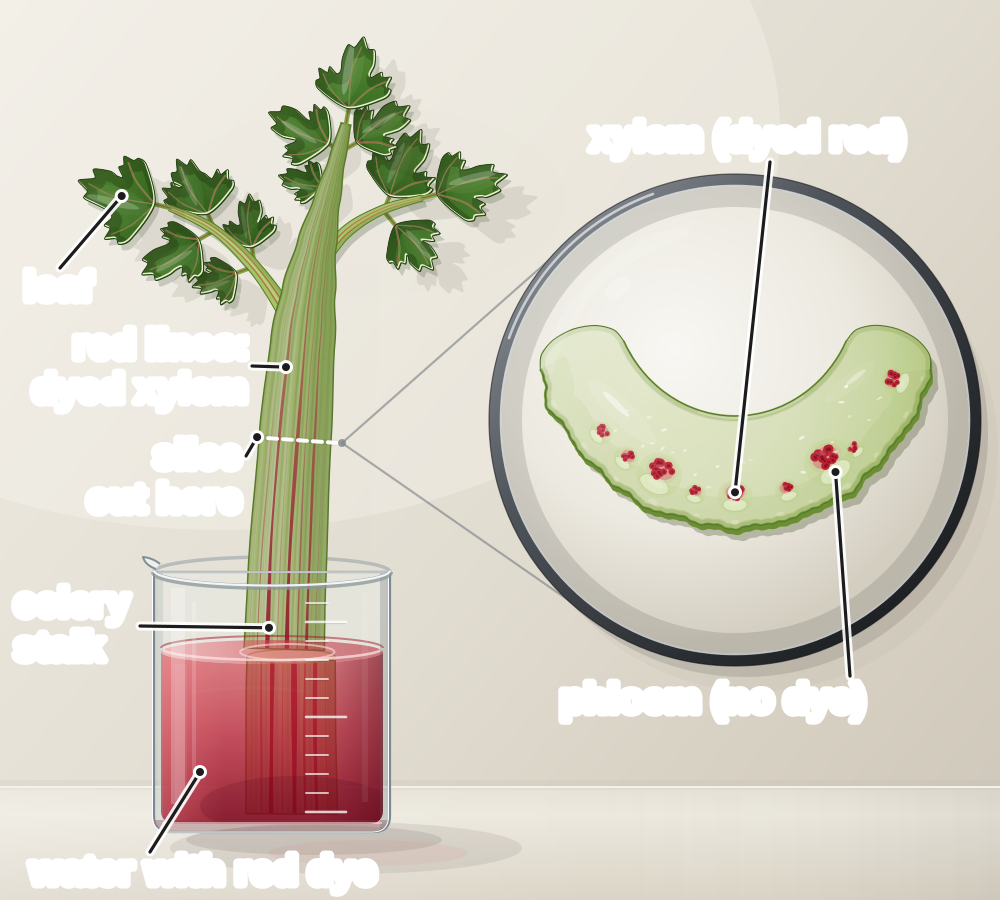
- A celery stalk stood in red dye: the dye moves up with the water, so it shows the xylem.
Screen 2
A real stalk and a diagram
- A real celery stalk is U-shaped, and only its xylem takes up the red dye.
- A diagram shows a round stem, cut across, with every tissue drawn clearly.
- In the diagram, brown = xylem and purple = phloem. Real xylem and phloem are pale.
Tap a difference to see it on both pictures.
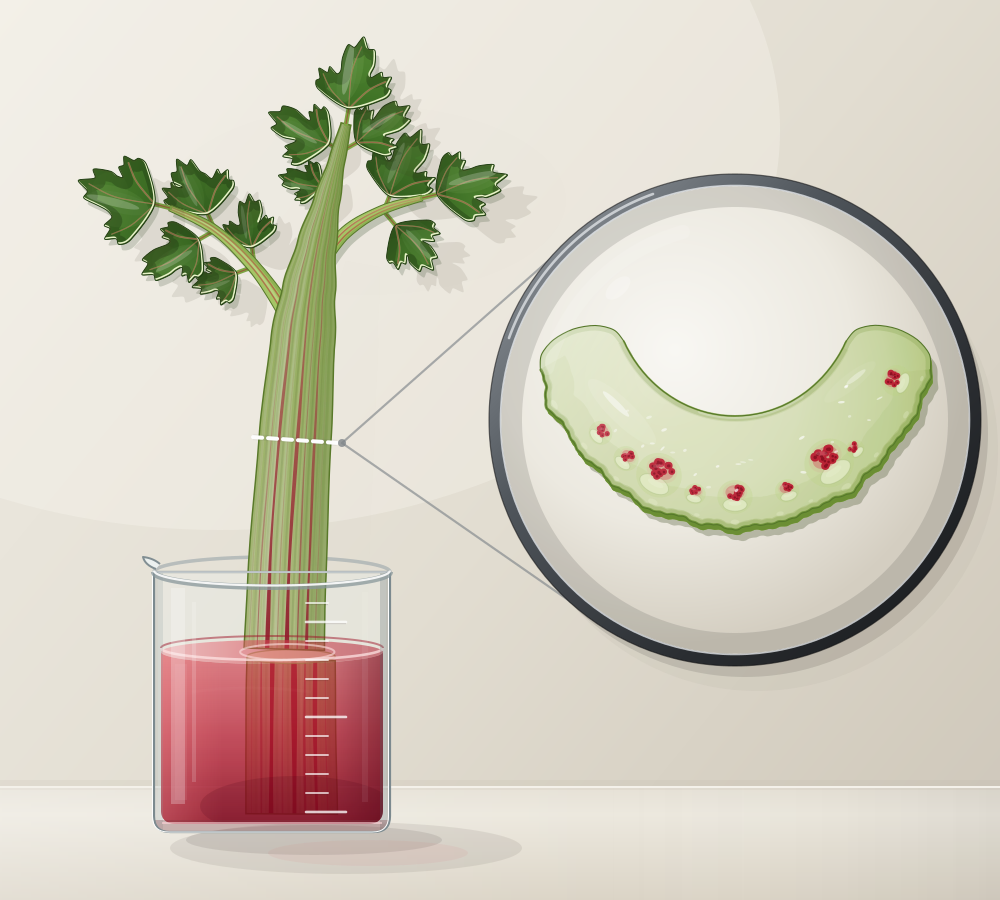
A real celery stalk
phloem on the outside
A diagram of a stem
phloem on the outside
Screen 3
Xylem and phloem up close
- Xylem: hollow tubes of dead cells with no end walls, strengthened by lignin.
- Phloem: tubes of elongated living cells. Pores in the end walls let cell sap pass from cell to cell.
- Xylem carries water up. Phloem carries sugars up and down.
Tap a part to see how it helps.
Screen 4
The transpiration stream
- Water enters the root hair cells, moves into the xylem and travels up to the leaves.
- In the leaves it evaporates, and water vapour leaves through the stomata.
- This pulls more water up behind it: the transpiration stream.
Screen 5
Checkpoint 1 of 3
Quick check on screens 1 to 4. Tap an answer.
1.A celery stalk stood in red dye. Why are some tubes in the stalk red?
2.Which statement about xylem is correct?
3.In the transpiration stream, what happens to the water when it reaches the leaves?
Screen 6
Translocation: sugars on the move
- Translocation is the movement of dissolved sugars through the phloem.
- Sugars made in the leaves go to where they are used (growing tips, roots) or stored (fruits, potatoes).
- So sugars move up and down the plant. Water in the xylem only moves up.
Send sugars to:
Tap a place to send sugars there.
Screen 7
Tracking water with dye
- Stand a celery stalk in water with red dye. The dye moves up with the water in the xylem.
- Cut the stalk at set times and measure how far the dye has moved.
- rate = distance ÷ time, in mm per minute.
After 30 minutes the dye has moved 90 mm.
| Time in minutes | 0 | 5 | 10 | 15 | 20 | 25 | 30 |
|---|---|---|---|---|---|---|---|
| Distance moved by the dye in mm | 0 | 16 | 29 | 45 | 61 | 74 | 90 |
Worked example: 90 mm in 30 minutes. rate = 90 ÷ 30 = 3 mm per minute.
Screen 8
Checkpoint 2 of 3
Quick check on screens 6 and 7. Tap an answer.
1.Which way do dissolved sugars move in the phloem?
2.What is translocation?
3.Red dye moved 60 mm up a celery stalk in 20 minutes. What was the rate of movement?
Screen 9
Xylem or phloem?
- Xylem: water and mineral ions, up only, dead cells, lignin. The transpiration stream.
- Phloem: dissolved sugars, up and down, living cells, pores in the end walls. Translocation.
- Transpiration is not translocation. Xylem does not carry sugars.
Statement 1 of 8
Carries water and mineral ions
| Xylem | Phloem | |
|---|---|---|
| Carries | water and mineral ions | dissolved sugars |
| Which way | up only: roots → stem → leaves | up and down: leaves → where sugars are used or stored |
| Cells | dead | living |
| Structure | hollow tubes, no end walls | tubes of elongated cells, pores in the end walls |
| Walls | strengthened by lignin | not strengthened by lignin |
| Process | transpiration stream | translocation |
| Both | found side by side in bundles in the roots, stem and leaves | |
Screen 10
Inside a tree trunk
- Wood is mostly old xylem. Lignin in the walls makes it hard and strong.
- Strong xylem supports the plant, so trees can grow tall.
- A thin layer of phloem lies just inside the bark.
Tap a layer to find out more.
Screen 11
Apply it: ringing a tree
- Removing a ring of bark removes the phloem, but not the xylem in the wood.
- Sugars cannot get past the ring, so they build up and the bark above it swells.
- The roots get no sugars. In time they die, and so does the tree.
Screen 12
Checkpoint 3 of 3
Quick check on screens 9 to 11. Tap an answer.
1.Which of these is true of phloem but NOT of xylem?
2.What is most of the wood in a tree trunk made of?
3.A ring of bark is removed from a tree trunk. Why do the roots die after some months?
Quiz
Quiz: B2 L13 Plant transport: xylem and phloem
10 questions. Tap an answer. Your first answer counts towards your score.
Which three organs make up a plant's transport system?
In the stem diagram in this lesson, the xylem is brown and the phloem is purple. What do these colours show?
What strengthens the walls of xylem tubes?
How does cell sap move from one phloem cell to the next?
Where does water first enter a plant?
What keeps water moving up the xylem?
A potato plant stores sugars in its potatoes underground. How do these sugars get there?
Dye moved 30 mm up a stalk in the first 10 minutes. At the same rate, how far will it move in 30 minutes?
Which line matches each process to the right substance and tissue?
A ring of bark is removed from a tree. Why do its leaves stay green at first?
Exam questions
The same five questions as the B2 L13 Exam questions worksheet. 20 marks.
Write your answer, then open the mark scheme and tick each point you made.
01Figure 1 shows two tissues from a plant stem, cut lengthways.
01.1Complete Figure 1.
Choose answers from the box.
01.2What does xylem transport?
Tick (✓) one box.
Mark scheme
- (1)
- (1)
- (1)
- (1)
01.1: 1 mark for each correct label. If more than one word from the box is written on one line, do not give that mark.
Model answer01.1 1 xylem; 2 lignin; 3 phloem. 01.2 Water and mineral ions.
02A student investigated how fast water moves up celery stalks.
The student:
- put three celery stalks in water with red dye
- left them for 20 minutes
- cut each stalk and measured how far the dye had moved up it.
Table 1 shows the results.
| Celery stalk | Distance the dye moved in mm |
|---|---|
| 1 | 52 |
| 2 | 61 |
| 3 | 55 |
02.1Calculate the mean distance the dye moved.
02.2Calculate the mean rate of movement of the dye.
Use the equation:
rate = distance ÷ time
Use your answer to Question 02.1.
02.3What is the name for the flow of water from the roots to the leaves?
Tick (✓) one box.
02.4Give one variable the student should keep the same for each celery stalk.
Mark scheme
- (1)
- (1)
- (1)
- (1)
- (1)
02.1: (52 + 61 + 55) ÷ 3 = 56.
02.2: allow their 02.1 answer ÷ 20, correctly calculated, for 2 marks. Correct answer with no working = 2 marks. do not accept 20 ÷ 56 (0.36).
02.4: allow "the amount of dye" for volume. ignore "the same equipment". do not accept "the distance the dye moved" (this is what is measured).
Model answer02.1 (52 + 61 + 55) ÷ 3 = 56 mm. 02.2 56 ÷ 20 = 2.8 mm per minute. 02.3 The transpiration stream. 02.4 The number of leaves on each stalk.
03Carrot plants store sugar in their roots.
Describe how sugar made in the leaves reaches the roots.
Mark scheme
- (1)
- (1)
allow "in cell sap" for dissolved. do not accept "xylem" (0 marks for that point). do not accept "transpiration" / "transpiration stream" for translocation.
Model answerThe sugar is dissolved and carried in the phloem. It moves down the plant to the roots by translocation.
04Figure 2 shows part of the trunk of a tree.
A ring of bark was cut away all round the trunk.
The phloem was removed with the bark. The wood was not damaged.
After some weeks, the bark just above the ring had swollen.
Explain why the bark above the ring swelled.
Mark scheme
- (1)
- (1)
- (1)
allow "sucrose" for sugars. ignore "food". do not accept "water builds up above the ring" (the xylem in the wood was not cut). do not accept "the xylem was removed".
Model answerSugars made in the leaves move down the trunk in the phloem. The phloem was removed at the ring, so the sugars cannot get past it to the roots. The sugars build up just above the ring, so the bark there swells.
05Xylem and phloem are transport tissues in plants.
Explain how the structures of xylem and phloem are adapted to their functions.
Mark scheme
Level of response. Read your answer, choose the level that fits best, then pick your mark.
| Level | Marks | Descriptor |
|---|---|---|
| 3 | 5–6 | A detailed and coherent explanation that covers both tissues. Several structures are each clearly linked to their function, for example: no end walls → water flows freely in an unbroken tube; lignin → the tubes do not collapse; pores in the end walls → cell sap passes from cell to cell. The substance each tissue carries is correct. |
| 2 | 3–4 | Relevant structures of both tissues are given and at least two are linked to their function, but the links may be incomplete. Or one tissue is explained in detail and the other is only described. |
| 1 | 1–2 | Simple statements of structure or of function, for example "xylem carries water" or "phloem has living cells", with little or no link between them. |
| 0 | 0 | No relevant content. |
A response that says xylem carries sugars, or that xylem cells are living, cannot reach Level 3. ignore the names sieve plate, sieve tube and companion cell (not needed; neither credited nor penalised).
Indicative content
- xylem carries water and mineral ions from the roots to the stem and leaves (in the transpiration stream)
- xylem is made of hollow tubes, so water can flow through them
- there are no end walls between the xylem cells, so the tube is continuous / nothing blocks the flow
- xylem cells are dead / have no cytoplasm, so nothing gets in the way of the water
- xylem walls are strengthened by lignin, so the tubes do not collapse / are strong
- lignin also supports the plant, so it can stand upright / grow tall
- xylem tubes run all the way from the roots into the leaf veins, so water reaches every part
- phloem carries dissolved sugars from the leaves to the rest of the plant (translocation)
- phloem is made of tubes of elongated cells joined end to end, so cell sap can travel a long way
- the end walls of phloem cells have pores, so cell sap / dissolved sugars can move from one cell to the next
- phloem cells are living
- phloem can carry sugars up and down, to where they are used (growing tips, roots) or stored (potatoes, fruits, seeds)
- xylem and phloem run together in bundles in the roots, stem and leaves, so every part of the plant is supplied
Your mark:
Model answer (Level 3)Xylem carries water and mineral ions up from the roots to the leaves. It is made of hollow tubes of dead cells with no end walls, so the water flows through an unbroken tube with nothing in the way. The walls are strengthened by lignin, so the tubes do not collapse, and lignin also helps to support the plant. Phloem carries dissolved sugars from the leaves to the rest of the plant. It is made of tubes of long, living cells joined end to end. The end walls have pores, so cell sap with dissolved sugars can move from one cell to the next. Sugars can move up or down the phloem, to where they are used or stored.
Total: 0 out of 20
Printable copy: the B2 L13 Exam questions worksheet and its mark scheme (PDF) are in .