Screen 1 of 12
Welcome back
Screen 1
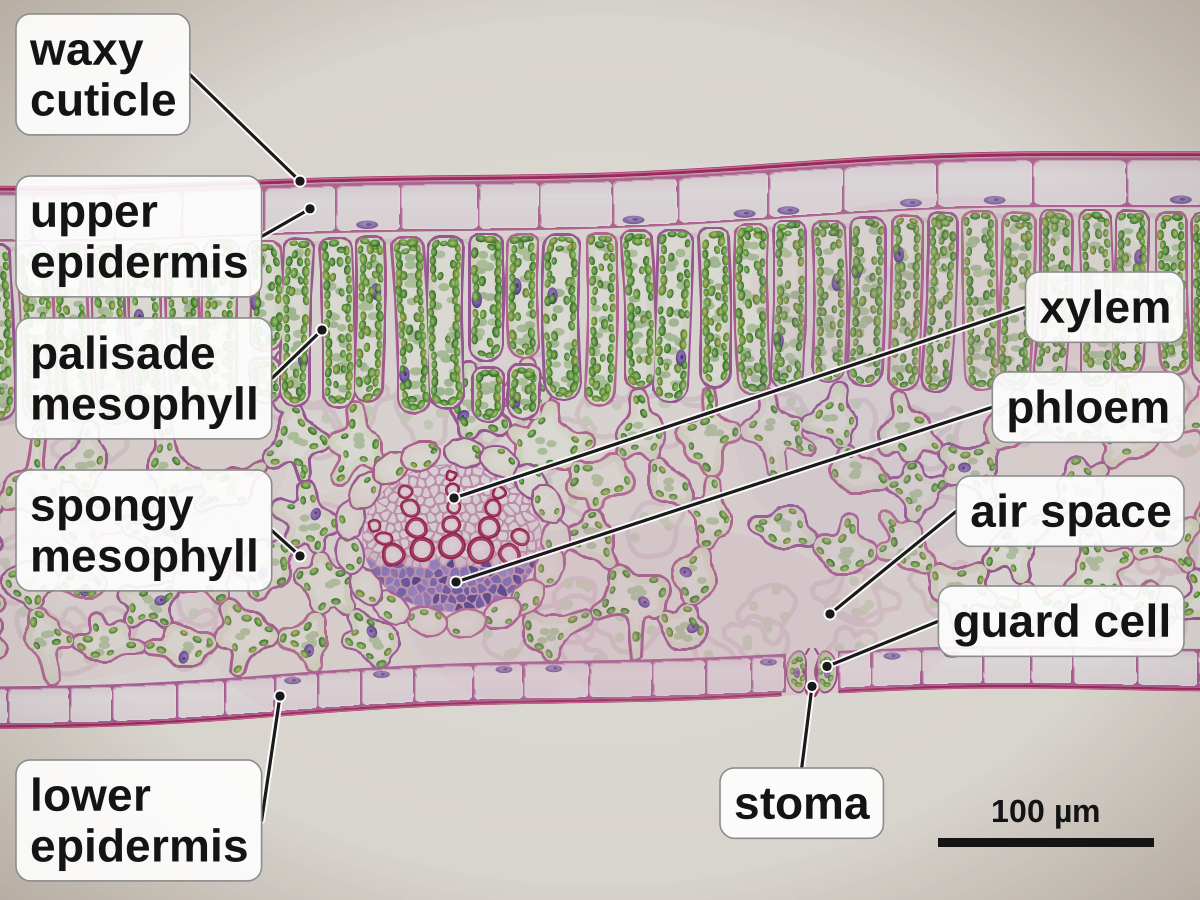
The leaf: a plant organ
- A leaf is an organ: different tissues working together to do a job.
- Its main job is photosynthesis: using light to make food. It also takes in and gives out gases.
- Leaves, stems and roots form a plant organ system that moves substances round the plant.
Screen 2
A real leaf section and a diagram
- A real section is a very thin slice of leaf, stained so the cells show up under a microscope.
- A diagram is simplified on purpose: neat cells and one colour for each tissue.
- Stains colour the cells. Real leaf cells are mostly clear, with green chloroplasts.
Tap a difference to see it on both pictures.
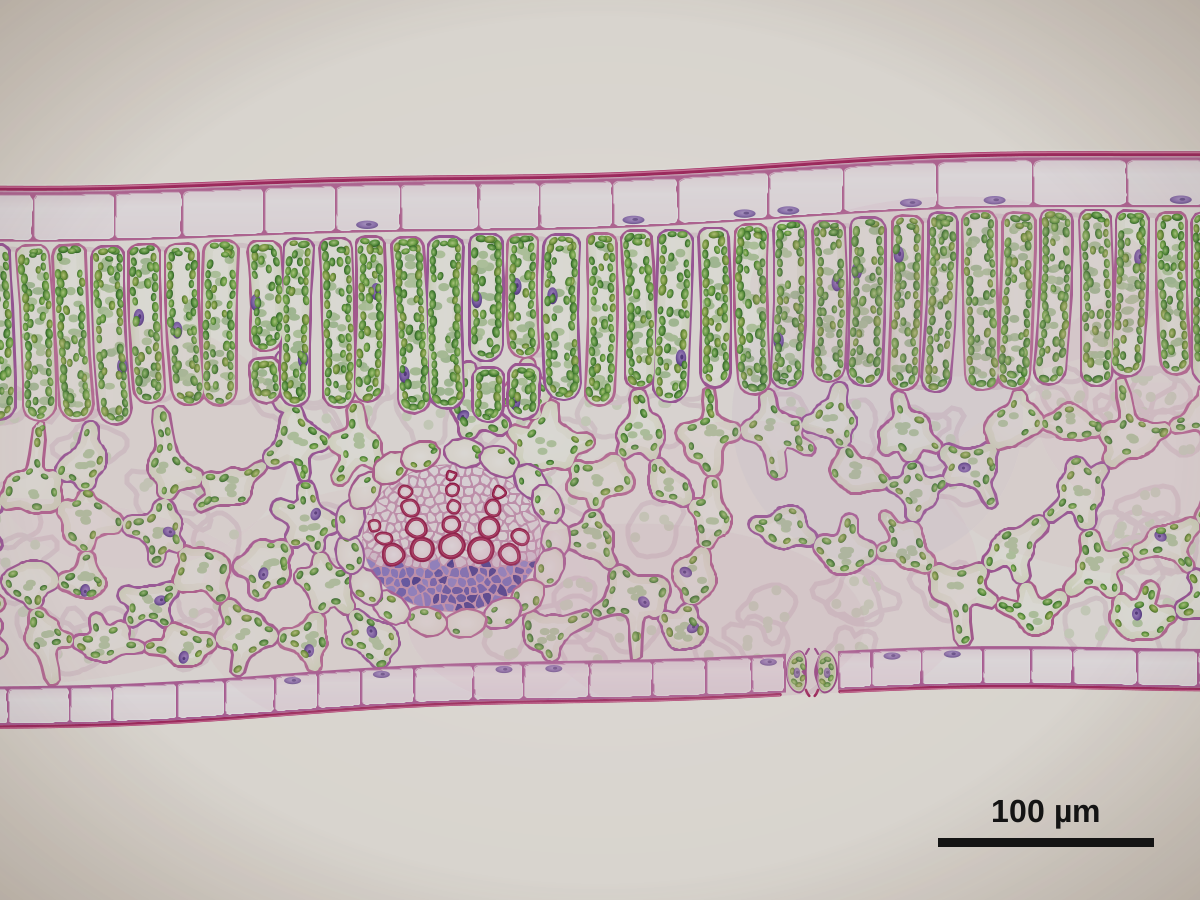
A real leaf section
↑ upper surface
A diagram
↑ upper surface
Screen 3
Leaf tissues and their jobs
- Each tissue has a structure that suits its job.
- Tap a part to see what it is like and what it does.
- The waxy cuticle is a layer of wax, not a layer of cells.
Tap a numbered pin to see its name for 3 seconds.
Tap a part to see what it is like and what it does.
Screen 4
How light reaches the chloroplasts
- The waxy cuticle and upper epidermis are transparent, so light passes straight through.
- Palisade cells are tall, packed near the top and full of chloroplasts: they absorb most of the light.
- The spongy mesophyll gets less light and has fewer chloroplasts.
Screen 5
Checkpoint 1 of 3
Quick check on screens 1 to 4. Tap an answer.
1.Which part of a leaf is not made of cells?
2.A leaf section on a microscope slide looks pink and purple. Where do these colours come from?
3.Why are the palisade mesophyll cells near the top of the leaf?
Screen 6
Gases move through the leaf
- In the light, carbon dioxide diffuses in through the stomata. Oxygen and water vapour diffuse out.
- Air spaces in the spongy mesophyll let gases reach every cell.
- A leaf is thin, so gases only have a short distance to diffuse.
All three gases move by diffusion, from where their concentration is higher to where it is lower.
Screen 7
Guard cells open and close stomata
- Each stoma is a tiny hole with two guard cells around it.
- Guard cells take in water and swell: the stoma opens. They lose water and go limp: it closes.
- Stomata open in the light. They close in the dark, or when the plant is short of water. Most are on the lower surface.
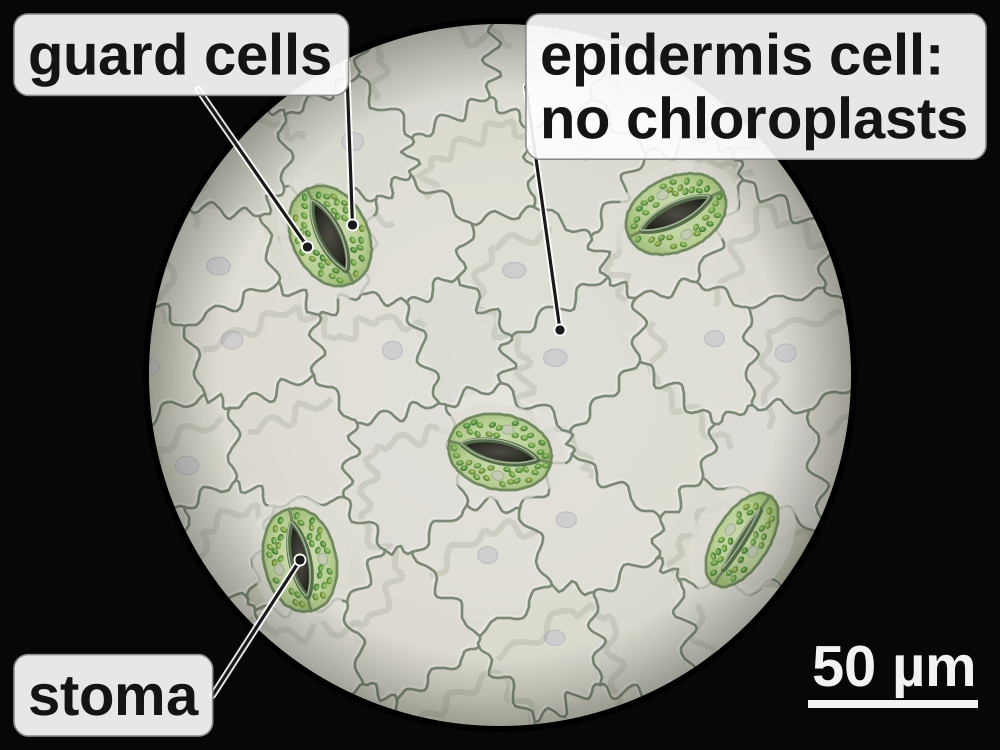
Solid blue dots = water. Grey dot = carbon dioxide. Faint blue dot = water vapour.
Screen 8
Checkpoint 2 of 3
Quick check on screens 6 and 7. Tap an answer.
1.How does carbon dioxide get from the air to the palisade cells?
2.What happens to the stomata when a plant is short of water?
3.Where are most of the stomata on a typical leaf?
Screen 9
Counting stomata
- Paint clear nail varnish on a leaf, peel it off, and count the stomata under a microscope.
- Stomatal density = mean number of stomata ÷ area of the field of view. Its unit is stomata per mm².
- The lower surface has far more stomata than the upper surface.
- Round field of view: area = π × r², with r in mm (1 mm = 1000 µm).
Stomata counted: 0
Field of view area = 0.1 mm²
| Surface | Field 1 | Field 2 | Field 3 | Mean | Stomata per mm² |
|---|---|---|---|---|---|
| Upper | 3 | 5 | 4 | 4 | 40 |
| Lower | 24 | 27 | 27 | 26 | 260 |
Lower surface: (24 + 27 + 27) ÷ 3 = 26 stomata. 26 ÷ 0.1 mm² = 260 stomata per mm².
Screen 10
Meristems: where plants grow
- Meristem tissue is at the growing tips of shoots and roots. It is not in the leaf.
- Meristem cells divide to make new cells. The new cells grow longer, then differentiate into tissues such as xylem and phloem.
Screen 11
Leaves for different places
- Leaves are adapted to the place where the plant lives.
- Stomata must open to the air. A thick waxy cuticle cuts water loss.
- Tap a leaf. Predict where its stomata will be, then check.
Tap a leaf, then tap Show me.
Screen 12
Checkpoint 3 of 3
Quick check on screens 9 to 11. Tap an answer.
1.A student counts 40 stomata in a field of view with an area of 0.1 mm². What is the stomatal density?
2.Where is meristem tissue found?
3.A water lily leaf floats on a pond. Where would you expect most of its stomata to be?
Quiz
Quiz: B2 L12 Leaf tissues and stomata
10 questions. Tap an answer. Your first answer counts towards your score.
Why is a leaf called an organ?
Which of these is true of a real stained leaf section, but NOT of a leaf diagram?
Which statement about the upper epidermis is correct?
Palisade cells are tall and packed tightly together near the top of the leaf. How does this help the leaf?
In the light, which gas made in the leaf diffuses out through the stomata?
Why does it help a leaf to be thin?
Which cells in the epidermis of a leaf contain chloroplasts?
A student counts 12, 15 and 18 stomata in three fields of view. Each field of view has an area of 0.05 mm². What is the stomatal density?
What happens to the new cells made by the meristem at a root tip?
A plant grows in a hot, dry desert. Which leaf feature would help it most?
Exam questions
The same five questions as the B2 L12 Exam questions worksheet. 20 marks.
Write your answer, then open the mark scheme and tick each point you made.
01Figure 1 shows a section through a leaf.
01.1Complete Figure 1.
Choose answers from the box.
01.2Which statement about the waxy cuticle is correct?
Tick (✓) one box.
Mark scheme
- (1)
- (1)
- (1)
- (1)
01.1: 1 mark for each correct label. If more than one word from the box is written on one line, do not give that mark. allow "palisade" for 1, "spongy" for 2 and "guard cells" for 3.
Model answer01.1 palisade mesophyll; spongy mesophyll; guard cell. 01.2 It reduces water loss from the leaf.
02Meristem tissue is found at the growing tips of shoots and roots.
02.1Describe what the cells in meristem tissue do.
02.2Some of the new cells become xylem cells. Other new cells become root hair cells.
Name the process by which cells become specialised.
Mark scheme
- (1)
- (1)
- (1)
02.1: allow "multiply" / "undergo mitosis" for divide. allow "the new cells differentiate / become specialised (into other types of cell)" or "so the shoot / root grows (longer)" / "for growth" for the second mark. do not accept "the cells grow into leaves".
02.2: allow "differentiate". do not accept "specialisation" (it repeats the question).
Model answer02.1 Meristem cells divide again and again to make new cells, which later differentiate. 02.2 Differentiation.
03A student wanted to find the number of stomata on the lower surface of a leaf.
The student painted clear nail varnish on the lower surface, peeled it off and looked at it with a microscope.
The student counted the stomata in three fields of view.
Table 1 shows the results.
| Field of view | Number of stomata |
|---|---|
| 1 | 18 |
| 2 | 23 |
| 3 | 19 |
03.1Calculate the mean number of stomata in one field of view.
03.2The area of one field of view was 0.08 mm².
Calculate the number of stomata in 1 mm² of the lower surface.
Use your answer to Question 03.1.
03.3Suggest one way the student could make the mean more representative of the whole leaf.
Mark scheme
- (1)
- (1)
- (1)
- (1)
03.2: allow their 03.1 answer ÷ 0.08, correctly calculated, for 2 marks. Correct answer with no working = 2 marks.
03.3: allow: take fields of view from different parts of the leaf / use more leaves / use leaves from different plants. ignore "repeat it" with no detail. ignore "use a better microscope".
Model answer03.1 (18 + 23 + 19) ÷ 3 = 20. 03.2 20 ÷ 0.08 = 250 stomata per mm². 03.3 Count the stomata in more fields of view, from different parts of the leaf.
04Figure 2 shows the same stoma at two different times.
Drawing A was made at midday. Drawing B was made at night.
04.1Name the type of cell labelled X.
04.2Suggest why it helps the plant to close its stomata at night.
Mark scheme
- (1)
- (1)
- (1)
04.1: allow "guard cells".
04.2: allow "prevents water loss". do not accept "the leaf stops breathing". ignore "to keep the leaf warm".
Model answer04.1 Guard cell. 04.2 There is no light at night, so there is no photosynthesis and no carbon dioxide is needed. Closing the stomata means less water vapour is lost from the leaf.
05The leaf is a plant organ. Its tissues work together to carry out photosynthesis.
Explain how the tissues of a leaf are adapted for photosynthesis.
Mark scheme
Level of response. Read your answer, choose the level that fits best, then pick your mark.
| Level | Marks | Descriptor |
|---|---|---|
| 3 | 5–6 | A detailed and coherent explanation. At least three tissues are each clearly linked to how they help photosynthesis (absorbing light, getting carbon dioxide in, bringing water, taking sugars away), with logical links, for example: palisade cells near the top → many chloroplasts → absorb most light. |
| 2 | 3–4 | Several relevant tissues are named and at least two are linked to how they help photosynthesis. The links may be incomplete. |
| 1 | 1–2 | Simple statements about the tissues of a leaf, for example "it has palisade cells" or "it has stomata", with little or no link to photosynthesis. |
| 0 | 0 | No relevant content. |
Indicative content
- the waxy cuticle and the upper epidermis are transparent / let light through to the palisade mesophyll
- (ordinary) epidermis cells have no chloroplasts, so light passes straight through
- the palisade mesophyll is near the top of the leaf, where most light reaches
- palisade cells contain many chloroplasts to absorb light (for photosynthesis)
- palisade cells are tall and packed tightly together, so many chloroplasts fit in the brightest part of the leaf
- the spongy mesophyll has air spaces, so carbon dioxide can diffuse to the (palisade) cells / large surface area for gas exchange
- stomata let carbon dioxide diffuse into the leaf (and oxygen out)
- guard cells open the stomata in the light, when carbon dioxide is needed
- the leaf is thin, so the diffusion distance is short; broad, so a large surface area absorbs light
- xylem brings water (needed for photosynthesis) to the leaf
- phloem carries the sugars made in photosynthesis away from the leaf
- the waxy cuticle reduces water loss (so the plant keeps the water it needs)
Your mark:
Model answer (Level 3)The waxy cuticle and the upper epidermis are transparent, and the epidermis cells have no chloroplasts, so light passes straight through to the palisade mesophyll. The palisade cells are near the top of the leaf, where the light is brightest. They are tall and packed tightly together, and each has many chloroplasts, so they absorb most of the light for photosynthesis. Carbon dioxide diffuses in through the stomata, which the guard cells open in the light. It then diffuses through the air spaces in the spongy mesophyll, which give a large surface area, to reach the palisade cells. The leaf is thin, so this distance is short. Xylem in the veins brings water to the leaf for photosynthesis, and phloem carries the sugars made away to the rest of the plant.
Total: 0 out of 20
Printable copy: the B2 L12 Exam questions worksheet and its mark scheme (PDF) are in .