Screen 1 of 13
Welcome back
Screen 1
Health and disease
- Health is the state of physical and mental well-being.
- Communicable diseases can spread from person to person. Non-communicable diseases cannot.
- Diet, stress and life situations also affect physical and mental health.
Tap a disease to sort it into its box.
Screen 2
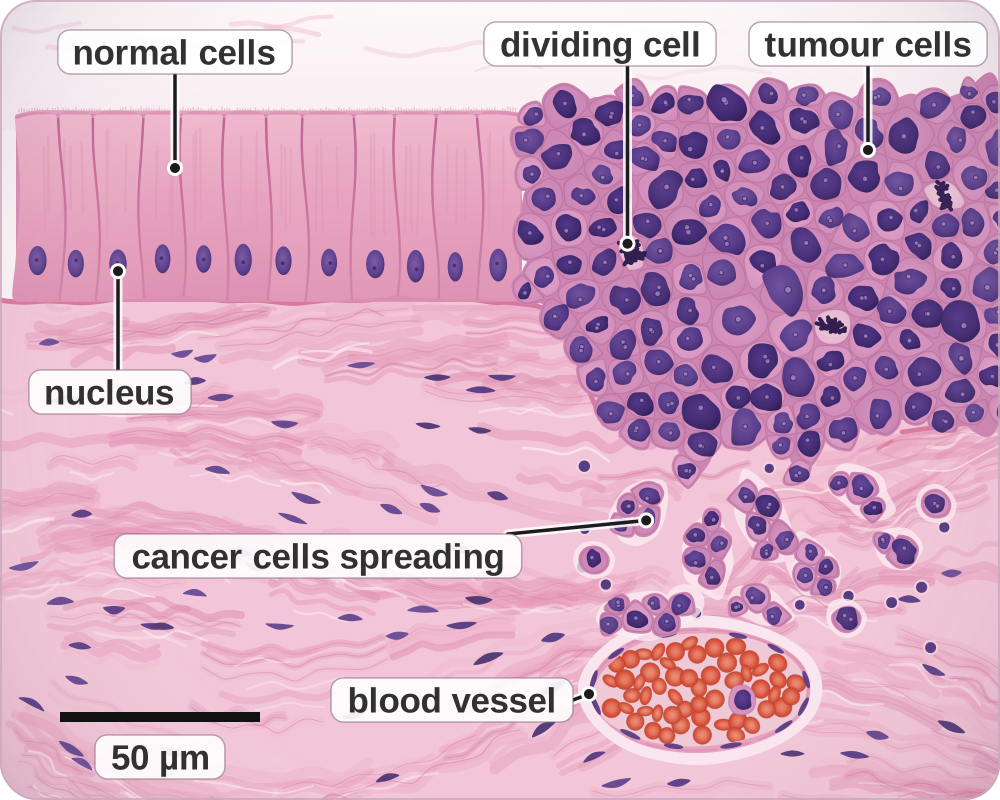
Cancer: cells out of control
- Cancer is the result of changes in cells that lead to uncontrolled growth and division.
- The extra cells pile up into a lump called a tumour.
- Cancer is non-communicable: you cannot catch it from another person.
Normal tissue on the left. A tumour on the right.
Screen 3
Real tissue and a diagram
- A real section is a thin slice of tissue, stained and seen through a microscope.
- A diagram is simplified, so you can see the main idea: crowded tumour cells beside normal cells.
- In the diagram, darker cells = tumour cells.
Tap a difference to see it on both pictures.
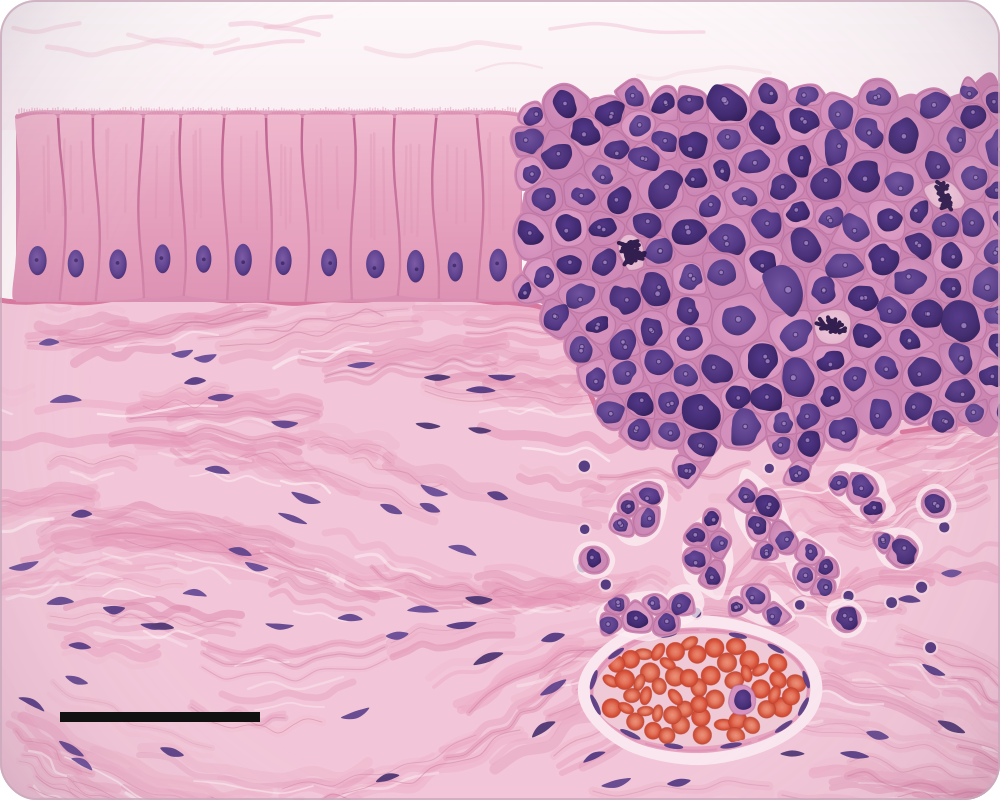
Real tissue (a painting)
normal ← | → tumour
A diagram
normal ← | → tumour
Screen 4
Benign and malignant tumours
- A benign tumour stays in one area, usually inside a membrane. It is not cancer.
- A malignant tumour is a cancer. Its cells invade the tissue around it.
- Cancer cells spread in the blood and form secondary tumours.
Screen 5
Checkpoint 1 of 3
Quick check on screens 1 to 4. Tap an answer.
1.What is health?
2.Which statement about cancer is correct?
3.Which describes a benign tumour?
Screen 6
Diseases can interact
- Different types of disease can interact: one health problem can make another more likely.
- Physical and mental health are linked.
Screen 7
Risk factors raise the chance
- A risk factor is linked to an increased rate of a disease.
- It can be part of a person's lifestyle, or a substance in the body or the environment.
- A risk factor raises the chance. It does not mean the person will get the disease.
Different people, same numbers. You cannot tell which person will get the disease.
Screen 8
Checkpoint 2 of 3
Quick check on screens 6 and 7. Tap an answer.
1.Which of these is an example of two types of disease interacting?
2.What is a risk factor?
3.In a study, 12 out of 100 people with a risk factor got a disease. 4 out of 100 people without it got the disease. What does this show?
Screen 9
Lifestyle and disease
- Smoking, diet, exercise and alcohol are lifestyle risk factors. Obesity is a risk factor for Type 2 diabetes.
- Carcinogens, including ionising radiation, are risk factors for cancer.
- Many diseases are caused by several factors acting together.
Tap a risk factor to see the parts of the body it affects.
Screen 10
Correlation and cause
- A correlation is a link: as one variable changes, the other changes too.
- A correlation alone does not prove that one thing causes the other.
- To prove cause, scientists need a causal mechanism: how the factor causes the disease.
Screen 11
Health data and samples
- Scientists study a sample: a group chosen to represent everyone.
- A good sample is large and chosen at random.
- To compare groups of different sizes, use percentages, not the number of cases.
| School | Number of students | Number with asthma | Percentage with asthma |
|---|---|---|---|
| A | 1200 | 96 | 8 % |
| B | 600 | 60 | 10 % |
Try it: work out a percentage
School A has more students with asthma: 96, not 60.
percentage = number with the disease ÷ number in the sample × 100. School B: 60 ÷ 600 × 100 = 10 %.
Screen 12
The cost of disease
- Non-communicable diseases have human costs (pain, worry, and they can shorten a life) and financial costs (money).
- The costs reach the person, their family and community, the country and the world.
- Lifestyle changes across a whole country change how common these diseases are.
Human cost:
Financial cost:
Screen 13
Checkpoint 3 of 3
Quick check on screens 9 to 12. Tap an answer.
1.Obesity is a risk factor for which disease?
2.On days when more ice creams are sold, more people get sunburn. What can you conclude?
3.Why do scientists use a large sample in a health study?
Quiz
Quiz: B2 L11 Health, risk factors and cancer
10 questions. Tap an answer. Your first answer counts towards your score.
Which of these is a non-communicable disease?
In the painting of tumour tissue, why are the cells pink and purple?
How do cells from a malignant tumour reach other parts of the body?
What is a secondary tumour?
A person's immune system does not work properly. What is more likely to happen?
Which risk factor is a substance in the environment, not part of a person's lifestyle?
Which organs can drinking a lot of alcohol damage?
A scatter graph shows that as the number of cigarettes smoked per day goes up, the lung cancer rate goes up. Which statement is correct?
In a sample of 400 people, 36 have asthma. What percentage of the sample have asthma?
Which of these is a financial cost of a non-communicable disease to the country?
Exam questions
The same five questions as the B2 L11 Exam questions worksheet. 20 marks.
Write your answer, then open the mark scheme and tick each point you made.
01Figure 1 shows two tumours, A and B, in a tissue.
01.1Complete Figure 1.
Choose answers from the box.
01.2Tumour B is malignant.
Which statement describes tumour B?
Tick (✓) one box.
Mark scheme
- (1)
- (1)
- (1)
- (1)
01.1: 1 mark for each correct label. If more than one word from the box is written on one line, do not give that mark.
Model answer01.1 1 membrane; 2 normal cells; 3 blood vessel. 01.2 Its cells can spread in the blood to other parts of the body.
02Scientists studied 2000 adults to find out if smoking is linked to lung disease.
Table 1 shows the results.
| Group | Number of people in the group | Number of people with lung disease |
|---|---|---|
| People who have never smoked | 1200 | 30 |
| People who smoke | 800 | 88 |
02.1Calculate the percentage of people who smoke who have lung disease.
Use the equation:
percentage = (number with lung disease ÷ number in the group) × 100
02.22.5 % of the people who have never smoked have lung disease.
The scientists compared percentages, not the number of people with lung disease.
Explain why.
02.3Which conclusion is supported by the data in Table 1?
Tick (✓) one box.
02.4Tobacco smoke contains substances that increase the risk of lung cancer.
Give the name for substances that increase the risk of cancer.
Mark scheme
- (1)
- (1)
- (1)
- (1)
- (1)
02.1: correct answer with no working = 2 marks. Allow 0.11 × 100 for the first mark.
02.2: allow "the groups were different sizes" / "more people had never smoked". ignore "to make it fair" or "to make it accurate" with no reference to the group sizes.
02.4: allow "carcinogenic substances". do not accept "nicotine". do not accept "tar" (tar contains carcinogens, but it is not the name for them).
Model answer02.1 88 ÷ 800 × 100 = 11 %. 02.2 The two groups had different numbers of people, so the percentages give a fair comparison. 02.3 Smoking increases the risk of lung disease. 02.4 Carcinogens.
03Different types of disease can interact.
Give two examples of how different types of disease interact.
Mark scheme
- (1)
- (1)
- (1)
- (1)
any two. allow named examples, e.g. "HPV can trigger cervical cancer" (1). do not accept "one disease leads to another" with no example.
Model answerDefects in the immune system make infectious diseases more likely. Severe physical ill health can lead to depression.
04Scientists collected data from 10 towns.
Figure 2 shows the mean time people spent exercising each week and the rate of cardiovascular disease in each town.
04.1Describe the correlation shown in Figure 2.
04.2A newspaper says:
'Figure 2 proves that exercise prevents cardiovascular disease.'
Explain why the newspaper is not correct.
Mark scheme
- (1)
- (1)
- (1)
- (1)
- (1)
04.1: allow "the more exercise, the fewer cases". do not accept "positive".
04.2: any two, max 2. allow "a third factor could cause both" (1). ignore "the newspaper is lying".
Model answer04.1 A negative correlation: the more time people spend exercising, the lower the rate of cardiovascular disease. 04.2 A correlation does not prove that exercise causes the lower rate. Other factors, such as diet or smoking, could be different in each town.
05Many non-communicable diseases are linked to lifestyle.
Explain how a person could change their lifestyle to reduce their risk of non-communicable diseases.
Mark scheme
Level of response. Read your answer, choose the level that fits best, then pick your mark.
| Level | Marks | Descriptor |
|---|---|---|
| 3 | 5–6 | A detailed and coherent explanation. At least three lifestyle changes are each clearly linked to a named non-communicable disease whose risk they reduce, with a reason, for example: stop smoking → no carcinogens from smoke in the lungs → lower risk of lung cancer. |
| 2 | 3–4 | Several relevant lifestyle changes are given and at least two are linked to a named disease. Reasons may be missing or incomplete. |
| 1 | 1–2 | Simple statements of lifestyle changes, such as "eat healthily" or "do more exercise", with little or no link to a disease. |
| 0 | 0 | No relevant content. |
Indicative content
- stop smoking / do not start smoking: lowers the risk of lung disease and lung cancer (fewer carcinogens and less tar in the lungs) and of cardiovascular disease (less damage to blood vessels)
- not smoking in pregnancy: more oxygen reaches the baby; lowers the risk of the baby being born early or small
- eat a balanced diet with less saturated fat and salt: lower blood cholesterol and blood pressure, so a lower risk of cardiovascular disease
- exercise regularly: lowers the risk of cardiovascular disease; helps keep a healthy body mass
- keep a healthy body mass / avoid obesity: lowers the risk of Type 2 diabetes
- drink less alcohol: lowers the risk of liver damage and of damage to brain function; no alcohol in pregnancy protects the baby's development
- avoid carcinogens: use sunscreen, shade and clothing, avoid sunbeds (UV light); avoid unnecessary exposure to ionising radiation; this lowers the risk of cancer
- these changes reduce the risk; they do not remove it, because there are also genetic risk factors and many factors act together
Your mark:
Model answer (Level 3)The person could stop smoking. Tobacco smoke contains carcinogens, so stopping lowers the risk of lung cancer, and it also lowers the risk of lung disease and cardiovascular disease. They could eat a balanced diet with less saturated fat and salt, which lowers blood cholesterol and blood pressure and so the risk of cardiovascular disease. Exercising regularly also lowers the risk of cardiovascular disease and helps them keep a healthy body mass, which lowers the risk of Type 2 diabetes, because obesity is a risk factor for it. Drinking less alcohol lowers the risk of liver damage and of harm to brain function. Using sunscreen and avoiding sunbeds reduces exposure to UV light, a carcinogen, so it lowers the risk of skin cancer. These changes reduce the risk but cannot remove it completely.
Total: 0 out of 20
Printable copy: the B2 L11 Exam questions worksheet and its mark scheme (PDF) are in .