Screen 1 of 12
Welcome back
Screen 1
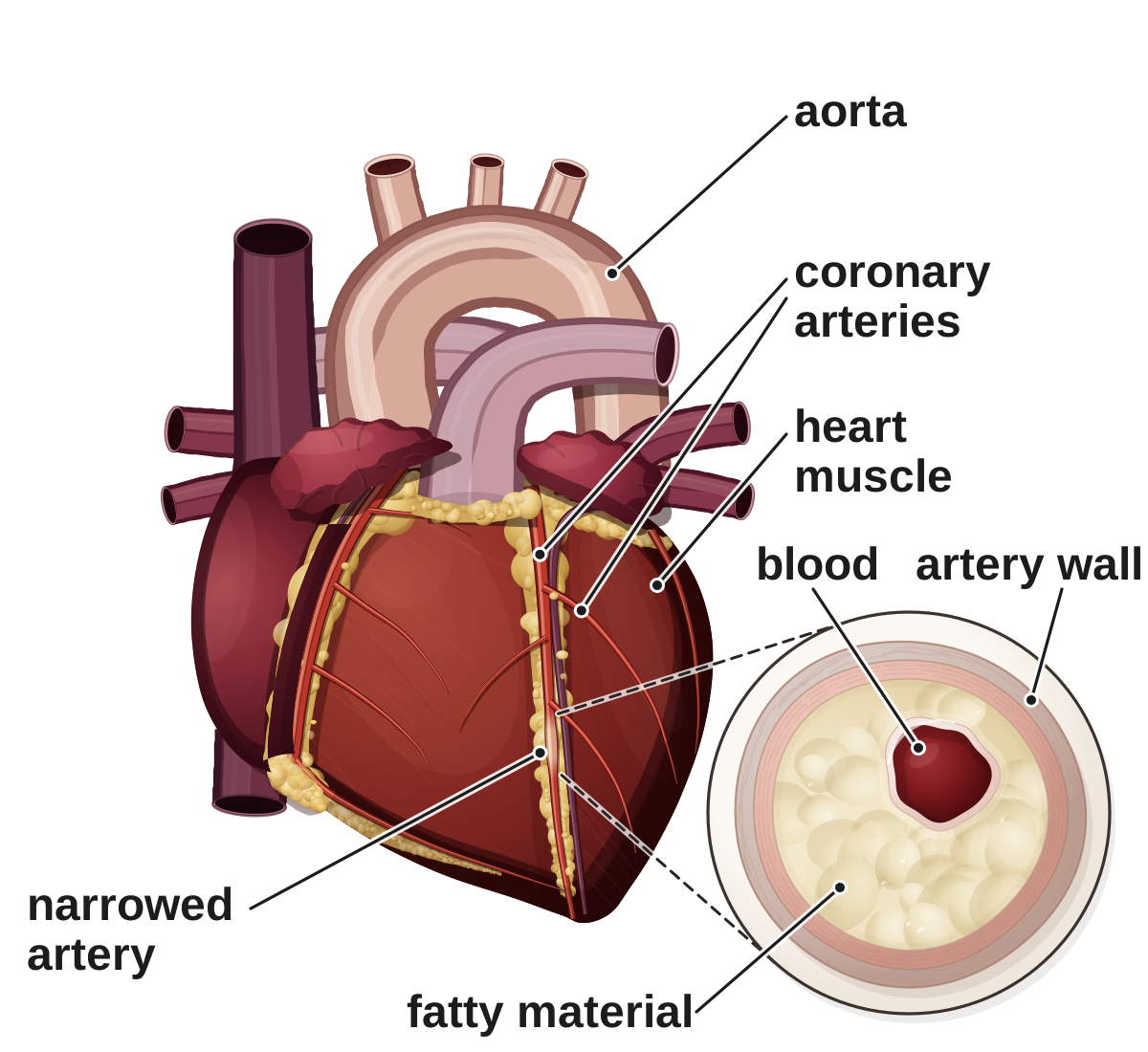
Coronary heart disease
- Coronary heart disease is a non-communicable disease: you cannot catch it from another person.
- Layers of fatty material build up inside the coronary arteries, narrowing them.
- Less blood flows through, so the heart muscle gets less oxygen. Heart muscle cells need oxygen for respiration, which releases the energy for contraction.
Screen 2
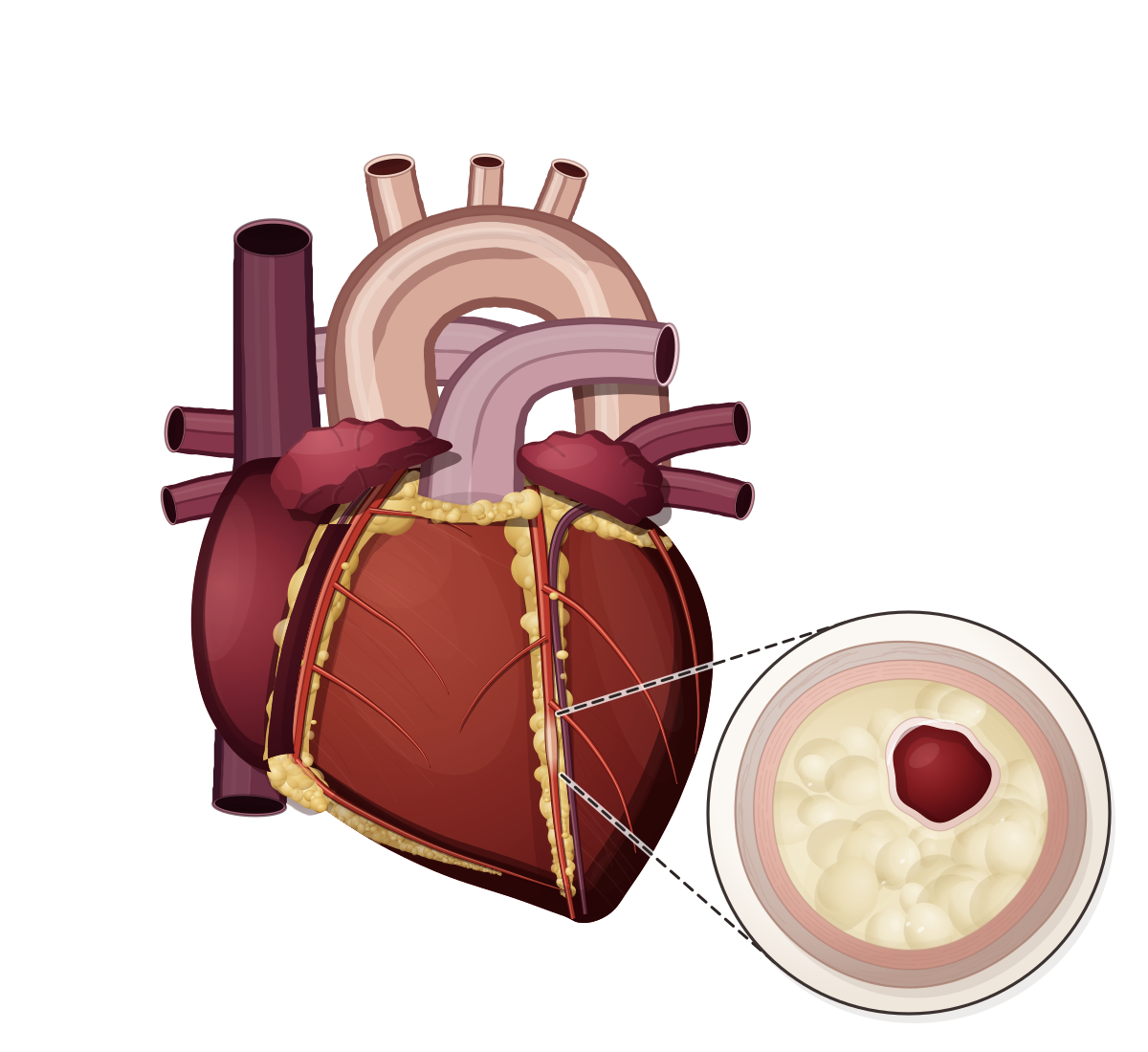
A real narrowed artery and a diagram
- From the outside, a real narrowed artery looks almost normal. The fatty material is inside its wall.
- A diagram is simplified on purpose, and its colours are not real.
Tap a difference to see it on both pictures.
A real narrowed artery
fatty material: inside the artery wall
A diagram
fatty material: inside the artery wall
Screen 3
How an artery narrows
- Fatty material builds up inside the artery wall slowly, over many years.
- The space for blood gets narrower, so less blood reaches the heart muscle.
- A blood clot can block a narrowed artery completely.
Screen 4
Stents: holding an artery open
- A stent is a small mesh tube that holds a narrowed artery open.
- It is carried into place on a tiny balloon, inside a thin tube.
- Blood flows freely again, so the heart muscle gets enough oxygen.
Screen 5
Checkpoint 1 of 3
Quick check on screens 1 to 4. Tap an answer.
1.In coronary heart disease, where does the fatty material build up?
2.Why does a narrowed coronary artery harm the heart muscle?
3.What does a stent do?
Screen 6
Statins: slowing the build-up
- Cholesterol is a fatty substance carried in the blood. A high level speeds up the build-up of fatty material.
- Statins are drugs that lower blood cholesterol, so fatty material builds up more slowly.
- Statins do not remove fatty material that is already there. They are usually taken every day, for life.
With a statin, there is less cholesterol in the blood, so fatty material builds up more slowly. It does not go away.
Screen 7
Statins: what the data show
- Doctors measured blood cholesterol in two groups for 12 months. One group took a statin every day.
- In the statin group, cholesterol fell in the first few months, then stayed lower.
- percentage decrease = fall ÷ starting value × 100
Tap a line on the chart, or Show the fall.
| Group | At the start | After 12 months | Fall |
|---|---|---|---|
| Taking a statin | 6.5 | 5.2 | 1.3 |
| No statin | 6.5 | 6.5 | 0 |
Taking a statin: 1.3 ÷ 6.5 × 100 = 20 % lower.
Example data, spread out so the pattern is easy to see. Real statins lower cholesterol within a few weeks.
Screen 8
Stent or statin?
- Doctors weigh up the advantages and disadvantages of each treatment with the patient.
- A stent works straight away, but only in one place. Statins work slowly, but in all the arteries.
- Many people have both: a stent to open the artery now, and statins to slow more build-up.
Tap a row to compare a stent and statins.
| Stent | Statins | |
|---|---|---|
| What it does | Holds one narrowed artery open. | Lower blood cholesterol, so fatty material builds up more slowly in all the arteries. |
| How fast | + advantageWorks straight away. | − disadvantageTake a few weeks to start lowering cholesterol. |
| How it is given | − disadvantageNeeds a small operation. | − disadvantageA tablet every day, usually for life. |
| Risks | − disadvantageBleeding or infection. A blood clot can form in the stent, and the artery can narrow again. | − disadvantageSide effects in some people, such as headaches or muscle aches. |
| Benefits | + advantageMore blood reaches the heart muscle at once. Less chest pain. | + advantageNo operation. A lower risk of a heart attack. |
Many people have both: a stent to open the artery now, and statins to slow more build-up.
Screen 9
Checkpoint 2 of 3
Quick check on screens 6 to 8. Tap an answer.
1.What do statins do?
2.In the 12-month study, what happened to the blood cholesterol of the group taking a statin?
3.Which is an advantage of a stent compared with statins?
Screen 10
Faulty valves and new valves
- Valves stop blood flowing backwards. A faulty valve may be stiff, so it does not open fully, or it may leak, so blood flows backwards.
- Either way the heart has to work harder, and the person may feel tired and short of breath.
- A faulty valve can be replaced with a biological valve (from a pig, a cow or a human donor) or a mechanical valve (made from strong artificial materials).
- Biological valves can wear out. Mechanical valves last for life, but the person takes anti-clotting drugs for life.
A healthy valve opens wide to let blood through, then shuts tight so none flows back.
Screen 11
Heart failure: transplants and artificial hearts
- In heart failure, the heart cannot pump enough blood round the body.
- A donor heart, or a heart and lungs, can be transplanted. The person takes drugs every day for life to stop rejection.
- An artificial heart can keep a person alive while they wait for a transplant, or let their own heart rest and recover.
- There are not enough donor hearts for everyone who needs one. In England, adults are considered to agree to donate their organs when they die, unless they opt out. Some people support this; others feel it should be an active choice.
Screen 12
Checkpoint 3 of 3
Quick check on screens 10 and 11. Tap an answer.
1.A heart valve does not close fully. What happens?
2.Why must a person with a mechanical valve take anti-clotting drugs for life?
3.When is an artificial heart used?
Quiz
Quiz: B2 L10 Coronary heart disease and treatment
10 questions. Tap an answer. Your first answer counts towards your score.
Why is coronary heart disease a non-communicable disease?
Which of these is true of a real narrowed artery, but NOT of the diagram?
A student says: "Fat floating in the blood blocks the coronary artery." What is the correct idea?
Why can a person with narrowed coronary arteries get chest pain during exercise?
A person has taken statins for five years. What have the statins done?
A person's blood cholesterol falls from 8.0 to 6.0 mmol per litre. What is the percentage decrease?
Why do many people have a stent fitted and also take statins?
A heart valve is stiff and does not open fully. What happens?
Which is correct about replacement heart valves?
Why can't everyone who needs a heart transplant have one straight away?
Exam questions
The same five questions as the B2 L10 Exam questions worksheet. 20 marks.
Write your answer, then open the mark scheme and tick each point you made.
01Coronary heart disease affects the coronary arteries.
01.1Which statement about coronary heart disease is correct?
Tick (✓) one box.
01.2Figure 1 shows two coronary arteries, cut across.
Artery A is healthy. Artery B is from a person with coronary heart disease.
Complete Figure 1.
Choose answers from the box.
01.3Describe how artery B is different from artery A.
Mark scheme
- (1)
- (1)
- (1)
- (1)
- (1)
01.2: if more than one word from the box is written on one line, do not give that mark. 01.3: allow "the artery is narrower" for the second mark. allow "the wall is thicker" for the first mark. do not accept "fat in the blood" / "the blood has become fatty" / "a blood clot" for the first mark.
Model answer01.1 It is a non-communicable disease. 01.2 1 artery wall; 2 fatty material. 01.3 In B, fatty material has built up inside the artery wall, so the space for blood is much narrower than in A.
02A doctor measured a patient's blood cholesterol.
The patient then took a statin every day for 6 months.
The doctor measured the patient's blood cholesterol again.
Table 1 shows the results.
| Blood cholesterol in mmol per litre | |
|---|---|
| Before taking the statin | 7.5 |
| After 6 months of taking the statin | 4.5 |
02.1Calculate the percentage decrease in the patient's blood cholesterol.
Use the equation:
percentage decrease = fall ÷ starting value × 100
02.2Explain how taking a statin can slow down the narrowing of the coronary arteries.
Mark scheme
- (1)
- (1)
- (1)
- (1)
02.1: correct answer with no working = 2 marks. allow 3 ÷ 7.5 × 100. do not accept 3.0 ÷ 4.5 × 100 = 67 % (0 marks). 02.2: allow "slows down the rate of fatty material deposit". do not accept "removes / dissolves / clears / unblocks the fatty material" for the second mark. ignore "lowers the fat in the blood".
Model answer02.1 Fall = 7.5 − 4.5 = 3.0. 3.0 ÷ 7.5 × 100 = 40 %. 02.2 The statin lowers the cholesterol in the blood, so fatty material builds up in the artery walls more slowly.
03A patient had chest pain when walking quickly.
A doctor found that one of the patient's coronary arteries was narrowed.
The doctor fitted a stent.
Figure 2 shows the stent in the artery.
Explain how the stent helps the patient's heart muscle.
Mark scheme
- (1)
- (1)
- (1)
do not accept "the stent removes / clears the fatty material" for the first mark. do not accept "energy is made / produced / created" (that point scores 0; others can still score). ignore "it stops a heart attack".
Model answerThe stent holds the narrowed artery open. More blood can flow through it to the heart muscle, so the muscle cells get more oxygen for respiration, releasing the energy they need to contract.
04A patient has a faulty heart valve.
The valve can be replaced with a mechanical valve or with a biological valve.
Give one advantage and one disadvantage of a mechanical valve compared with a biological valve.
Mark scheme
- (1)
- (1)
do not accept "it wears out" as a disadvantage. do not accept "it is rejected". ignore "it needs an operation" (both kinds need one). ignore "it is made from carbon and metal" on its own.
Model answerAdvantage: a mechanical valve lasts for life. Disadvantage: the patient must take anti-clotting drugs every day for life.
05A man has coronary heart disease. One of his coronary arteries is badly narrowed.
His doctor says he could have a stent fitted, or he could take statins.
Evaluate the use of a stent and the use of statins to treat this man.
Mark scheme
Level of response. Read your answer, choose the level that fits best, then pick your mark.
| Level | Marks | Descriptor |
|---|---|---|
| 3 | 5–6 | A detailed and coherent evaluation. Advantages and disadvantages of both treatments are given and compared, and there is a conclusion with a reason linked to this man (his artery is badly narrowed). |
| 2 | 3–4 | Some advantages and disadvantages of both treatments, or a detailed account of one. A conclusion may be given but is not supported by a reason. |
| 1 | 1–2 | Simple statements about a stent or statins, for example "a stent opens the artery" or "statins are tablets". Little or no comparison and no conclusion. |
| 0 | 0 | No relevant content. |
Indicative content
- stent: holds the narrowed artery open / works straight away
- stent: more blood and oxygen reach the heart muscle at once, so less chest pain
- stent: needs a (small) operation, with risks such as bleeding or infection
- stent: a blood clot can form in the stent / the artery can narrow again
- stent: does not remove fatty material or stop it building up elsewhere / only treats one place
- statins: no operation; a tablet
- statins: lower blood cholesterol, so fatty material builds up more slowly, in all the arteries
- statins: lower the risk of a heart attack in the future
- statins: take weeks to work / do not open an artery that is already badly narrowed
- statins: do not remove fatty material that is already there
- statins: must be taken every day, usually for life / people may forget
- statins: side effects in some people, such as headaches or muscle aches
- conclusion, for example: a stent, because his artery is badly narrowed and needs opening now; or both, a stent now and statins to slow more build-up
Your mark:
Model answer (Level 3)A stent would hold his badly narrowed artery open straight away, so more blood and oxygen would reach his heart muscle and his chest pain would ease. But it needs a small operation, with a risk of bleeding or infection, a blood clot can form in the stent, and it does not stop fatty material building up in other places. Statins need no operation. They lower his blood cholesterol, so fatty material builds up more slowly in all his arteries. But they take weeks to work, they do not remove fatty material that is already there, so they cannot open his narrowed artery, and he would have to take them every day for life, with possible side effects. Because his artery is already badly narrowed, I think he should have a stent, and also take statins to slow down more build-up.
Total: 0 out of 20
Printable copy: the B2 L10 Exam questions worksheet and its mark scheme (PDF) are in .