Screen 1 of 12
Welcome back
Screen 1
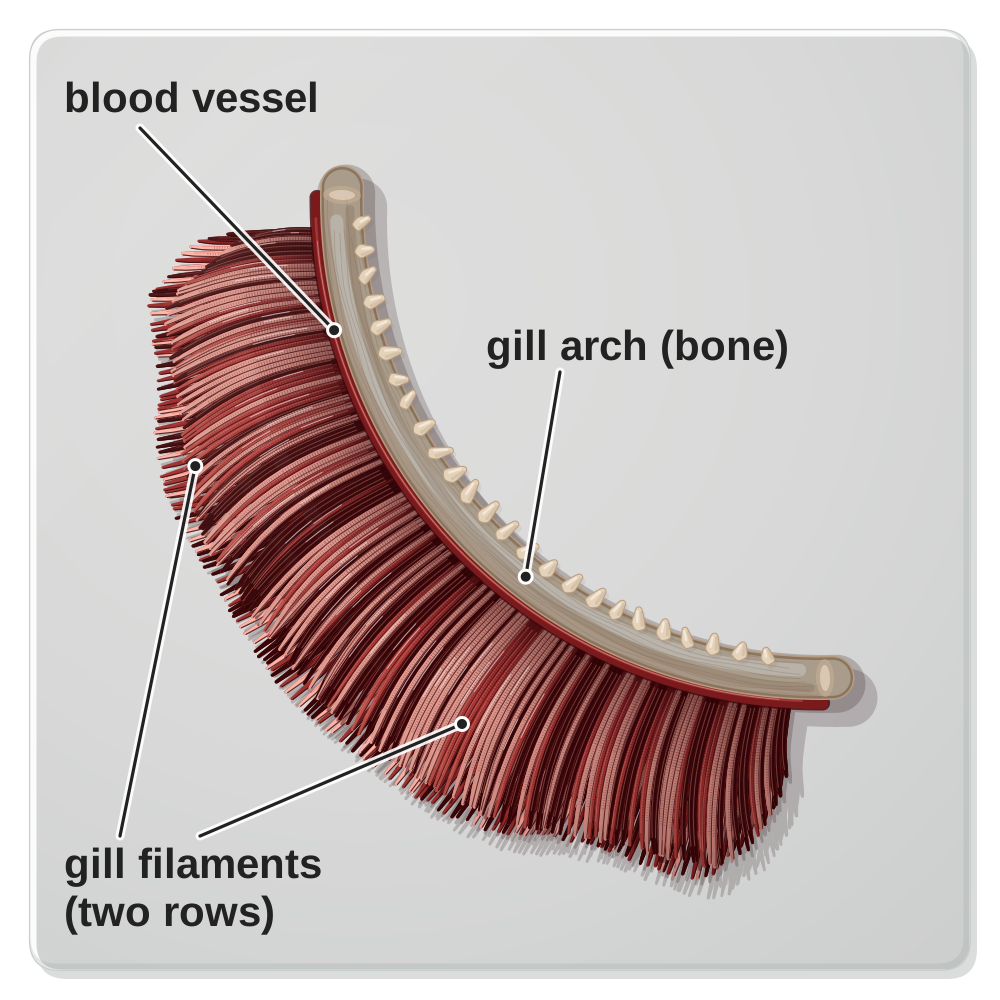
A fish gill: an exchange surface
- A fish takes in oxygen from the water through its gills. Gills are an exchange surface.
- Each gill has a curved, bony gill arch that holds two rows of thin, feathery gill filaments.
- The filaments give a huge surface area. Real gills are deep red because they are full of blood.
Screen 2
A real gill and a diagram
- A real gill has hundreds of deep red filaments, in two rows.
- A diagram is simplified on purpose: it shows a few filaments and draws the tiny plates much bigger.
- Real gills are deep red because they are full of blood. The diagram is simplified.
Tap a difference to see it on both pictures.
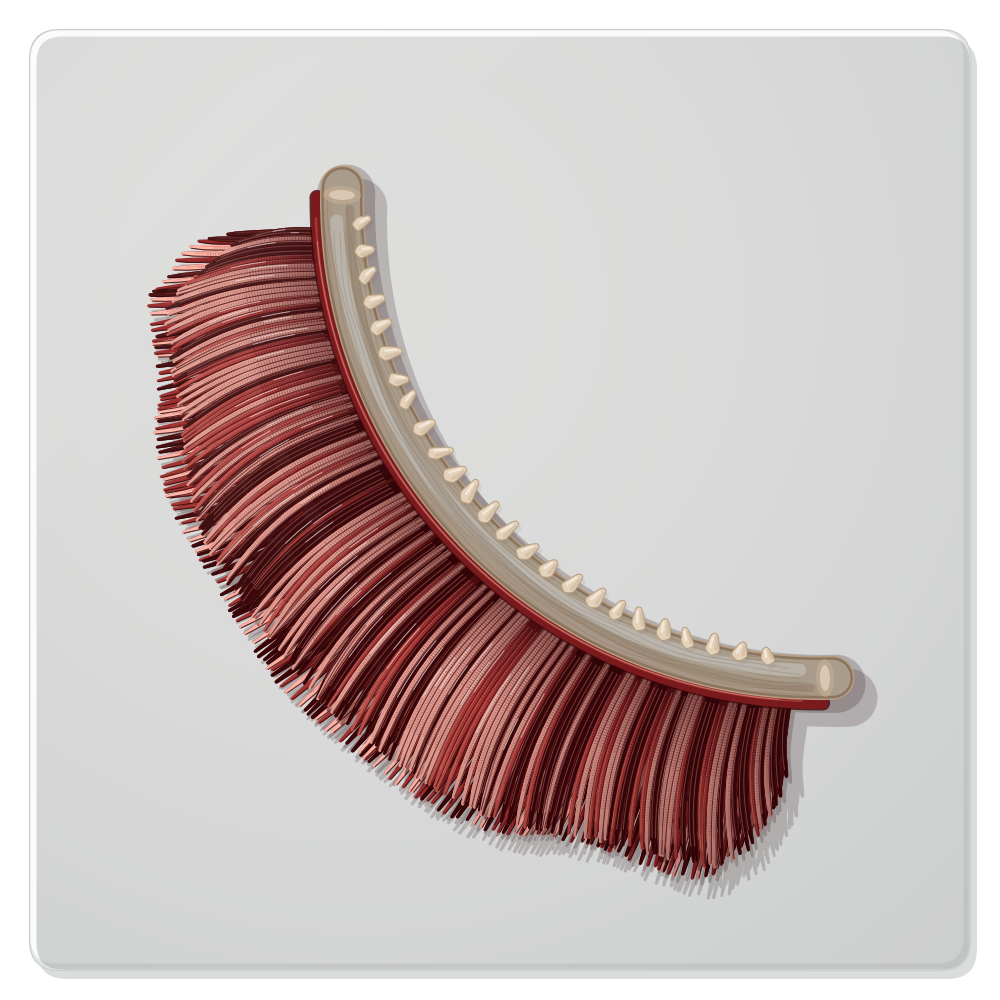
A real gill
bony arch + thin filaments
A diagram
bony arch + thin filaments
Screen 3
Active transport: against the gradient
- Active transport moves substances from a more dilute solution to a more concentrated solution: against a concentration gradient.
- It needs energy from respiration. Diffusion and osmosis do not.
- Root hair cells use it to take in mineral ions, such as nitrate, from the soil.
Mineral ions in the soil water: low
Mineral ions in the cell: high16
Screen 4
Active transport in the gut
- Just after a meal, there is lots of sugar (glucose) in the gut. It diffuses into the blood.
- Later, the gut has less sugar than the blood. Active transport keeps moving sugar into the blood.
- The blood carries the sugar to the body's cells, where it is used for respiration.
Just after a meal, the gut has more sugar than the blood. Sugar diffuses into the blood, from a higher to a lower concentration. No energy is needed.
Sugar in the gut: high · Sugar in the blood: low
The wall of the small intestine is folded into villi (B2 L2 The digestive system).
Screen 5
Checkpoint 1 of 3
Quick check on screens 1 to 4. Tap an answer.
1.Why are real fish gills deep red?
2.Which of these describes active transport?
3.Some hours after a meal, the gut has less sugar than the blood. How is sugar still absorbed into the blood?
Screen 6
Diffusion, osmosis and active transport
- Diffusion: particles move from a higher to a lower concentration. No energy is needed.
- Osmosis: water moves from a dilute solution to a more concentrated solution, through a partially permeable membrane. No energy is needed.
- Active transport: substances move from a lower to a higher concentration. It needs energy from respiration.
Only active transport moves substances against a concentration gradient and needs energy. In osmosis, water moves. In active transport, a dissolved substance moves.
| Diffusion | Osmosis | Active transport | |
|---|---|---|---|
| What moves | particles of a gas or a dissolved substance | water only | substances such as mineral ions and sugar |
| Which way | higher → lower concentration | dilute → more concentrated solution | lower → higher concentration (against the gradient) |
| Energy from respiration? | no | no | yes |
| Membrane | not always needed (in cells: the cell membrane) | partially permeable | a cell membrane |
| Example | oxygen into the blood in the gills | water into a root hair cell | mineral ions into a root hair cell |
Screen 7
Surface area to volume ratio
- Surface area is the total area of the outside of an object, in cm². Volume is the space inside it, in cm³.
- The surface area to volume ratio compares them. Simplify it to "something : 1".
- As a cube gets bigger, its surface area to volume ratio gets smaller.
Try it: a cube calculator
Surface area = 6 × side × side = 6 × 1 × 1 = 6 cm²
Volume = side × side × side = 1 × 1 × 1 = 1 cm³
Surface area : volume = 6 : 1
Check: for any cube, R = 6 ÷ side. 6 ÷ 1 = 6.
For example: a 3 cm cube has 54 cm² of surface and 27 cm³ of volume. 54 : 27 = 2 : 1.
Screen 8
Checkpoint 2 of 3
Quick check on screens 6 and 7. Tap an answer.
1.Which of these needs energy from respiration?
2.A cuboid has a surface area of 40 cm² and a volume of 16 cm³. What is its surface area to volume ratio?
3.A cube gets bigger. What happens to its surface area to volume ratio?
Screen 9
Why big organisms need exchange surfaces
- A single-celled organism has a large surface area to volume ratio. Diffusion across its surface meets its needs.
- A multicellular organism has a smaller ratio, and most of its cells are far from the surface.
- So it needs exchange surfaces to take substances in, and a transport system to carry them to every cell.
Surface area to volume ratio: large
Screen 10
Gills: built for exchange
- Many thin gill filaments, each covered in tiny plates, give a large surface area.
- The plates are thin, so oxygen has a short diffusion path into the blood.
- A good blood supply carries oxygen away, and water flowing over the gills brings more. Both keep the concentration gradient steep.
Hundreds of filaments × many tiny plates on each = a huge surface area.
Screen 11
Exchange surfaces in animals and plants
- Every exchange surface has a large surface area and a short diffusion path.
- In animals there is also an efficient blood supply, and gas exchange surfaces are ventilated.
- Plants have no blood. Root hair cells give a large surface area; leaves are flat and thin, with stomata and air spaces.
Gills (fish): oxygen in, carbon dioxide out. Many thin filaments covered in tiny plates, a good blood supply, and water flowing over them.
Every exchange surface has a large surface area and a short diffusion path.
Screen 12
Checkpoint 3 of 3
Quick check on screens 9 to 11. Tap an answer.
1.Why does a single-celled organism not need an exchange surface such as gills?
2.How does water flowing over a fish's gills help the fish take in oxygen?
3.Which feature helps a leaf to exchange gases?
Quiz
Quiz: B1 L10 Active transport and exchange surfaces
10 questions. Tap an answer. Your first answer counts towards your score.
What is an exchange surface?
Which of these is true of a real gill, but NOT of a diagram of a gill?
The water in the soil has very few mineral ions. How do mineral ions get into a root hair cell?
Why do root hair cells have many mitochondria?
Which of these is true of osmosis, but NOT of active transport?
A cube has sides of 10 cm. Its surface area is 600 cm² and its volume is 1000 cm³. What is its surface area to volume ratio?
Why does a large animal need a transport system?
Which of these is NOT a feature of an effective exchange surface?
Which exchange surface takes in water and mineral ions from the soil?
Villi in the small intestine have a good blood supply. How does this help?
Exam questions
The same five questions as the B1 L10 Exam questions worksheet. 20 marks.
Write your answer, then open the mark scheme and tick each point you made.
01Figure 1 shows a diagram of part of a fish gill.
01.1Complete Figure 1.
Choose answers from the box.
01.2Which feature of the gill filaments gives them a large surface area?
Tick (✓) one box.
Mark scheme
- (1)
- (1)
- (1)
- (1)
01.1: 1 mark for each correct label. allow capillary for line 3. If more than one word from the box is written on one line, do not give that mark. 01.2: If more than one box is ticked, 0 marks.
Model answer01.1 1 gill arch; 2 gill filament; 3 blood vessel. 01.2 They are covered in tiny plates.
02A teacher made a model to show how size affects diffusion.
She cut three cubes of agar jelly of different sizes, shown in Figure 2. The jelly contained an indicator that is pink in alkali and colourless in acid.
She put the cubes in acid and timed how long each cube took to become colourless all the way through.
Table 1 shows the results.
| Side of cube in cm | Surface area in cm² | Volume in cm³ | Surface area : volume | Time to become colourless in minutes |
|---|---|---|---|---|
| 0.5 | X | 0.125 | Y | 1.5 |
| 1 | 6 | 1 | 6 : 1 | 6 |
| 2 | 24 | 8 | 3 : 1 | 23 |
02.1Calculate the surface area X of the 0.5 cm cube.
Use the equation:
surface area of a cube = 6 × side × side
02.2Calculate the surface area to volume ratio Y of the 0.5 cm cube.
Give your answer in the form ___ : 1
02.3Describe the pattern in Table 1.
02.4The cubes are a model of organisms of different sizes.
Use Table 1 to suggest why a large organism needs exchange surfaces and a transport system.
Mark scheme
- (1)
- (1)
- (1)
- (1)
- (1)
- (1)
02.1: Correct answer with no working = 2 marks. 02.2: allow their 02.1 answer ÷ 0.125, written as ___ : 1. do not accept 1 : 12. 02.3: allow "the smaller the surface area to volume ratio, the longer it takes". "it takes longer" alone = 0: the answer must link size or ratio to time. 02.4: allow data used for the first mark, for example "the 2 cm cube took about 4 times as long as the 1 cm cube".
Model answer02.1 6 × 0.5 × 0.5 = 1.5 cm². 02.2 1.5 : 0.125 = 12 : 1. 02.3 The bigger the cube, the longer it takes to become colourless. 02.4 Bigger cubes have a smaller surface area to volume ratio and take much longer for the acid to diffuse to the middle. So a large organism needs exchange surfaces to take in enough, and a transport system to carry substances to every cell.
03Root hair cells take in nitrate ions from the soil.
Table 2 shows the concentration of nitrate ions in the soil water and in a root hair cell.
| Where | Concentration of nitrate ions in arbitrary units |
|---|---|
| soil water | 0.5 |
| root hair cell | 25 |
Explain why the root hair cell must use active transport to take in nitrate ions.
Use data from Table 2.
Mark scheme
- (1)
- (1)
the first mark needs data or a comparison from Table 2. allow "diffusion would move nitrate ions out of the cell" for the second mark. do not accept "energy is made / produced".
Model answerThe concentration of nitrate ions is higher in the root hair cell (25) than in the soil water (0.5). So the ions must be moved against the concentration gradient, and this needs energy from respiration.
04Table 3 shows three exchange surfaces.
Complete Table 3.
Tick (✓) the features that each exchange surface has.
The first row has been done for you.
| Exchange surface | Large surface area | Efficient blood supply | Ventilated |
|---|---|---|---|
| Alveoli in the lungs (done for you) | |||
| Villi in the small intestine | |||
| A leaf |
Mark scheme
- (1)
- (1)
each row must be fully correct for its mark.
Model answervilli: large surface area and efficient blood supply; leaf: large surface area only.
05Diffusion, osmosis and active transport are three ways that substances move into and out of cells.
Compare diffusion, osmosis and active transport.
Mark scheme
Level of response. Read your answer, choose the level that fits best, then pick your mark.
| Level | Marks | Descriptor |
|---|---|---|
| 3 | 5–6 | A detailed and coherent comparison of all three processes. What moves, which way it moves (relative to the concentration gradient) and whether energy is needed are given for each, with clear similarities and differences, and examples. |
| 2 | 3–4 | A comparison of at least two of the processes, with some similarities or differences correctly stated. There may be an omission or one error. |
| 1 | 1–2 | Simple statements about one or more of the processes, with little or no comparison. |
| 0 | 0 | No relevant content. |
Indicative content
- all three move substances into or out of cells / across membranes
- diffusion: the net movement of particles from a higher to a lower concentration / down a concentration gradient
- diffusion happens in gases and in solutions; example: oxygen into the blood / carbon dioxide out of a respiring cell
- osmosis: the movement of water only
- osmosis: from a dilute solution to a more concentrated solution, through a partially permeable membrane
- osmosis is the diffusion of water
- in osmosis, water moves; in active transport, a dissolved substance (such as mineral ions or sugar) moves
- example of osmosis: water into a root hair cell
- active transport: from a more dilute to a more concentrated solution / from a lower to a higher concentration / against a concentration gradient
- active transport needs energy from respiration; diffusion and osmosis do not
- examples of active transport: mineral ions into root hair cells / sugar from the gut into the blood
- cells that do a lot of active transport have many mitochondria
- do not accept "energy is made / produced"; for osmosis, "from a high concentration to a low concentration" is credited only if it says "of water"
Your mark:
Model answer (Level 3)All three move substances into or out of cells. In diffusion, particles of a gas or a dissolved substance move from a higher to a lower concentration, for example oxygen into the blood. Osmosis is the diffusion of water only, from a dilute solution to a more concentrated solution through a partially permeable membrane, for example water into a root hair cell. Active transport is different: it moves substances from a lower to a higher concentration, against the concentration gradient, for example mineral ions into a root hair cell. Active transport needs energy from respiration, so cells that do a lot of it have many mitochondria. Diffusion and osmosis need no energy.
Total: 0 out of 20
Printable copy: the B1 L10 Exam questions worksheet and its mark scheme (PDF) are in Downloads.
Downloads
- PPTXB1 L10 PowerPointLesson with checkpoints, revision notes, all worksheets and answers in green. 10.6 MB.
- PDFB1 L10 Revision notes4 printable pages, 0.8 MB.
- PDFB1 L10 Mandatory worksheetThe main worksheet (Foundation). 2 pages, 0.3 MB.
- PDFB1 L10 Challenge worksheetHarder questions. 2 pages, 0.2 MB.
- PDFB1 L10 Alternative worksheetKey notes and simpler tasks. 2 pages, 0.6 MB.
- PDFB1 L10 Exam questionsExam-style, black and white, 5 questions, 20 marks: the same questions as the online exam questions. 4 pages, 0.1 MB.
- PDFB1 L10 Exam questions mark schemeThe mark scheme for the exam questions. 2 pages, 49 KB.
Worksheet answers are in the PowerPoint, in green, after each worksheet.