Screen 1 of 12
Welcome back
Screen 1
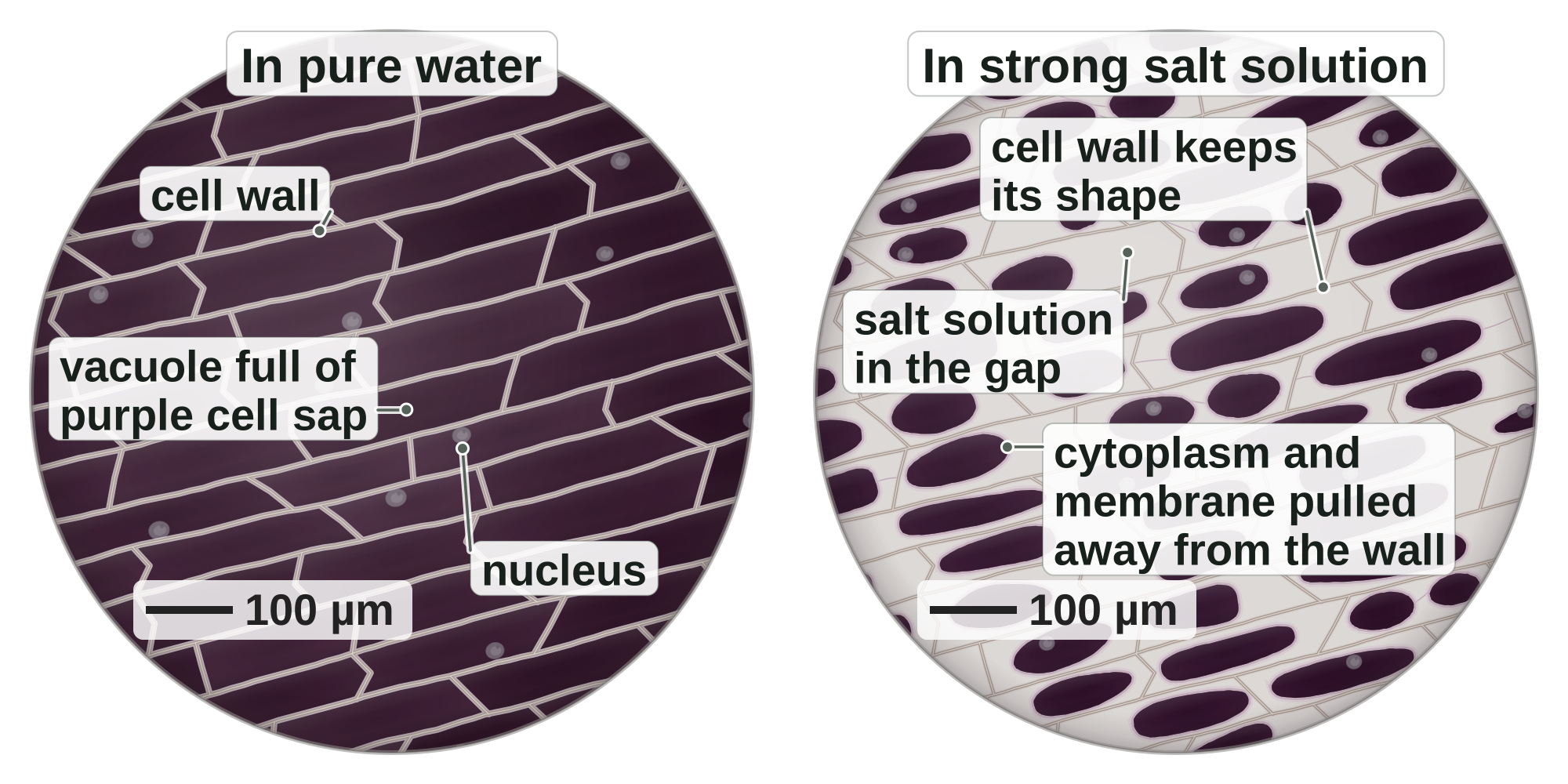
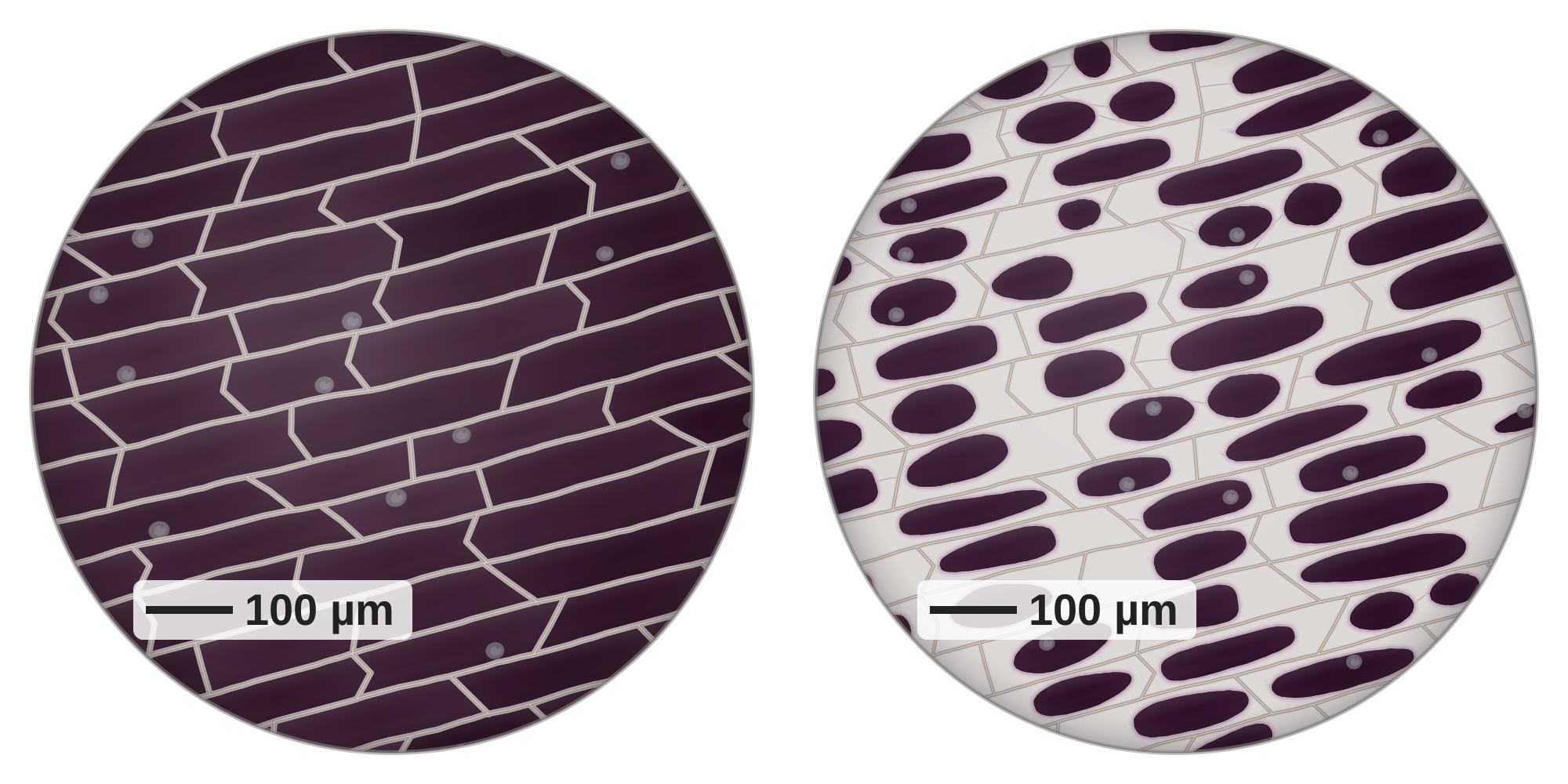
Red onion cells in water and salt
- These are red onion cells. Their cell sap is purple on its own, so no stain is needed.
- Left: cells in pure water. Right: the same kind of cells in a strong salt solution.
- In salt solution the purple has shrunk: water has left the cells by osmosis.
Screen 2
Real onion cells and a diagram
- The painting shows many real cells, packed together. The diagram shows one cell in each solution.
- The diagram's arrows show which way water moves. You cannot see water move in real cells.
Tap a difference to see it on both pictures.
Real onion cells
← dilute | concentrated →
A diagram
← dilute | concentrated →
Screen 3
Osmosis: water crosses a membrane
- A partially permeable membrane lets small water molecules through, but not larger sugar molecules.
- A dilute solution has a high concentration of water (pure water has the highest). A concentrated solution has less water.
- Water moves both ways, but more moves into the concentrated solution: a net movement. This is osmosis. It needs no energy from respiration.
Screen 4
Checkpoint 1 of 3
Quick check on screens 1 to 3. Tap an answer.
1.The red onion cells in the painting are purple. Why?
2.Which of these has the highest concentration of water?
3.A dilute and a concentrated sugar solution are separated by a partially permeable membrane. What happens?
Screen 5
Plant cells in different solutions
- In a dilute solution, water moves in. The vacuole swells and the cell becomes turgid. The cell wall stops it bursting.
- In a concentrated solution, water moves out. The cell becomes flaccid and the plant wilts.
- If it loses more water, the cytoplasm and cell membrane pull away from the cell wall: plasmolysis.
Screen 6
Animal cells and root hair cells
- Animal cells have no cell wall. In pure water, a red blood cell swells and may burst.
- In a concentrated solution, water moves out and a red blood cell shrinks.
- Root hair cells take in water from the soil by osmosis.
Pure water is more dilute than the inside of the cell. Water moves in by osmosis. With no cell wall to stop it, the cell swells and may burst.
Screen 7
Checkpoint 2 of 3
Quick check on screens 5 and 6. Tap an answer.
1.A plant cell is put in pure water. What happens to it?
2.Why can a red blood cell burst in pure water, but a plant cell cannot?
3.The water in the soil is more dilute than the inside of a root hair cell. How does water get into the cell?
Screen 8
The potato practical: method
- Cut potato cylinders the same size. Find each one's mass, then leave it in a sugar solution.
- Next day, blot each cylinder and find its mass again.
- Take care with the cork borer and the scalpel: cut onto a tile, away from your fingers.
Try it yourself: the virtual lab for this required practical.
Screen 9
The potato practical: variables
- Independent variable (you change it): the concentration of the sugar (or salt) solution.
- Dependent variable (you measure it): the percentage change in mass.
- Control variables (you keep them the same): the same potato, the size of the cylinders, the volume of solution, the time and the temperature.
Tap a chip to see that part of the practical.
Screen 10
Percentage change in mass
- Percentage change in mass = (final mass − starting mass) ÷ starting mass × 100.
- A gain in mass is positive: water moved in. A loss is negative: water moved out.
- The cylinders start with different masses, so a percentage lets you compare them fairly.
- Rate of water uptake = gain in mass ÷ time, in g per hour.
| Concentration (mol/dm³) | Starting massStart mass (g) | Final mass (g) | Change in massChange (g) | Percentage change in mass (%)% change |
|---|---|---|---|---|
| 0.0 | 2.50 | 2.80 | +0.30gained | +12 |
| 0.2 | 2.40 | 2.52 | +0.12gained | +5 |
| 0.4 | 2.25 | 2.16 | −0.09lost | −4 |
| 0.6 | 2.00 | 1.70 | −0.30lost | −15 |
| 0.8 | 3.00 | 2.46 | −0.54lost | −18 |
| 1.0 | 2.40 | 1.92 | −0.48lost | −20 |
Screen 11
Results, graph and conclusion
- Do three cylinders at each concentration. Leave out an anomaly, then find the mean.
- Plot the mean percentage change against the concentration. Draw a line of best fit.
- Where the line crosses 0 %, there is no net movement of water: about 0.3 mol/dm³.
| Concentration (mol/dm³) | Cylinder (%) | Mean (%) | ||
|---|---|---|---|---|
| 1 | 2 | 3 | ||
| 0.0 | +12 | +17 | +19 | +16 |
| 0.2 | +5 | +7 | +18 | +6 |
| 0.4 | −4 | −3 | −5 | −4 |
| 0.6 | −15 | −10 | −11 | −12 |
| 0.8 | −18 | −19 | −17 | −18 |
| 1.0 | −20 | −22 | −21 | −21 |
anomaly: leave it out
| Concentration (mol/dm³) | 0.0 | 0.2 | 0.4 | 0.6 | 0.8 | 1.0 |
|---|---|---|---|---|---|---|
| Mean (%) | +16 | +6 | −4 | −12 | −18 | −21 |
Try it yourself: the virtual lab for this required practical.
Screen 12
Checkpoint 3 of 3
Quick check on screens 8 to 11. Tap an answer.
1.In the potato practical, which of these must be kept the same in every tube?
2.Why do we compare the percentage change in mass, and not just the change in grams?
3.The line of best fit crosses 0 % at 0.3 mol/dm³. What does this show?
Quiz
Quiz: B1 L9 Osmosis
10 questions. Tap an answer. Your first answer counts towards your score.
What is a partially permeable membrane?
Which statement about a concentrated sugar solution is correct?
Which of these is true of osmosis?
A plant cell has lost so much water that its cytoplasm has pulled away from the cell wall. What is this called?
Why do the leaves of a plant droop (wilt) when the plant is short of water?
A red blood cell is put in a very concentrated salt solution. What happens?
Why is each potato cylinder blotted gently before its mass is found?
Why should every cylinder come from the same potato?
A cylinder's mass goes from 4.00 g to 3.50 g. What is the percentage change in mass?
A student's means were: 0.0 mol/dm³, +14 %; 0.2 mol/dm³, +5 %; 0.4 mol/dm³, −6 %; 0.6 mol/dm³, −13 %. Between which two concentrations is there no net movement of water?
Exam questions
The same 5 questions as the B1 L9 Exam questions worksheet. 20 marks.
Write your answer, then open the mark scheme and tick each point you made.
01Figure 1 shows a plant cell before and after it was put in a concentrated salt solution.
01.1Complete Figure 1.
Choose answers from the box.
01.2What has happened to the cell in Figure 1?
Tick (✓) one box.
Mark scheme
- (1)
- (1)
- (1)
- (1)
01.1: 1 mark for each correct label. If more than one word from the box is written on one line, do not give that mark. allow "vacuole" for line 3. 01.2: If more than one box is ticked, 0 marks.
Model answer01.1 1 cell wall; 2 cell membrane; 3 permanent vacuole. 01.2 It has lost water by osmosis.
02A student investigated how the concentration of sugar solution affects the mass of potato cylinders.
Table 1 shows the results.
| Concentration of sugar solution in mol/dm³ | Starting mass in g | Final mass in g | Percentage change in mass |
|---|---|---|---|
| 0.0 | 1.60 | 1.84 | +15.0 |
| 0.2 | 1.50 | 1.56 | X |
| 0.4 | 1.80 | 1.71 | −5.0 |
| 0.6 | 1.70 | 1.53 | −10.0 |
| 0.8 | 1.60 | 1.36 | −15.0 |
02.1Calculate value X.
Use the equation:
percentage change in mass = (final mass − starting mass) ÷ starting mass × 100
02.2Why did the student calculate the percentage change in mass, and not just the change in mass?
02.3Give one variable the student should control.
02.4Use Table 1 to estimate the concentration of sugar solution at which there is no net movement of water.
02.5The student blotted each cylinder with a paper towel before finding its mass.
Give one reason why.
Mark scheme
- (1)
- (1)
- (1)
- (1)
- (1)
- (1)
02.1: allow 4 or +4. Correct answer with no working = 2 marks. do not accept −4 for the answer mark. 02.2: do not accept "to make it accurate". ignore "to make it fair" on its own. 02.3: do not accept "the concentration" (it is the independent variable). ignore "the amount" with no detail. 02.4: allow any value from 0.25 to 0.35. 02.5: allow "to remove excess water". ignore "to dry it" on its own.
Model answer02.1 (1.56 − 1.50) ÷ 1.50 × 100 = +4.0 %. 02.2 The cylinders had different starting masses, so a percentage lets them be compared fairly. 02.3 The volume of sugar solution. 02.4 About 0.3 mol/dm³. 02.5 To remove solution from the surface, so only the mass of the potato is measured.
03Root hair cells take in water from the soil.
Explain how.
Mark scheme
- (1)
- (1)
do not accept "by active transport" for the second mark. do not accept "from a high concentration to a low concentration" without "of water" for the first mark.
Model answerThe water in the soil is more dilute than the inside of the root hair cell, so water moves into the cell by osmosis.
04Figure 2 shows two sugar solutions, A and B, separated by a partially permeable membrane.
In which direction will there be a net movement of water?
Explain your answer.
Mark scheme
- (1)
- (1)
the second mark depends on the first. do not accept "sugar moves from B to A". do not accept "from high concentration to low concentration" without "of water". allow "into B" for the first mark.
Model answerThere is a net movement of water from A to B, because A is the more dilute solution (it has the higher concentration of water).
05A student wants to find the concentration of sugar solution that causes no change in the mass of potato tissue.
Describe a method the student could use.
You should include how the student would make it a fair test and how they would use the results.
Mark scheme
Level of response. Read your answer, choose the level that fits best, then pick your mark.
| Level | Marks | Descriptor |
|---|---|---|
| 3 | 5–6 | A detailed and coherent method in a logical order that would give valid results. It includes a range of concentrations, finding the mass before and after, at least two control variables, and how the results are used to find the concentration with no change in mass (a percentage change and a graph crossing 0 %, or the concentration between a gain and a loss). |
| 2 | 3–4 | A method with the main steps in a mostly sensible order. Some detail is missing, for example the control variables or how the concentration with no change is found. At least one control variable is given. |
| 1 | 1–2 | Simple statements about the method, for example "put potato in sugar solution" or "weigh it". The order may be unclear, with little about making it fair. |
| 0 | 0 | No relevant content. |
Indicative content
- cut potato cylinders with a cork borer, all the same diameter
- trim them to the same length with a scalpel (on a tile); remove the skin
- make up a range of sugar solutions, for example 0.0, 0.2, 0.4, 0.6, 0.8 and 1.0 mol/dm³
- put the same volume of each solution (for example 10 cm³) into labelled boiling tubes
- blot each cylinder and find its starting mass on a balance
- put one cylinder in each tube and leave them for the same time (for example overnight) at the same temperature
- remove, blot in the same way and find the final mass
- calculate the percentage change in mass
- repeat (for example three cylinders at each concentration) and calculate the mean
- plot percentage change in mass against concentration and draw a line of best fit
- where the line crosses 0 % there is no change in mass / no net movement of water: read off that concentration
- control variables: the same potato, the same size of cylinder, the same volume, the same time, the same temperature
- safety: cut away from the fingers, onto a tile
- An answer that never finds the mass both before and after cannot reach Level 2.
Your mark:
Model answer (Level 3)Use a cork borer to cut potato cylinders of the same diameter, and trim them all to 3 cm with a scalpel on a tile. Put 10 cm³ of sugar solution into each of six labelled boiling tubes: 0.0, 0.2, 0.4, 0.6, 0.8 and 1.0 mol/dm³. Blot each cylinder and find its starting mass on a balance. Put one cylinder in each tube and leave them all overnight at the same temperature. Take them out, blot them in the same way and find the final masses. Use the same potato for every cylinder. Calculate the percentage change in mass for each one. Do three cylinders at each concentration and find the mean. Plot the mean percentage change against the concentration and draw a line of best fit. The concentration where the line crosses 0 % is where there is no change in mass.
Total: 0 out of 20
Printable copy: the B1 L9 Exam questions worksheet and its mark scheme (PDF) are in Downloads.
Downloads
- PPTXB1 L9 PowerPointLesson with checkpoints, revision notes, all worksheets and answers in green. 8.1 MB.
- PDFB1 L9 Revision notes4 printable pages, 0.8 MB.
- PDFB1 L9 Mandatory worksheetThe main worksheet (Foundation). 2 pages, 0.3 MB.
- PDFB1 L9 Challenge worksheetHarder questions. 2 pages, 0.3 MB.
- PDFB1 L9 Alternative worksheetKey notes and simpler tasks. 2 pages, 0.4 MB.
- PDFB1 L9 Exam questionsExam-style, black and white, 5 questions, 20 marks: the same questions as the online exam questions. 4 pages, 94 KB.
- PDFB1 L9 Exam questions mark schemeThe mark scheme for the exam questions. 2 pages, 48 KB.
Worksheet answers are in the PowerPoint, in green, after each worksheet.