Screen 1 of 12
Welcome back
Screen 1
Diffusion: particles spreading out
- Drop a purple crystal into still water. The purple slowly spreads out through the water.
- The colour shows where the purple particles are: dark where they are crowded, paler where there are fewer.
- This spreading out of particles is diffusion. It happens in gases and in solutions.
Zoom in on the beaker:
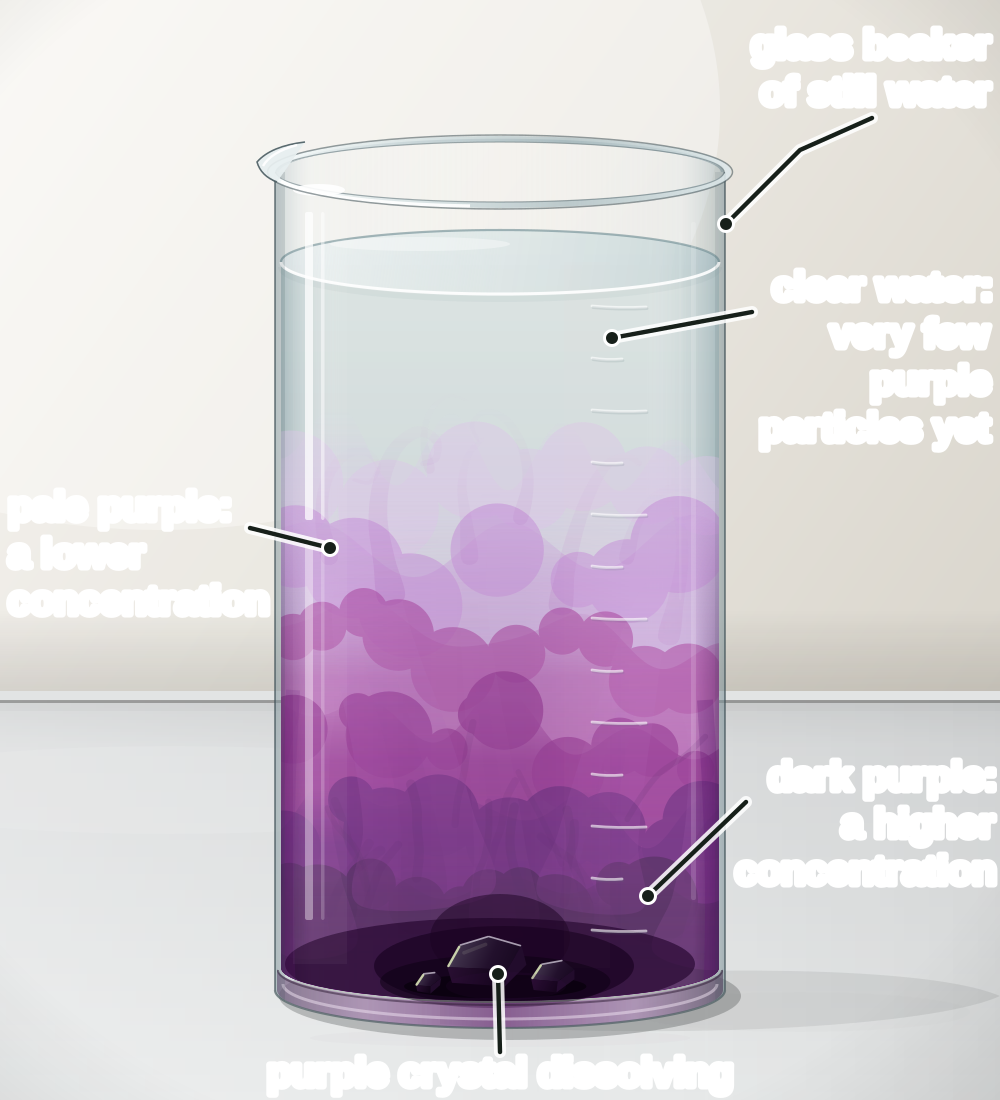
Near the crystal: lots of particles. A high concentration.
The particles never stop moving. Real particles are far too small to see: the dots are a model.
Screen 2
A real beaker and a particle diagram
- In the real beaker you see colour. You cannot see the particles.
- A particle diagram is a model: each dot stands for a particle, and the arrow shows the net movement.
- Particles are far too small to see: the dots in the diagram are a model.
Tap a difference to see it on both pictures.
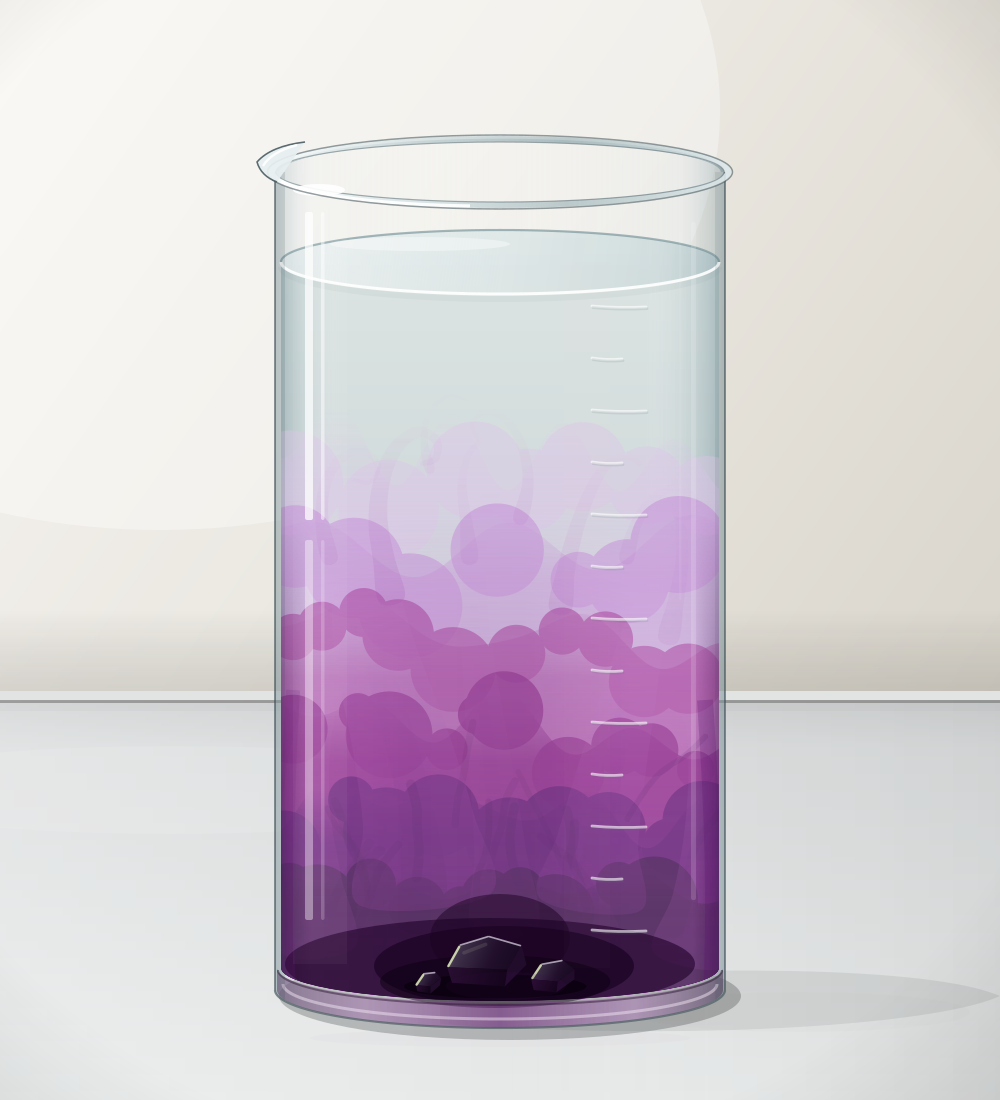
A real beaker
darkest at the bottom
A particle diagram
most dots at the bottom
Screen 3
Particles move at random
- Particles in a gas or a solution are always moving, at random, in all directions.
- They cross the dashed line both ways. More cross from the crowded side, because there are more of them there.
- So there is a net movement from a higher concentration to a lower concentration. This is diffusion.
- The particles move on their own: diffusion needs no energy from respiration.
Watch one particle: it moves at random. It does not know which side is crowded.
Crossed to the right: 0 · Crossed to the left: 0
Net movement: 0 particles
Now about the same number cross each way.
Each particle moves at random. The net movement is the difference between the two counts.
Screen 4
Evenly spread: no net movement
- As the particles spread, the difference in concentration gets smaller, so the net movement slows down.
- When the particles are evenly spread, they still move.
- The same number cross each way, so there is no net movement.
Screen 5
Checkpoint 1 of 3
Quick check on screens 1 to 4. Tap an answer.
1.Why can you not see the purple particles one by one in the beaker?
2.Particles move at random. Why is there still a net movement from a higher to a lower concentration?
3.The particles are now evenly spread. What happens next?
Screen 6
Diffusion in the body
- Oxygen diffuses into the blood in the lungs, and from the blood into respiring cells.
- Carbon dioxide diffuses out of cells into the blood, and out of the blood in the lungs.
- Urea, a waste product, diffuses from cells into the blood plasma. The kidneys remove it: this is excretion, the removal of waste products made in the body.
Each substance diffuses from where its concentration is higher to where it is lower.
The blood goes through the heart on the way (B2 L6 The heart and circulation).
Screen 7
Keeping the gradient steep
- Cells use oxygen in respiration, so the oxygen concentration inside them stays low.
- Flowing blood brings more oxygen, and carries carbon dioxide and urea away.
- This keeps the concentration gradients steep, so diffusion stays fast.
Screen 8
Checkpoint 2 of 3
Quick check on screens 6 and 7. Tap an answer.
1.Liver cells make urea. It diffuses from the liver cells into the blood plasma. Where is the concentration of urea higher?
2.Respiration in a body cell makes carbon dioxide. Which way does the carbon dioxide diffuse?
3.How does flowing blood help oxygen keep diffusing into a body cell?
Screen 9
Four factors: faster or slower?
- The concentration gradient is the difference in concentration between two areas. Diffusion is faster when it is bigger (steeper).
- It is faster at a higher temperature, and across a larger surface area.
- It is faster over a shorter distance, such as a thin membrane.
Pick a factor, predict, then run the race.
Predict first:
Screen 10
Measuring the rate of diffusion
- Coloured dye spreads down into clear agar jelly. Measure how far it moves in a set time.
- Rate of diffusion = distance ÷ time, for example in mm per minute.
- The higher the temperature, the faster the dye diffuses.
Rate = distance ÷ time. At 30 °C: 10.2 ÷ 60 = 0.17 mm per minute.
| Temperature (°C) | Distance moved (mm) | Rate of diffusion (mm/min) |
|---|---|---|
| 10 | 7.8 | 0.13 |
| 20 | 9.0 | 0.15 |
| 30 | 10.2 | 0.17 |
| 40 | 11.4 | 0.19 |
| 50 | 12.6 | 0.21 |
Example results. The colour shows where the dye particles are: they are far too small to see. In still jelly there are no currents, so the dye moves only by diffusion.
Screen 11
Apply it: muscles during exercise
- During exercise, muscle cells respire faster. They use more oxygen and make more carbon dioxide.
- The concentration gradients get steeper, so both gases diffuse faster.
- Working muscles also get a little warmer, so the particles move faster.
At rest: oxygen in and carbon dioxide out at a steady rate.
The heart also pumps the blood faster during exercise (B2 L6 The heart and circulation).
Screen 12
Checkpoint 3 of 3
Quick check on screens 9 to 11. Tap an answer.
1.Which change makes diffusion faster?
2.A dye moves 12 mm into jelly in 60 minutes. What is its rate of diffusion?
3.During exercise, why does oxygen diffuse into muscle cells faster?
Quiz
Quiz: B1 L8 Diffusion
10 questions. Tap an answer. Your first answer counts towards your score.
A purple crystal is dissolving at the bottom of a beaker of still water. The purple is darkest at the bottom and fades towards the top. What does this show?
Which is true of the particle diagram, but NOT of the real beaker?
How do particles in a liquid or a gas move?
Which of these is true of diffusion?
A drop of food colouring is left in a glass of still water for a day. The colour is now even all through the water. What are the colouring particles doing?
Urea diffuses out of liver cells. Where does it go next?
Body cells use oxygen in respiration all the time. How does this help oxygen diffuse into them?
Why does diffusion happen faster at a higher temperature?
A dye spreads through jelly at 0.4 mm each minute. How far does it spread in 15 minutes?
A runner's leg muscle cells are respiring fast. What happens to the diffusion of carbon dioxide out of these cells?
Exam questions
The same five questions as the B1 L8 Exam questions worksheet. 20 marks.
Write your answer, then open the mark scheme and tick each point you made.
01Figure 1 shows particles of a substance dissolved in water.
01.1Complete Figure 1.
Choose answers from the box.
01.2Which statement about diffusion is correct?
Tick (✓) one box.
Mark scheme
- (1)
- (1)
- (1)
- (1)
01.1: 1 mark for each correct label. If more than one phrase from the box is written on one line, do not give that mark. Do not accept osmosis or cell wall.
Model answer01.1 1 higher concentration; 2 lower concentration; 3 net movement. 01.2 Diffusion happens in gases and in solutions.
02A student investigated how the concentration of a dye affects how far it diffuses through agar jelly.
- The student cut a hole (a well) in a dish of agar jelly.
- The student filled the well with a dye solution.
- After 30 minutes, the student measured the distance the dye had moved from the edge of the well.
- The student did this for four different concentrations of the dye.
| Concentration of dye (%) | Distance moved by the dye in 30 minutes (mm) |
|---|---|
| 1 | 3.0 |
| 2 | 4.5 |
| 4 | 6.0 |
| 8 | 7.5 |
02.1Calculate the rate of diffusion of the 8 % dye.
Use the equation:
rate of diffusion = distance ÷ time
Give your answer in mm per minute.
02.2Describe how the concentration of the dye affects the distance it moves.
Use Table 1.
02.3Explain why the 8 % dye moved the furthest.
Mark scheme
- (1)
- (1)
- (1)
- (1)
- (1)
02.1: correct answer with no working = 2 marks. 4 (30 ÷ 7.5) = 0 marks. Allow 0.25 written as 1/4.
02.2: allow "the higher the concentration, the further the dye moves". Allow "each time the concentration doubles, the distance goes up by 1.5 mm". Do not accept "it goes up" with no variable named.
02.3: allow "more particles move out of the well than move back". Ignore "there is more dye". Do not accept "the particles have more energy" (that is temperature).
Model answer02.1 7.5 ÷ 30 = 0.25 mm per minute. 02.2 As the concentration of the dye increases, the distance it moves increases. 02.3 The 8 % dye has the biggest difference in concentration between the dye and the agar, so the concentration gradient is steepest and the dye diffuses fastest.
03Liver cells make urea.
Figure 3 shows a liver cell next to a capillary. Each ◆ is a particle of urea.
03.1The kidneys remove urea from the body. This is an example of excretion.
What is meant by excretion?
03.2Explain why urea diffuses from the liver cell into the blood.
Use Figure 3.
Mark scheme
- (1)
- (1)
- (1)
03.1: allow "getting rid of waste made by the body / by cells". Ignore "in urine" / "by the kidneys". Do not accept "getting rid of undigested food / faeces" or "getting rid of waste" with no idea that the waste is made in the body.
03.2: allow "11 urea particles in the cell and 2 in the blood" for the first mark. Do not accept "the cell pushes urea out" or "the kidneys pull urea into the blood".
Model answer03.1 The removal of waste products made in the body. 03.2 There are more urea particles in the liver cell than in the blood, so the concentration of urea is higher in the cell. Urea diffuses from the higher to the lower concentration, into the blood.
04A student put a drop of food colouring into a beaker of cold water.
The student put another drop into a beaker of hot water.
Neither beaker was stirred.
The colour spread out faster in the hot water.
Explain why.
Mark scheme
- (1)
- (1)
Ignore convection / currents. Do not accept "the particles expand / get bigger / melt". Do not accept "the hot water has more energy" alone for the first mark: the answer must refer to the particles.
Model answerIn the hot water the particles have more energy, so they move faster and spread out faster.
05Body cells need a constant supply of oxygen for respiration.
Oxygen diffuses from the blood into the cells.
Carbon dioxide diffuses from the cells into the blood.
Explain how the concentration gradients of oxygen and carbon dioxide between the blood and the body cells are kept steep, and why this is important for the cells.
Mark scheme
Level of response. Read your answer, choose the level that fits best, then pick your mark.
| Level | Marks | Descriptor |
|---|---|---|
| 3 | 5–6 | A detailed and coherent explanation. How both gradients are kept steep is explained (cells use oxygen and make carbon dioxide; the blood keeps flowing), and this is clearly linked to fast diffusion and to why the cells need it (respiration, removal of waste). |
| 2 | 3–4 | How at least one gradient is kept steep is explained, with some link to faster diffusion or to respiration. The links may be incomplete. |
| 1 | 1–2 | Simple relevant statements, for example "the blood brings oxygen" or "cells use oxygen", with little or no link to the concentration gradient. |
| 0 | 0 | No relevant content. |
Indicative content
- cells use oxygen in respiration, so the oxygen concentration inside the cells stays low
- flowing blood keeps bringing fresh blood with a high oxygen concentration
- so the oxygen concentration is higher in the blood than in the cells: a steep gradient
- respiration makes carbon dioxide, so its concentration inside the cells stays high
- flowing blood carries carbon dioxide away (to the lungs, where it is breathed out), so its concentration in the blood next to the cells stays low
- the heart keeps the blood moving / the blood is replaced all the time
- a steeper concentration gradient gives a faster rate of diffusion
- so the cells get oxygen fast enough for respiration, which releases energy (for example for muscle contraction)
- so carbon dioxide (a waste product) does not build up in the cells
- if the blood stopped flowing, the gradients would become less steep and diffusion would slow down
- during exercise, cells respire faster, so the gradients become steeper
- do not credit "respiration gives the oxygen energy to diffuse" or "energy is made / produced"
Your mark:
Model answer (Level 3)Respiration in the cells uses oxygen all the time, so the oxygen concentration inside the cells stays low. The blood keeps flowing, pumped by the heart, so fresh blood with a high oxygen concentration keeps arriving. This keeps the oxygen gradient between the blood and the cells steep. Respiration also makes carbon dioxide, so its concentration inside the cells is high, and the flowing blood carries it away to the lungs, so its concentration in the blood stays low. Steep gradients mean fast diffusion. This is important because the cells need oxygen quickly for respiration, which releases the energy they need, and carbon dioxide is a waste product that must not build up.
Total: 0 out of 20
Printable copy: the B1 L8 Exam questions worksheet and its mark scheme (PDF) are in Downloads.
Downloads
- PPTXB1 L8 PowerPointLesson with checkpoints, revision notes, all worksheets and answers in green. 11.3 MB.
- PDFB1 L8 Revision notes4 printable pages, 0.7 MB.
- PDFB1 L8 Mandatory worksheetThe main worksheet (Foundation). 2 pages, 0.2 MB.
- PDFB1 L8 Challenge worksheetHarder questions. 2 pages, 0.5 MB.
- PDFB1 L8 Alternative worksheetKey notes and simpler tasks. 2 pages, 0.3 MB.
- PDFB1 L8 Exam questionsExam-style, black and white, 5 questions, 20 marks: the same questions as the online exam questions. 4 pages, 0.1 MB.
- PDFB1 L8 Exam questions mark schemeThe mark scheme for the exam questions. 2 pages, 46 KB.
Worksheet answers are in the PowerPoint, in green, after each worksheet.