Screen 1 of 12
Welcome back
Screen 1
What is a stem cell?
- A stem cell is an undifferentiated cell: it is not yet specialised for a particular job.
- It can divide to make many more cells of the same type.
- It can differentiate into certain other types of cell.
Screen 2
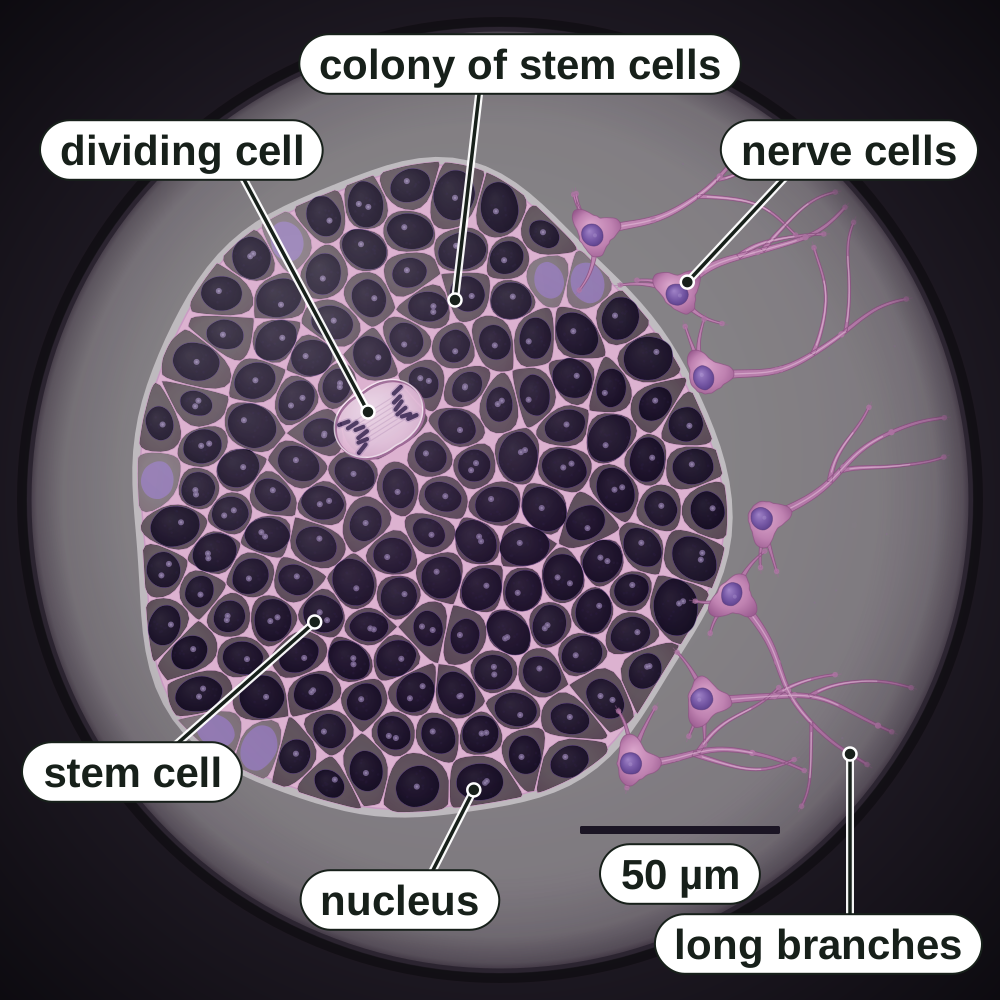
Real stem cells and a diagram
- Real stem cells look plain and alike, and they grow packed together in a colony.
- A diagram draws one stem cell, then the cells it can become, each with its own shape.
- The colours in the painting are stains. The colours in the diagram show the types of cell.
Tap a difference to see it on both pictures.
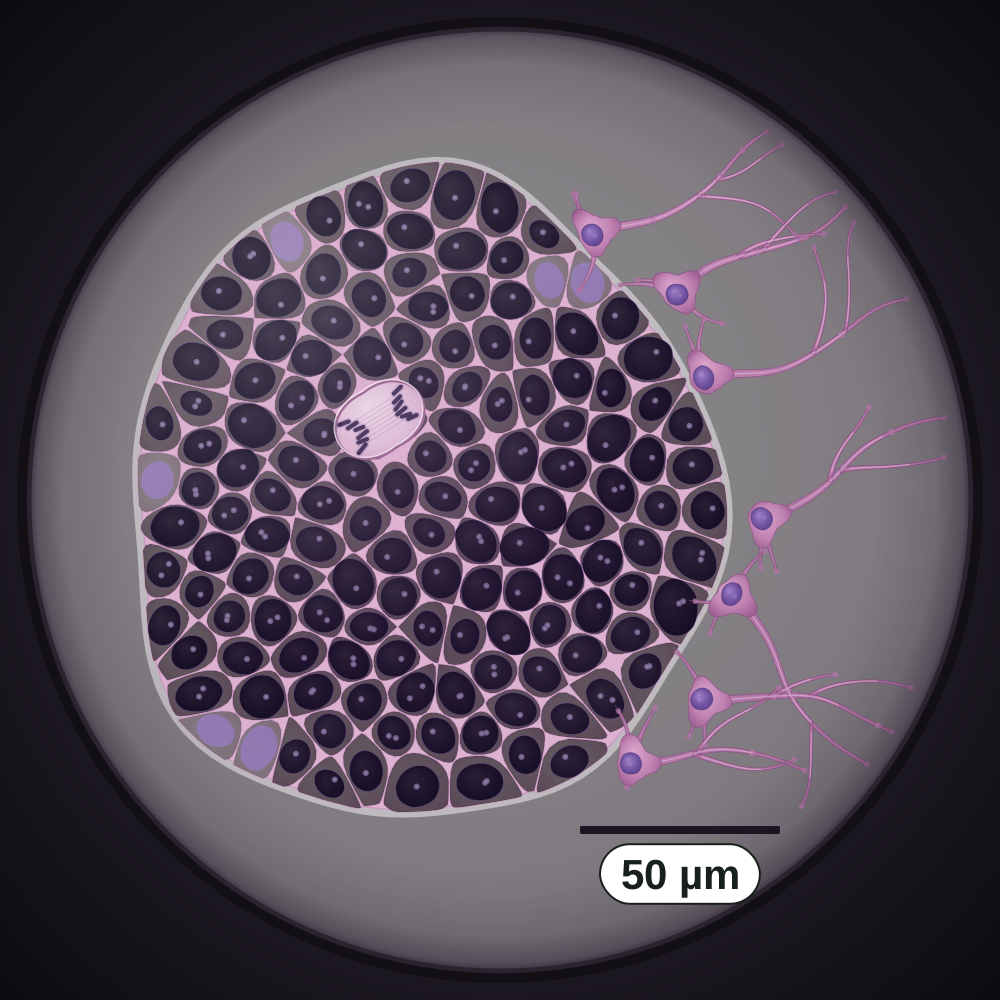
Stem cells in a dish (a painting)
stem cells → nerve cells
A diagram
stem cells → nerve cells
Screen 3
Divide and differentiate
- A stem cell divides by mitosis to make more stem cells. They are genetically identical.
- Some of the new cells differentiate: they gain the sub-cellular structures they need for one job.
- Division makes more cells. Differentiation changes what a cell can do.
Screen 4
Where stem cells are found
- In an embryo, stem cells make all the cells of the body as it grows. In a lab, they can be made to become most types of human cell.
- In an adult, stem cells in the bone marrow can form many types of cell, including blood cells.
- In a plant, stem cells in meristems (the tips of roots and shoots) can become any type of plant cell, all through the plant's life.
Most, many or any? Tap a source to find out.
Embryo
most types of human cell
Bone marrow
many types of cell, including blood cells
Meristem
any type of plant cell
Screen 5
Checkpoint 1 of 3
Quick check on screens 1 to 4. Tap an answer.
1.Which of these describes a stem cell?
2.A stem cell divides by mitosis. What does it make?
3.Which stem cells can differentiate into any type of plant cell, all through the plant's life?
Screen 6
Bone marrow makes new blood cells
- In an adult, stem cells repair the body and replace cells that wear out.
- In the bone marrow, stem cells divide all the time. Some new cells become red blood cells or white blood cells.
- A bone marrow transplant from a donor already helps people with some blood disorders, such as leukaemia.
- The stem cell divides.
- One new cell stays a stem cell.
- The other differentiates into a red blood cell.
- The new blood cell moves into the blood.
Screen 7
Cloning plants from meristems
- Meristem cells can be used to clone plants quickly and cheaply.
- The clones are genetically identical to the parent plant, so they all have its useful features.
- Growers clone rare plants to save them from extinction, and crop plants with features such as disease resistance.
Each field shows 20 plants. Green shield = the useful feature: it resists an old disease. The new disease is a different one. Example data, not real.
| Method | Plants grown | With the useful feature | Affected by a new disease |
|---|---|---|---|
| Seeds | 400 | 200 (50 %) | 120 (30 %) |
| Clones from meristems | 10 000 | 10 000 (100 %) | 10 000 (100 %) |
Seeds: 200 ÷ 400 × 100 = 50 % have the useful feature.
Screen 8
Checkpoint 2 of 3
Quick check on screens 6 and 7. Tap an answer.
1.What do stem cells in adult bone marrow do?
2.Which treatment using stem cells is already used to treat some blood disorders, such as leukaemia?
3.A farmer grows 500 cloned plants of one crop variety. A new disease arrives that this variety cannot resist. What is most likely to happen?
Screen 9
Stem cells in medicine
- Stem cells could be made to differentiate into new cells, to replace cells that are damaged or do not work.
- Bone marrow transplants are used now. Treatments for diabetes and paralysis are being researched.
- Stem cells may be able to help these conditions. They are not yet a cure.
Testing a new treatment takes many years, to check it is safe and that it works.
Screen 10
Therapeutic cloning
- In therapeutic cloning, an embryo is produced with the same genes as the patient.
- Its stem cells are made to differentiate into the cells the patient needs.
- The new cells are not rejected by the patient's body, because they have the same genes.
In the diagram, ◆ = the patient's genes; ■ = another person's genes. A diagram is simplified.
Screen 11
Benefits, risks and views
- Benefits: stem cells may help people with conditions such as diabetes and paralysis, and cells from therapeutic cloning are not rejected.
- Risks: a virus could be passed on with the cells, and the cells might divide out of control.
- Views: some people, including some religious groups, object to using embryos; others think the benefits to patients matter more.
In the UK, embryos used for research are usually spare embryos from fertility treatment, given with consent. The law allows research only on embryos up to 14 days old.
Screen 12
Checkpoint 3 of 3
Quick check on screens 9 to 11. Tap an answer.
1.Which statement about stem cells and paralysis is correct?
2.In therapeutic cloning, why are the new cells not rejected by the patient's body?
3.Which of these is a risk of using stem cells in medicine?
Quiz
Quiz: B1 L7 Stem cells
10 questions. Tap an answer. Your first answer counts towards your score.
Look at the painting on screen 1. How can you tell that most of the cells are stem cells?
What happens when a stem cell differentiates?
A gardener wants cells that can become any type of plant cell. Where on the plant should she take them from?
Why might embryonic stem cells help with more conditions than adult stem cells?
Why does an adult need stem cells in their bone marrow all through life?
From 250 plants grown from seed, 75 had a useful feature. What percentage is this?
Why do farmers grow some crops as clones?
A newspaper headline says: "Stem cells cure diabetes". Which statement is most accurate?
In therapeutic cloning, what is the embryo produced for?
Which of these is an ethical or religious objection to using embryonic stem cells?
Exam questions
The same 5 questions as the B1 L7 Exam questions worksheet. 20 marks.
Write your answer, then open the mark scheme and tick each point you made.
01Stem cells are found in different places.
01.1Draw one line from each source of stem cells to what its stem cells can become.
Online: write the letter of the correct box beside each source.
Source of stem cells
What the stem cells can become
- AOnly nerve cells
- BMost types of human cell
- CAny type of plant cell
- DOnly one type of plant cell
- EMany types of cell, including blood cells
01.2Figure 1 shows a young plant. Four parts of the plant are labelled A, B, C and D.
Which two letters show where meristem tissue is found?
Online: tick two letters.
Mark scheme
- (1)
- (1)
- (1)
- (1)
01.1: more than one line from a source: no mark for that source.
01.2: both letters needed, in either order. A third letter: no mark.
Model answer01.1 Embryo: most types of human cell. Adult bone marrow: many types of cell, including blood cells. Plant meristem: any type of plant cell. 01.2 A and D.
02A rare plant is in danger of extinction.
Scientists grew new plants of this species in two ways.
Table 1 shows the results.
| Method | What the scientists started with | Number of new plants after 6 months |
|---|---|---|
| Planting seeds | 200 seeds | 18 |
| Cloning meristem cells | 1 shoot tip | 450 |
02.1Only some of the seeds grew into new plants.
Calculate the percentage of the seeds that grew into new plants.
02.2Use Table 1 to give one advantage of cloning the plant from meristem cells.
02.3Which statement about the 450 cloned plants is correct?
Tick (✓) one box.
02.4Suggest one disadvantage of growing this rare plant only as clones.
Mark scheme
- (1)
- (1)
- (1)
- (1)
- (1)
02.1: correct answer with no working: 2 marks. Allow 0.09 × 100 for the first mark. Do not accept 0.09 as the final answer (no × 100) for the second mark.
02.2: allow many plants from only one shoot tip, or from a small piece of one plant. Ignore "cheaper" (not in the table).
02.3: more than one box ticked: no mark.
02.4: allow no variation; they could all be killed by one disease; they could not adapt to a change in the environment. Do not accept "they are all the same" with no link to variation, disease or change.
Model answer02.1 18 ÷ 200 × 100 = 9 %. 02.2 Cloning gave many more new plants: 450 from one shoot tip, compared with 18 from 200 seeds. 02.3 They are all genetically identical. 02.4 There is no variation, so one new disease could kill them all.
03Some patients need new cells to replace cells that are damaged.
03.1Therapeutic cloning could make stem cells for a patient.
What is produced in therapeutic cloning?
Tick (✓) one box.
03.2A doctor says:
"Stem cells from therapeutic cloning are better for this patient than stem cells from another person."
Explain why.
Mark scheme
- (1)
- (1)
- (1)
03.1: more than one box ticked: no mark.
03.2: do not accept "because they are stem cells" or "because they are young". Allow: the body recognises the cells as its own.
Model answer03.1 An embryo with the same genes as the patient. 03.2 The cells from the cloned embryo have the same genes as the patient, so they are not rejected by the patient's body. Cells from another person may be rejected.
04Paralysis can happen when nerve cells are damaged, for example in an accident.
Describe how stem cells might be used to help a person with paralysis.
Mark scheme
- (1)
- (1)
Allow "turned into" for differentiate. Allow: so the person may be able to move again, for the second mark, if linked to new nerve cells. Ignore "cure". Do not accept "stem cells divide into nerve cells" for the first mark.
Model answerStem cells could be made to differentiate into nerve cells. These new nerve cells could replace the damaged nerve cells and repair the damage.
05Scientists are researching the use of embryonic stem cells to treat conditions such as diabetes.
Evaluate the use of embryonic stem cells in medical treatments.
Mark scheme
Level of response. Read your answer, choose the level that fits best, then pick your mark.
| Level | Marks | Descriptor |
|---|---|---|
| 3 | 5–6 | A detailed and balanced evaluation. Benefits, at least one practical risk and at least one ethical or religious issue are described, and a conclusion is given with a supporting reason. |
| 2 | 3–4 | Benefits and at least one risk or ethical issue are described, with some balance, or one side only is described in detail. A conclusion may be given without a clear reason. |
| 1 | 1–2 | Simple statements about benefits or objections, with little detail. |
| 0 | 0 | No relevant content. |
Indicative content
- Benefits: embryonic stem cells can differentiate into most types of human cell; they may be able to help conditions such as diabetes and paralysis; they could replace damaged cells; in therapeutic cloning the embryo has the same genes as the patient, so the cells are not rejected; research helps scientists understand how diseases develop.
- Risks: a viral infection could be passed on with the cells; the cells might divide out of control (a tumour); treatments are new, still being researched, and long-term effects are not known; treatments may not work.
- Ethical and religious issues: taking the stem cells destroys the embryo; some people, including some religious groups, believe an early embryo should have the same right to life as a person; others think the benefits to patients matter more; spare embryos from fertility treatment would not be used anyway; in the UK, research is allowed only on embryos up to 14 days old, with consent.
- Conclusion: any conclusion with a reason (for, against, or "only if ...") scores the same as the one in the model answer.
An answer about only one side (only benefits, or only objections) cannot reach Level 3. Ignore "it is wrong" / "it is fine" with no reason.
Your mark:
Model answer (Level 3)Embryonic stem cells can differentiate into most types of human cell, so they may be able to help people with conditions such as diabetes or paralysis by replacing damaged cells. If the embryo is made by therapeutic cloning, the cells have the same genes as the patient, so they are not rejected. However, there are risks: a virus could be passed on with the cells, and the cells might divide out of control and form a tumour. The treatments are still being researched, so we do not know if they are safe in the long term. Taking the stem cells destroys the embryo. Some people, including some religious groups, believe an embryo has the same right to life as a person, so they object. Others think helping patients matters more, especially when spare embryos would not be used anyway. I think the research should continue, because it may help many people, but only with strict laws and careful testing.
Total: 0 out of 20
Printable copy: the B1 L7 Exam questions worksheet and its mark scheme (PDF) are in Downloads.
Downloads
- PPTXB1 L7 PowerPointLesson with checkpoints, revision notes, all worksheets and answers in green. 8.6 MB.
- PDFB1 L7 Revision notes4 printable pages, 0.8 MB.
- PDFB1 L7 Mandatory worksheetThe main worksheet (Foundation). 2 pages, 0.2 MB.
- PDFB1 L7 Challenge worksheetHarder questions. 2 pages, 0.1 MB.
- PDFB1 L7 Alternative worksheetKey notes and simpler tasks. 2 pages, 0.4 MB.
- PDFB1 L7 Exam questionsExam-style, black and white, 5 questions, 20 marks: the same questions as the online exam questions. 4 pages, 91 KB.
- PDFB1 L7 Exam questions mark schemeThe mark scheme for the exam questions. 2 pages, 48 KB.
Worksheet answers are in the PowerPoint, in green, after each worksheet.