Screen 1 of 12
Welcome back
Screen 1
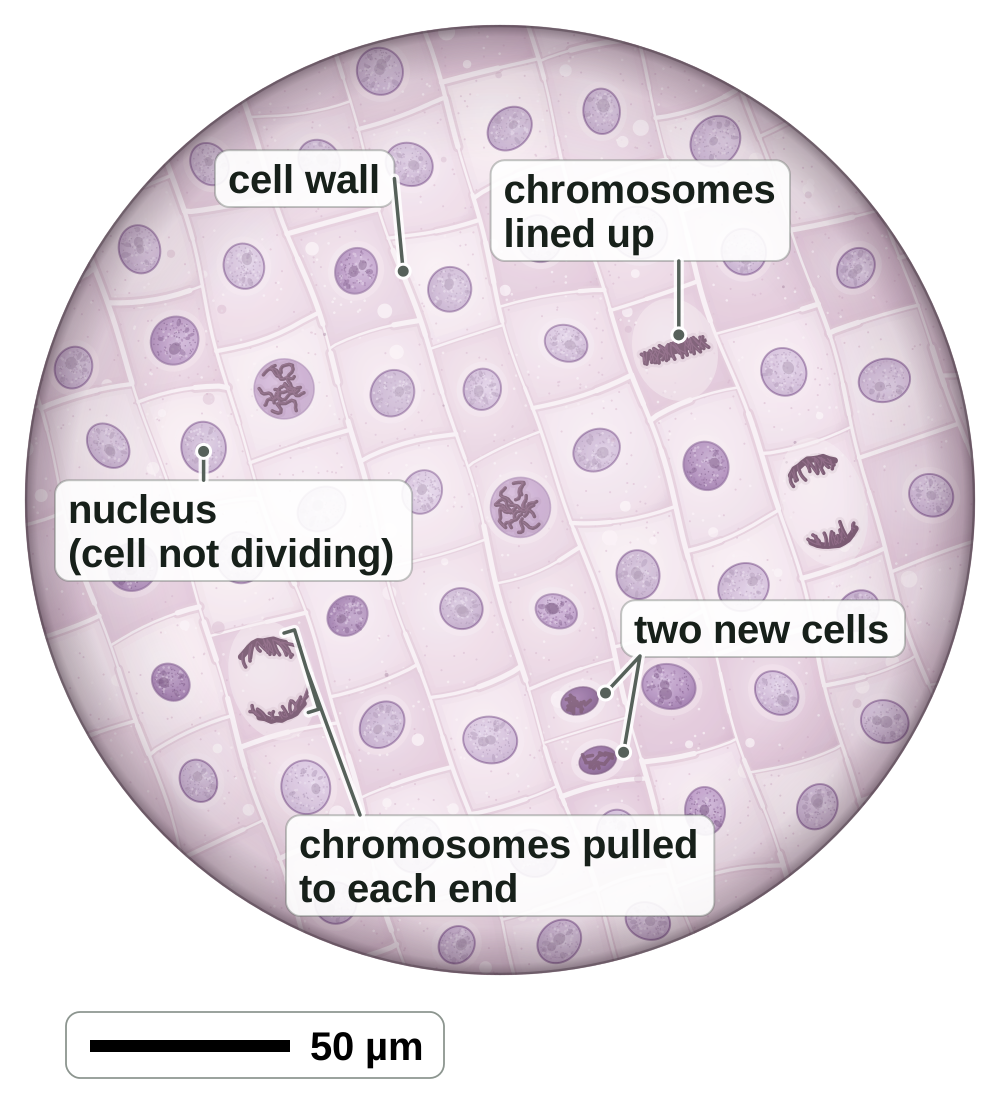
Inside a growing root tip
- Roots grow at their tips. Here, cells divide again and again to make new cells.
- This is a painting of an onion root tip, squashed thin and stained, seen through a light microscope.
- Most cells have one round nucleus. In a few cells the chromosomes show as dark threads: these cells are dividing.
Screen 2
A real root tip and a diagram
- The painting shows many real cells. Only a few of them are dividing.
- The diagram shows one cell going round the cell cycle, so you can follow its chromosomes.
- Stains colour the chromosomes; most cells are not dividing.
Tap a difference to see it on both pictures.
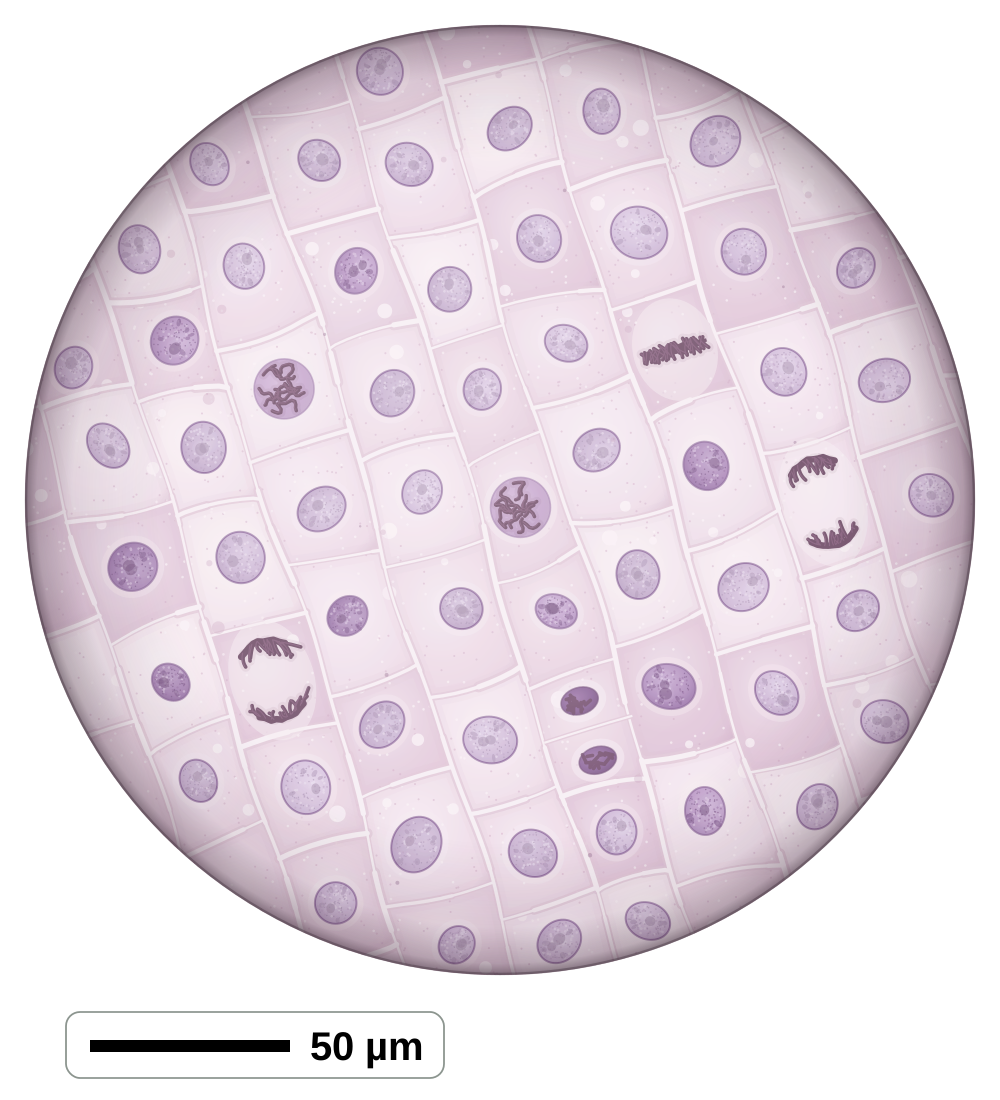
A real root tip
many cells · a few dividing
A diagram
one cell · round the cycle
Screen 3
Chromosomes, DNA and genes
- The nucleus contains chromosomes. Each chromosome is made of one long molecule of DNA.
- A gene is a small section of DNA on a chromosome. Each chromosome carries a large number of genes.
- In body cells, chromosomes are normally in pairs. A human body cell has 46 chromosomes, in 23 pairs.
Tap a part to zoom in from the cell to a gene.
Screen 4
The cell cycle: three stages
- Cells divide in a series of stages called the cell cycle.
- It has three stages: grow and copy, mitosis, then the cell divides.
- Press Next step to follow one cell round the cycle.
Each daughter cell: 4 chromosomes
Screen 5
Checkpoint 1 of 3
Quick check on screens 1 to 4. Tap an answer.
1.Most cells in the root tip painting show a round nucleus but no separate chromosomes. Why?
2.Which sentence about genes is correct?
3.When is the DNA copied in the cell cycle?
Screen 6
Copy, then share: two identical cells
Screen 7
Counting dividing cells
- Scientists count the cells that are dividing to find out where a root grows fastest.
- percentage of cells dividing = cells dividing ÷ total cells × 100
- Worked example: 6 of 40 cells are dividing. 6 ÷ 40 × 100 = 15 %.
| Distance from the root tip | Cells counted | Cells dividing | Percentage of cells dividing (%) |
|---|---|---|---|
| 0 to 1 mm | – | – | – |
| 1 to 2 mm | – | – | – |
| 2 to 3 mm | – | – | – |
| 3 to 4 mm | – | – | – |
Tap a part of the root to count its dividing cells.
Screen 8
Checkpoint 2 of 3
Quick check on screens 6 and 7. Tap an answer.
1.A human skin cell has 46 chromosomes. It divides by mitosis. How many chromosomes are in each new cell?
2.Why are the two cells made by mitosis genetically identical?
3.In a root tip, 8 of 160 cells are dividing. What percentage of the cells are dividing?
Screen 9
Mitosis for growth
- Multicellular organisms grow by making new cells. New body cells are made by mitosis.
- If every cell divides, the number of cells doubles each round: 1, 2, 4, 8, 16.
- After n rounds there are 2ⁿ cells. After 10 rounds: 2¹⁰ = 1024 cells, about 1 × 10³.
Screen 10
Repair and replacement
- Mitosis makes new cells to repair damage, such as a cut in the skin.
- It also replaces cells that wear out. New skin cells are made all the time to replace the ones that rub off.
- The new cells are genetically identical to the cells they came from.
Repair: cells beside the cut divide by mitosis. The new cells fill the gap.
Screen 11
Where is mitosis happening?
- Look for an organism that is growing, repairing damage or replacing cells.
- Tap a card, then choose Mitosis or Not mitosis.
- Watch out: mitosis makes two identical cells. Making sex cells and bacteria splitting are different processes.
Tap a card to start.
All eight cards are sorted. Mitosis is for growth, repair and replacement.
Screen 12
Checkpoint 3 of 3
Quick check on screens 9 to 11. Tap an answer.
1.One cell divides by mitosis. In each round, every cell divides once. How many cells are there after 4 rounds?
2.Which of these is mitosis used for in an adult human?
3.A cut in the skin heals. How are the new skin cells made?
Quiz
Quiz: B1 L6 Cell division: mitosis
10 questions. Tap an answer. Your first answer counts towards your score.
In a stained root tip, how can you tell that a cell is dividing?
Why does a cell cycle diagram show only 4 chromosomes in each cell?
Which list is in order of size, starting with the smallest?
What happens in stage 1 of the cell cycle?
Which part of the cell divides during mitosis?
A cell has 10 units of DNA. It copies its DNA and divides by mitosis. How much DNA is in each new cell?
In a root tip, 21 of 300 cells are dividing. What percentage of the cells are dividing?
One cell divides by mitosis. In each round, every cell divides once. After how many rounds are there more than 1000 cells?
Dead cells rub off the surface of your skin all the time. Why does your skin not wear away?
Which of these does NOT involve mitosis?
Exam questions
The same 5 questions as the B1 L6 Exam questions worksheet. 20 marks.
Write your answer, then open the mark scheme and tick each point you made.
01Figure 1 shows an animal cell dividing.
01.1Complete Figure 1.
Choose answers from the box.
01.2What is happening to the cell in Figure 1?
Tick (✓) one box.
Mark scheme
- (1)
- (1)
- (1)
- (1)
01.1: 1 mark for each correct label. If more than one word from the box is written on one line, do not give that mark. do not accept "nucleus" for 1. do not accept "cell wall" for 2 (an animal cell has no cell wall).
01.2: If more than one box is ticked, give 0 marks.
Model answer01.1 1 chromosome; 2 cell membrane; 3 cytoplasm. 01.2 One set of chromosomes is being pulled to each end of the cell.
02A student looked at cells from an onion root tip with a light microscope.
She counted the cells at three distances from the tip of the root.
Table 1 shows her results.
| Distance from the root tip in mm | Number of cells counted | Number of cells dividing |
|---|---|---|
| 1 | 250 | 30 |
| 3 | 250 | 10 |
| 5 | 250 | 2 |
02.1Calculate the percentage of cells dividing 1 mm from the root tip.
02.2Describe the pattern in the results in Table 1.
02.3Suggest why very few cells are dividing 5 mm from the root tip.
Mark scheme
- (1)
- (1)
- (1)
- (1)
02.1: Correct answer with no working = 2 marks. allow 0.12 for 1 mark (not multiplied by 100). do not accept 833 (250 ÷ 30 × 100).
02.2: allow the reverse: the closer to the tip, the more cells are dividing. allow "the number of dividing cells goes down as the distance goes up".
02.3: allow "growth (cell division) happens at the root tip". ignore "they have stopped dividing" on its own (it repeats the question). ignore "they are old".
Model answer02.1 30 ÷ 250 = 0.12. 0.12 × 100 = 12 %. 02.2 The further from the root tip, the fewer cells are dividing. 02.3 The cells there are getting longer and becoming specialised, instead of dividing.
03Describe what happens to a cell before mitosis starts.
Mark scheme
- (1)
- (1)
- (1)
allow "the chromosomes are copied" for the third mark. do not accept "the cell divides" or "the nucleus divides" (that is mitosis). ignore the names of the phases.
Model answerThe cell grows and makes more sub-cellular structures, such as ribosomes and mitochondria. Its DNA replicates to form two copies of each chromosome.
04Figure 2 shows how the amount of DNA in a cell changes during one cell cycle.
04.1At what time did the cell start to copy its DNA?
04.2Explain why the amount of DNA halves at X.
Mark scheme
- (1)
- (1)
- (1)
04.2: allow "half the DNA goes into each daughter cell" for the second mark. do not accept "half the chromosomes are lost / destroyed".
Model answer04.1 8 hours. 04.2 The cell divides into two. One copy of each chromosome goes into each new cell, so each new cell has half of the copied DNA: the same amount as the cell had at the start.
05Root tips grow because their cells divide by mitosis.
Describe what happens during the cell cycle of a root tip cell.
Explain how the cell cycle allows the root to grow.
Mark scheme
Level of response. Read your answer, choose the level that fits best, then pick your mark.
| Level | Marks | Descriptor |
|---|---|---|
| 3 | 5–6 | A detailed and coherent answer. All three stages of the cell cycle are described in the correct order, including copying the DNA before mitosis, and growth of the root is clearly explained by more cells being made by mitosis, again and again. |
| 2 | 3–4 | At least two stages are described correctly, with a simple link to growth, such as "more cells are made". The order or some detail may be missing. |
| 1 | 1–2 | Simple statements, such as "the cell splits in two" or "the root gets more cells", with little or no link between them. |
| 0 | 0 | No relevant content. |
Indicative content
- stage 1: the cell grows
- it makes more sub-cellular structures, such as ribosomes and mitochondria
- the DNA replicates to form two copies of each chromosome
- stage 2, mitosis: the chromosomes line up, and one set of chromosomes is pulled to each end of the cell
- the nucleus divides
- stage 3: the cytoplasm and cell membrane divide (a new cell wall forms between the cells)
- two daughter cells are made, genetically identical to each other and to the parent cell
- each new cell has the same number of chromosomes as the parent cell (16 in an onion cell)
- the new cells grow and divide again, so the number of cells keeps doubling
- more cells make the root longer: growth
- cells further from the tip stop dividing, get longer and become specialised
- ignore the names of the phases of mitosis; allow "meristem" for the root tip; do not accept "four cells are made"
Your mark:
Model answer (Level 3)In stage 1, the root tip cell grows and makes more sub-cellular structures, such as ribosomes and mitochondria. Its DNA replicates, so there are two copies of each chromosome. In stage 2, mitosis, the chromosomes line up and one set is pulled to each end of the cell, and the nucleus divides. In stage 3, the cytoplasm and cell membrane divide, making two daughter cells. They are genetically identical, with the same number of chromosomes as the parent cell. The new cells grow and divide again, so the number of cells at the root tip keeps increasing. More cells make the root longer, so the root grows. Further from the tip, the cells stop dividing and get longer.
Total: 0 out of 20
Printable copy: the B1 L6 Exam questions worksheet and its mark scheme (PDF) are in Downloads.
Downloads
- PPTXB1 L6 PowerPointLesson with checkpoints, revision notes, all worksheets and answers in green. 13.5 MB.
- PDFB1 L6 Revision notes4 printable pages, 0.9 MB.
- PDFB1 L6 Mandatory worksheetThe main worksheet (Foundation). 2 pages, 0.3 MB.
- PDFB1 L6 Challenge worksheetHarder questions. 2 pages, 0.1 MB.
- PDFB1 L6 Alternative worksheetKey notes and simpler tasks. 2 pages, 0.5 MB.
- PDFB1 L6 Exam questionsExam-style, black and white, 5 questions, 20 marks: the same questions as the online exam questions. 4 pages, 93 KB.
- PDFB1 L6 Exam questions mark schemeThe mark scheme for the exam questions. 2 pages, 47 KB.
Worksheet answers are in the PowerPoint, in green, after each worksheet.