Screen 1 of 12
Welcome back
Screen 1
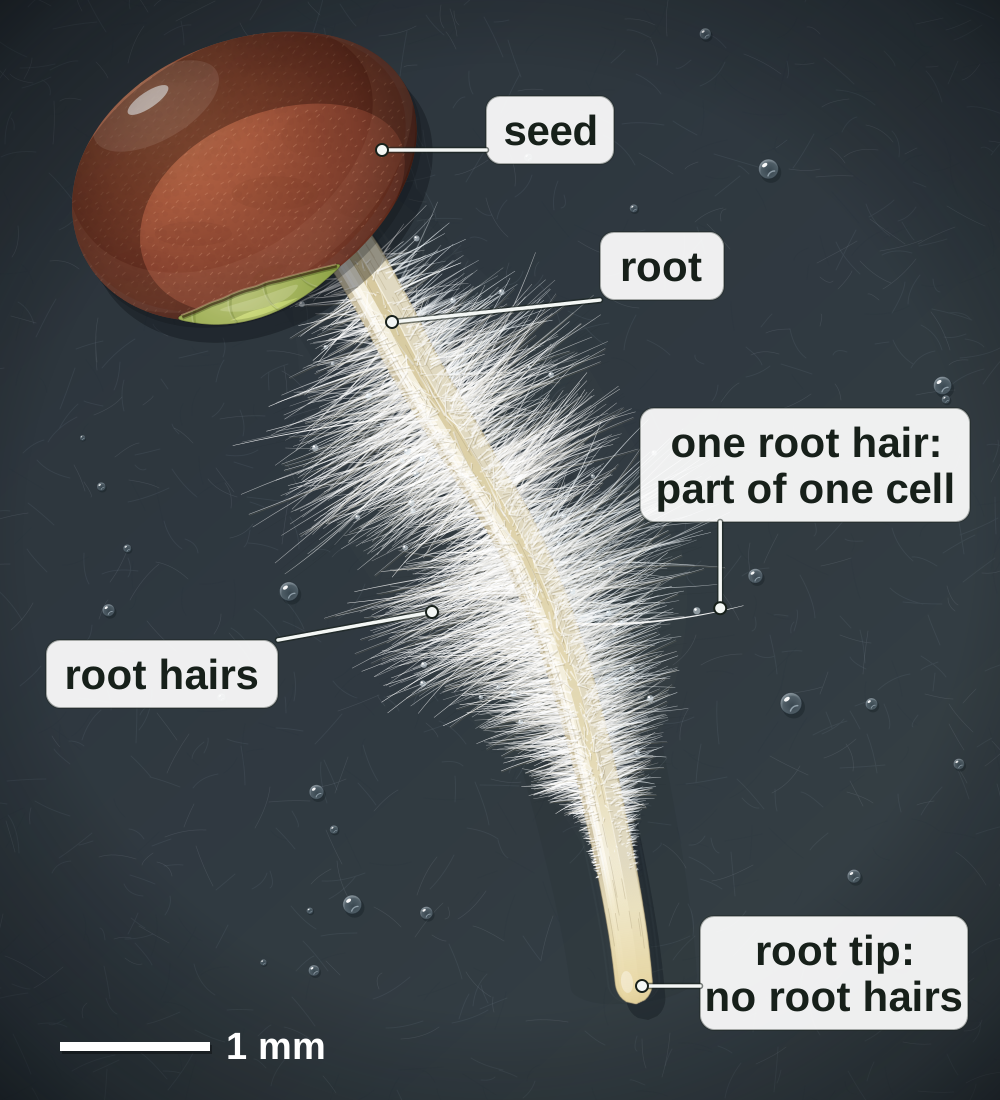
A seedling root up close
- This is a painting of the root of a young radish seedling, seen through a hand lens.
- The white fuzz is thousands of root hairs. Each one is part of a single cell: a root hair cell.
- A specialised cell has a structure that suits it to one job.
Screen 2
A real root and a diagram
- The painting shows a real root with thousands of root hairs. The diagram shows just one root hair cell, drawn big.
- A diagram is simplified on purpose, so you can see the parts of the cell.
Tap a difference to see it on both pictures.
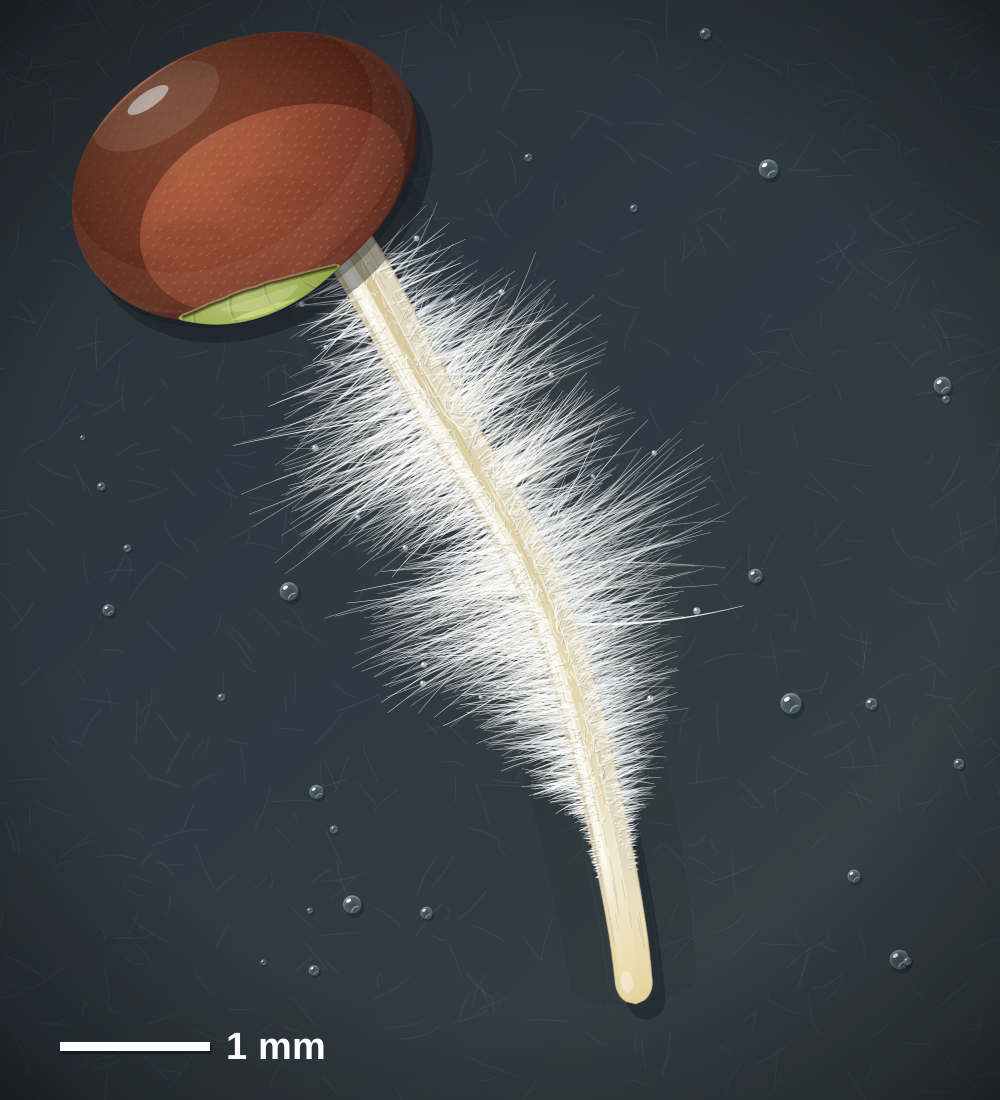
A real root (painting)
seen through a hand lens
A diagram
one root hair cell, drawn big
Screen 3
Root hair cells: built to take in water
- A root hair cell's long, thin extension gives it a large surface area touching the water in the soil.
- So it can take in more water and mineral ions.
- Explain any adaptation like this: feature → how it helps → job.
With its long, thin hair, the cell has a large surface area touching the soil water, so it takes in water quickly.
Tap a feature to see how it helps the cell.
Screen 4
Sperm cells: built to swim
- A sperm cell's job is to reach an egg cell and fertilise it.
- Its tail, its mitochondria, the enzymes in its head and its nucleus each help.
- Press Next step to see how.
Screen 5
Checkpoint 1 of 3
Quick check on screens 1 to 4. Tap an answer.
1.In the painting of the seedling root, what is each white hair?
2.How does the long, thin extension help a root hair cell?
3.What do the enzymes in the head of a sperm cell do?
Screen 6
Nerve cells and muscle cells
- A nerve cell carries electrical impulses from one part of the body to another.
- A muscle cell contracts (gets shorter) to cause movement.
- Watch an impulse run along a nerve cell and make muscle cells contract. Tap a feature to see how it helps.
Nerve cells carry electrical impulses. Muscle cells contract to cause movement. Tap a feature to see how it helps.
Screen 7
Comparing the sizes of cells
- Specialised cells come in very different sizes.
- To compare two sizes, change them into the same unit first: 1 mm = 1000 µm.
- Worked example: an egg cell is 0.1 mm across. 0.1 × 1000 = 100 µm. 100 ÷ 50 = 2, so it is about 2 times as wide as a sperm cell is long.
| Cell | About how big |
|---|---|
| 50 µm long | |
| 0.1 mm (100 µm) across | |
| up to 1 mm (1000 µm) long | |
| 1 m long, from the bottom of the spine to the toes |
Screen 8
Checkpoint 2 of 3
Quick check on screens 6 and 7. Tap an answer.
1.What is the job of a nerve cell?
2.How does a muscle cell get shorter when it contracts?
3.A root hair is 0.7 mm long. A sperm cell is 50 µm long. How many times longer is the root hair? (1 mm = 1000 µm)
Screen 9
Xylem and phloem cells
- Xylem cells are dead. With no end walls, they form long, hollow tubes that carry water and mineral ions.
- Lignin strengthens their walls and helps to support the plant.
- Phloem cells are living. Pores in their end walls let cell sap, carrying dissolved sugars, move from cell to cell.
Screen 10
How cells become specialised
- Differentiation is how a cell becomes specialised: it gains the sub-cellular structures it needs for its job.
- Most animal cells differentiate at an early stage. Many plant cells can differentiate all their lives.
- Differentiation is not cell division: a cell divides by mitosis (B1 L6 Cell division: mitosis), and becomes specialised by differentiating.
Screen 11
Apply it: cells you have not met
- In the exam you may meet a cell you have not studied. Read its job, then look for its features.
- Pick a cell, tap a feature, then choose how it helps.
- Build each answer as feature → how it helps → job.
Pick a cell, then tap one of its features.
Job: these cells line the airways (the tubes to the lungs). They move mucus, with trapped dust and microorganisms, up and away from the lungs.
Job: an egg cell joins with a sperm cell at fertilisation. Then the new cell divides to make new cells.
Screen 12
Checkpoint 3 of 3
Quick check on screens 9 to 11. Tap an answer.
1.Xylem cells are dead when they carry water. How does this help?
2.What is differentiation?
3.Airway cells have tiny hairs called cilia that beat to move mucus. Why do they have many mitochondria?
Quiz
Quiz: B1 L5 Specialised cells
10 questions. Tap an answer. Your first answer counts towards your score.
Which of these is the meaning of "specialised cell"?
Through a hand lens, what colour are real root hairs, and why?
A seedling is pulled out of the soil, and most of its root hairs are torn off. It is planted again, but it wilts. Why?
Which part of a sperm cell moves it towards the egg cell?
How do the branched endings of a nerve cell help it do its job?
A muscle cell contracts many times a minute. Which sub-cellular structure does it need many of?
A nerve cell is 0.5 m long. A sperm cell is 50 µm long. How many times longer is the nerve cell? (1 m = 1000 mm and 1 mm = 1000 µm)
What do phloem cells carry?
Which statement about differentiation is correct?
A cell near the top surface of a leaf is packed with chloroplasts. Suggest what this cell is specialised to do.
Exam questions
The same 5 questions as the B1 L5 Exam questions worksheet. 20 marks.
Write your answer, then open the mark scheme and tick each point you made.
01Figure 1 shows four specialised cells, A, B, C and D.
01.1Name cells A, B and C.
Choose answers from the box.
01.2Cell D contains protein fibres that slide over each other.
What is the job of cell D?
Tick (✓) one box.
Mark scheme
- (1)
- (1)
- (1)
- (1)
01.1: 1 mark for each correct name. If more than one name is written for one cell, do not give that mark. allow "sperm" for A. do not accept "xylem cell" for B.
01.2: If more than one box is ticked, give 0 marks.
Model answer01.1 A sperm cell; B root hair cell; C nerve cell. 01.2 To contract to cause movement.
02Root hair cells take in water and mineral ions from the soil.
02.1A root hair is 0.6 mm long.
1 mm = 1000 µm
What is the length of the root hair in micrometres (µm)?
02.2The root hair is 12 µm wide.
Calculate how many times longer the root hair is than it is wide.
02.3Root hair cells have no chloroplasts.
Suggest why.
Mark scheme
- (1)
- (1)
- (1)
- (1)
02.2: allow their 02.1 answer ÷ 12 correctly worked for 2 marks. allow 0.6 ÷ 0.012 for the first mark. Correct answer with no working = 2 marks. ignore units.
02.3: allow "they do not photosynthesise". do not accept "because they are white" or "because they are not green".
Model answer02.1 0.6 × 1000 = 600 µm. 02.2 600 ÷ 12 = 50 times. 02.3 They are underground, where there is no light, so they cannot photosynthesise.
03Figure 2 shows a cell from the lining of the small intestine.
This cell absorbs digested food molecules, such as glucose, from the inside of the small intestine.
Some of the molecules are taken into the cell by active transport. Active transport needs energy from respiration.
03.1The surface of the cell has many tiny folds.
Explain how the folds help the cell to do its job.
03.2The cell has many mitochondria.
Explain why.
Mark scheme
- (1)
- (1)
- (1)
- (1)
03.1: allow "more surface" / "bigger surface" for the first mark. do not accept "more space".
03.2: do not accept "mitochondria make / produce energy" (that point scores 0, the second point can still score).
Model answer03.1 The folds give the cell a large surface area, so it can absorb more digested food molecules. 03.2 Mitochondria release energy by respiration. The cell needs this energy for active transport of glucose into the cell.
04Describe how cell differentiation in animals is different from cell differentiation in plants.
Write your answer below.
Mark scheme
- (1)
- (1)
allow "animal cells lose the ability to differentiate early" for the first mark. allow "in adult animals, cell division is mainly for repair and replacement" for the first mark if the plant point is also made. do not accept "plant cells divide and animal cells do not".
Model answerMost animal cells differentiate at an early stage, but many plant cells keep the ability to differentiate throughout their lives.
05When you decide to move your arm, nerve cells carry electrical impulses to the muscle cells in your arm. The muscle cells contract.
Explain how nerve cells and muscle cells are adapted to do their jobs.
Mark scheme
Level of response. Read your answer, choose the level that fits best, then pick your mark.
| Level | Marks | Descriptor |
|---|---|---|
| 3 | 5–6 | A detailed and coherent explanation of both cells. At least two features of the nerve cell and two of the muscle cell are given, and each is linked to how it helps the cell do its job. |
| 2 | 3–4 | Features of both cells are given, with some linked to their jobs; or one cell is explained in detail. |
| 1 | 1–2 | Simple statements of features or jobs, such as "nerve cells are long" or "muscles contract", with little or no explanation. |
| 0 | 0 | No relevant content. |
Indicative content
- nerve cells carry electrical impulses (from the brain or spinal cord to the muscles)
- a nerve cell is long, so it can carry impulses a long way (for example, down the arm)
- branched endings connect with many other cells / pass impulses to many muscle cells
- a fatty sheath insulates the nerve cell, so impulses travel quickly
- muscle cells contract (get shorter) to cause movement
- muscle cells contain protein fibres that slide over each other, so the cell gets shorter
- muscle cells have many mitochondria, which release energy (by respiration) for contraction
- many muscle cells contract together (in muscular tissue), so the arm moves
- allow names not needed for AQA when used correctly: "axon" for the long fibre, "myelin (sheath)" for the fatty sheath, "nerve endings" or "dendrites" for branched endings. do not accept "nerve cells carry blood" or "mitochondria make / produce energy" (those points score nothing)
Your mark:
Model answer (Level 3)Nerve cells carry electrical impulses to the muscle cells. A nerve cell is long, so it can carry impulses a long way down the arm. Its branched endings connect with many muscle cells, so one impulse can reach many of them. A fatty sheath insulates the nerve cell, so the impulses travel quickly. Muscle cells contract to move the arm. They contain protein fibres that slide over each other, so the cell gets shorter. They have many mitochondria, which release the energy needed for contraction. Many muscle cells contract together, so the arm moves.
Total: 0 out of 20
Printable copy: the B1 L5 Exam questions worksheet and its mark scheme (PDF) are in Downloads.
Downloads
- PPTXB1 L5 PowerPointLesson with checkpoints, revision notes, all worksheets and answers in green. 9.6 MB.
- PDFB1 L5 Revision notes4 printable pages, 0.9 MB.
- PDFB1 L5 Mandatory worksheetThe main worksheet (Foundation). 2 pages, 0.3 MB.
- PDFB1 L5 Challenge worksheetHarder questions. 2 pages, 0.1 MB.
- PDFB1 L5 Alternative worksheetKey notes and simpler tasks. 2 pages, 0.5 MB.
- PDFB1 L5 Exam questionsExam-style, black and white, 5 questions, 20 marks: the same questions as the online exam questions. 4 pages, 0.6 MB.
- PDFB1 L5 Exam questions mark schemeThe mark scheme for the exam questions. 2 pages, 46 KB.
Worksheet answers are in the PowerPoint, in green, after each worksheet.