Screen 1 of 12
Welcome back
Screen 1
Real cells under a microscope
- All living things are made of cells.
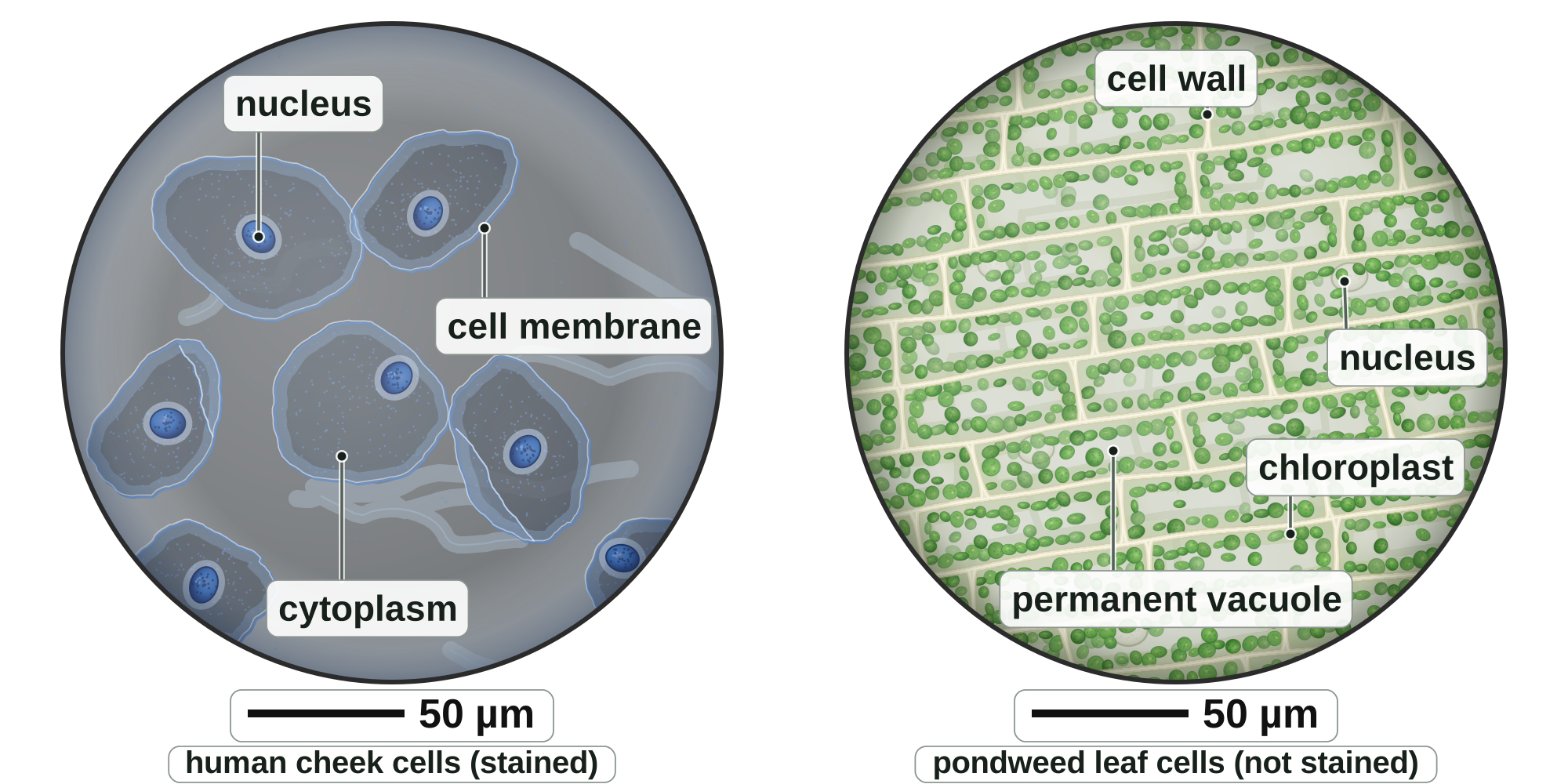
- This is a painting of what you see down a light microscope: human cheek cells (left) and pondweed leaf cells (right).
- Animal and plant cells are eukaryotic cells: their genetic material is enclosed in a nucleus.
Screen 2
Real cells and cell diagrams
- Real cells are tiny, packed together and almost see-through.
- A diagram is simplified on purpose: one neat cell, with every part drawn clearly.
- Stains colour the cells: the blue is a dye. The green chloroplasts are their real colour.
Tap a difference to see it on both pictures.
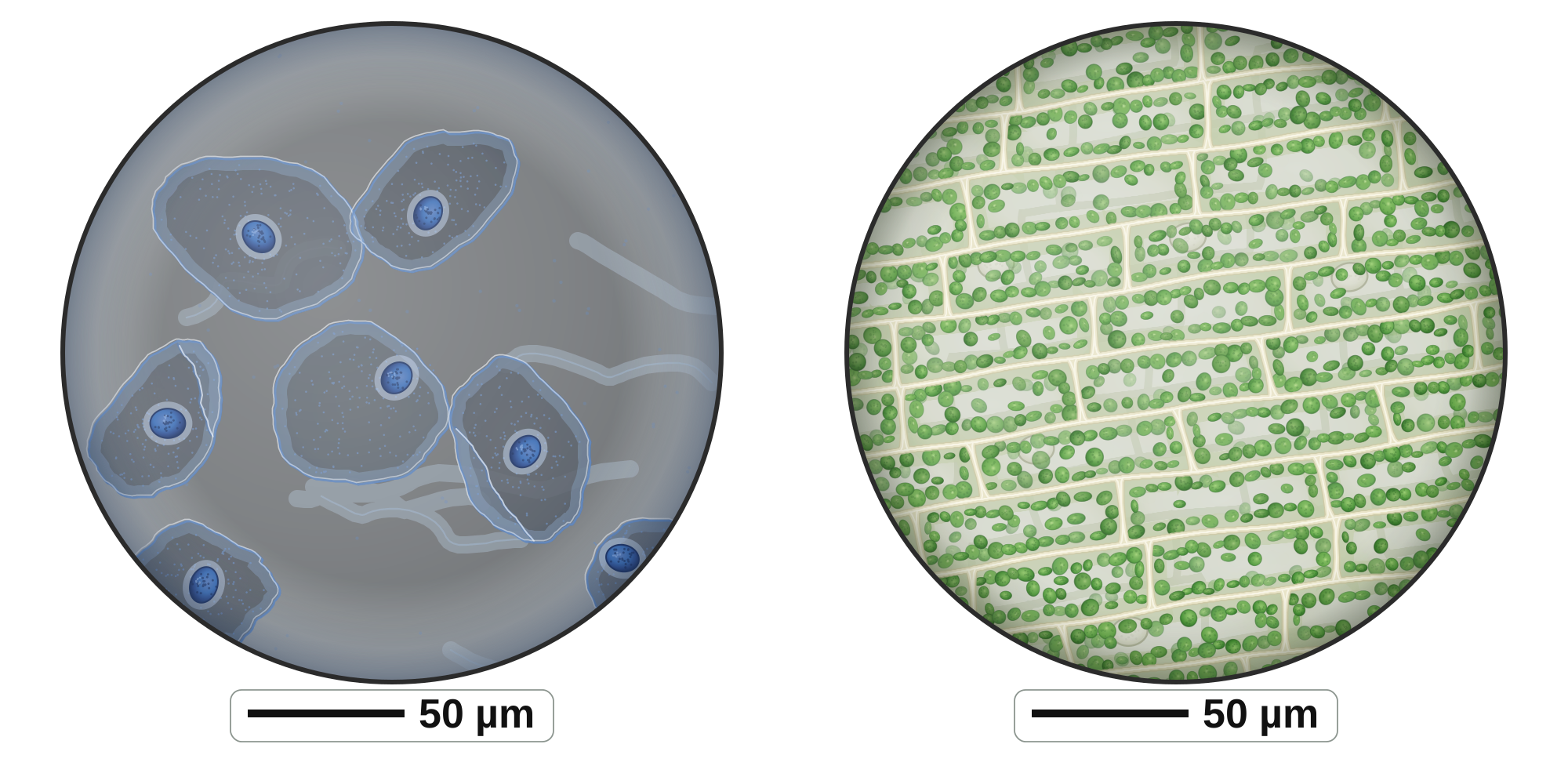
Real cells (painting)
animal on the left · plant on the right
Cell diagrams
animal on the left · plant on the right
Screen 3
Inside an animal cell
- Most animal cells have five parts: a nucleus, cytoplasm, a cell membrane, mitochondria and ribosomes.
- Each part has a job. Tap a part to see it.
- Turn the colour off to see the cell as an exam diagram.
Tap a part to see its job.
Screen 4
Cell parts working together
- The parts of a cell work together to keep the cell alive.
- Press Next step to follow glucose and oxygen into a cell.
Screen 5
Checkpoint 1 of 3
Quick check on screens 1 to 4. Tap an answer.
1.In the painting, the cheek cells are blue. Why are they blue?
2.Oxygen passes into a cheek cell. Which part of the cell controls this movement?
3.A muscle cell needs energy to contract. What do its mitochondria do?
Screen 6
Building a plant cell
- Plant cells have the same five parts as animal cells.
- They also have a cell wall, and often a permanent vacuole and chloroplasts.
- Press Next step to build a plant cell.
Screen 7
Animal and plant cells compared
- Animal and plant cells share five parts.
- Only plant cells have a cell wall, and often a permanent vacuole and chloroplasts.
- Tap a part, then tap where it belongs.
Tap a part to start.
Screen 8
Checkpoint 2 of 3
Quick check on screens 6 and 7. Tap an answer.
1.A plant cell has a cell wall and a cell membrane. What does the cell wall do?
2.Which of these parts do both animal cells and plant cells have?
3.A cell has a nucleus, mitochondria, no cell wall and no permanent vacuole. Where is it from?
Screen 9
How big are the parts?
- Cells and their parts are measured in micrometres (µm). 1 mm = 1000 µm.
- To estimate how many parts fit across a cell: width of the cell ÷ width of the part.
- Worked example: a cheek cell is about 50 µm across. Its nucleus is about 10 µm. 50 ÷ 10 = 5 nuclei.
| Part | About how big |
|---|---|
| plant cell | 10 to 100 µm |
| animal cell | 10 to 30 µm (a cheek cell is bigger: about 50 µm) |
| nucleus | 5 to 10 µm |
| chloroplast | about 5 µm |
| mitochondrion | about 1 µm |
| ribosome | about 25 nm (0.025 µm) |
Tap a part to line it up across the cell.
Screen 10
Plant cells respire day and night
- Chloroplasts absorb light to make food by photosynthesis. This happens only in the light.
- Mitochondria release energy by aerobic respiration. This happens all the time, day and night.
- Plant cells respire as well as photosynthesise.
Photosynthesis needs light. Respiration never stops.
Screen 11
Which cell is it?
- Tap a card, then choose: animal cell, or plant or algal cell.
- Look for the cell wall first. Not every plant cell has chloroplasts.
Tap a card to start.
All six cells are sorted. Tap a card to see why.
Screen 12
Checkpoint 3 of 3
Quick check on screens 9 to 11. Tap an answer.
1.A pondweed cell is about 60 µm long. A chloroplast is about 5 µm long. How many fit along it?
2.When do the mitochondria in a leaf cell release energy?
3.Cells from an onion bulb have no chloroplasts. How can you tell they are plant cells?
Quiz
Quiz: B1 L1 Animal and plant cells
10 questions. Tap an answer. Your first answer counts towards your score.
Animal and plant cells are eukaryotic cells. What does eukaryotic mean?
Why can you not see ribosomes in the painting of cheek cells?
Which sentence about the cytoplasm is correct?
Enzymes are proteins. Where in a cell are enzymes made?
What is inside the permanent vacuole of a plant cell?
Cotton fibres are made of the same tough substance as plant cell walls. What is this substance?
Which part does every plant cell have, but no animal cell has?
A cheek cell is about 50 µm across. A mitochondrion is about 1 µm long. About how many mitochondria would fit end to end across the cell?
Why does a leaf cell need both chloroplasts and mitochondria?
A single cell from a pond has a nucleus, a cell wall made of cellulose and a chloroplast. What is it most likely to be?
Exam questions
The same 5 questions as the B1 L1 Exam questions worksheet. 20 marks.
Write your answer, then open the mark scheme and tick each point you made.
01Figure 1 shows a plant cell.
01.1Complete Figure 1.
Choose answers from the box.
01.2What is the function of the cell wall?
Tick (✓) one box.
01.3Name the substance that plant cell walls are made of.
Mark scheme
- (1)
- (1)
- (1)
- (1)
- (1)
01.1: 1 mark for each correct label. If more than one word from the box is written on one line, do not give that mark. allow "vacuole" for 3. do not accept "cell membrane" for 1.
01.2: If more than one box is ticked, give 0 marks.
01.3: allow phonetic spellings, such as "celulose". do not accept "cell sap", "chlorophyll" or "cellular".
Model answer01.1 1 cell wall; 2 chloroplast; 3 permanent vacuole. 01.2 It strengthens the cell. 01.3 Cellulose.
02A student used a light microscope to look at cells from the inside of her cheek.
Figure 2 shows her drawing of one cheek cell.
02.1The cheek cell has no cell wall.
Give one other way that the cheek cell in Figure 2 is different from the plant cell in Figure 1.
02.2About 6 nuclei would fit side by side across the cheek cell.
The cheek cell is 48 µm wide.
Estimate the width of the nucleus.
02.3The student could not see any mitochondria or ribosomes in the cheek cell.
Suggest why.
Mark scheme
- (1)
- (1)
- (1)
- (1)
02.1: allow the same points written about the plant cell (for example "the plant cell has chloroplasts"). ignore "no cell wall" (given in the question). do not accept "it has no nucleus" or "it has no mitochondria".
02.2: Correct answer with no working = 2 marks. allow 8 µm written anywhere in the space. do not accept 288 (48 × 6) or 42 (48 − 6).
02.3: allow "too small to see clearly". allow "the magnification / resolution of a light microscope is not high enough". do not accept "cheek cells have no mitochondria" or "the stain hides them".
Model answer02.1 The cheek cell has no chloroplasts. 02.2 48 ÷ 6 = 8 µm. 02.3 Mitochondria are too small to see clearly with a light microscope, and ribosomes are far too small to see at all: its resolution is not high enough.
03Draw one line from each sub-cellular structure to its function.
(Online: choose one function for each structure.)
Mark scheme
- (1)
- (1)
- (1)
If more than one line is drawn from a structure, do not give the mark for that structure.
Model answerMitochondria: aerobic respiration; nucleus: contains genetic material, which controls the activities of the cell; ribosomes: protein synthesis.
04Plant cells have a permanent vacuole.
04.1Name the liquid inside the permanent vacuole.
04.2Give the function of the permanent vacuole.
Mark scheme
- (1)
- (1)
04.1: allow "a (weak) solution of sugars and salts". do not accept "water" alone or "cytoplasm".
04.2: allow "supports the cell" or "keeps the cell turgid". ignore "stores cell sap". do not accept "strengthens the cell wall" or "makes food".
Model answer04.1 Cell sap. 04.2 It helps to keep the cell firm.
05A student looked at cheek cells and at leaf cells from pondweed with a light microscope.
Compare the structure of a cheek cell with the structure of a pondweed leaf cell.
In your answer, give the function of each structure you name.
Mark scheme
Level of response. Read your answer, choose the level that fits best, then pick your mark.
| Level | Marks | Descriptor |
|---|---|---|
| 3 | 5–6 | A detailed and coherent comparison. At least three structures are correctly given as found in both cells and at least two as found only in the pondweed leaf cell, with a correct function for most structures named. |
| 2 | 3–4 | Some structures are correctly given as found in both cells or only in the pondweed leaf cell, with a correct function for some of them. The comparison may be incomplete. |
| 1 | 1–2 | Simple statements, such as "the plant cell has a cell wall" or "both have a nucleus", with few or no functions. |
| 0 | 0 | No relevant content. |
Indicative content
- both cells have a nucleus, which contains genetic material that controls the activities of the cell
- both have cytoplasm, where most chemical reactions happen
- both have a cell membrane, which controls the movement of substances into and out of the cell
- both have mitochondria, where aerobic respiration happens, releasing energy
- both have ribosomes, where proteins are made (protein synthesis)
- both are eukaryotic: the genetic material is enclosed in a nucleus
- only the pondweed cell has a cell wall, made of cellulose, which strengthens the cell
- only the pondweed cell has chloroplasts, which absorb light to make food by photosynthesis
- only the pondweed cell has a permanent vacuole, filled with cell sap, which keeps the cell firm
- the cheek cell has an irregular shape; the pondweed cell has a regular, brick shape
- Do not credit "mitochondria make / produce energy" (that statement scores nothing; other points can still score).
Your mark:
Model answer (Level 3)Both cells are eukaryotic, so both have a nucleus, which contains genetic material that controls the activities of the cell. Both have cytoplasm, where most chemical reactions happen, and a cell membrane, which controls the movement of substances into and out of the cell. Both have mitochondria, where aerobic respiration releases energy, and ribosomes, where proteins are made. Only the pondweed cell has a cell wall made of cellulose, which strengthens the cell. Only the pondweed cell has chloroplasts, which absorb light to make food by photosynthesis, and a permanent vacuole filled with cell sap, which keeps the cell firm. The cheek cell has an irregular shape, but the pondweed cell is a regular brick shape.
Total: 0 out of 20
Printable copy: the B1 L1 Exam questions worksheet and its mark scheme (PDF) are in Downloads.
Downloads
- PPTXB1 L1 PowerPointLesson with checkpoints, revision notes, all worksheets and answers in green. 10.4 MB.
- PDFB1 L1 Revision notes4 printable pages, 0.9 MB.
- PDFB1 L1 Mandatory worksheetThe main worksheet (Foundation). 2 pages, 0.3 MB.
- PDFB1 L1 Challenge worksheetHarder questions. 2 pages, 0.3 MB.
- PDFB1 L1 Alternative worksheetKey notes and simpler tasks. 2 pages, 0.5 MB.
- PDFB1 L1 Exam questionsExam-style, black and white, 5 questions, 20 marks: the same questions as the online exam questions. 4 pages, 97 KB.
- PDFB1 L1 Exam questions mark schemeThe mark scheme for the exam questions. 2 pages, 47 KB.
Worksheet answers are in the PowerPoint, in green, after each worksheet.