Screen 1 of 12
Welcome back
Screen 1
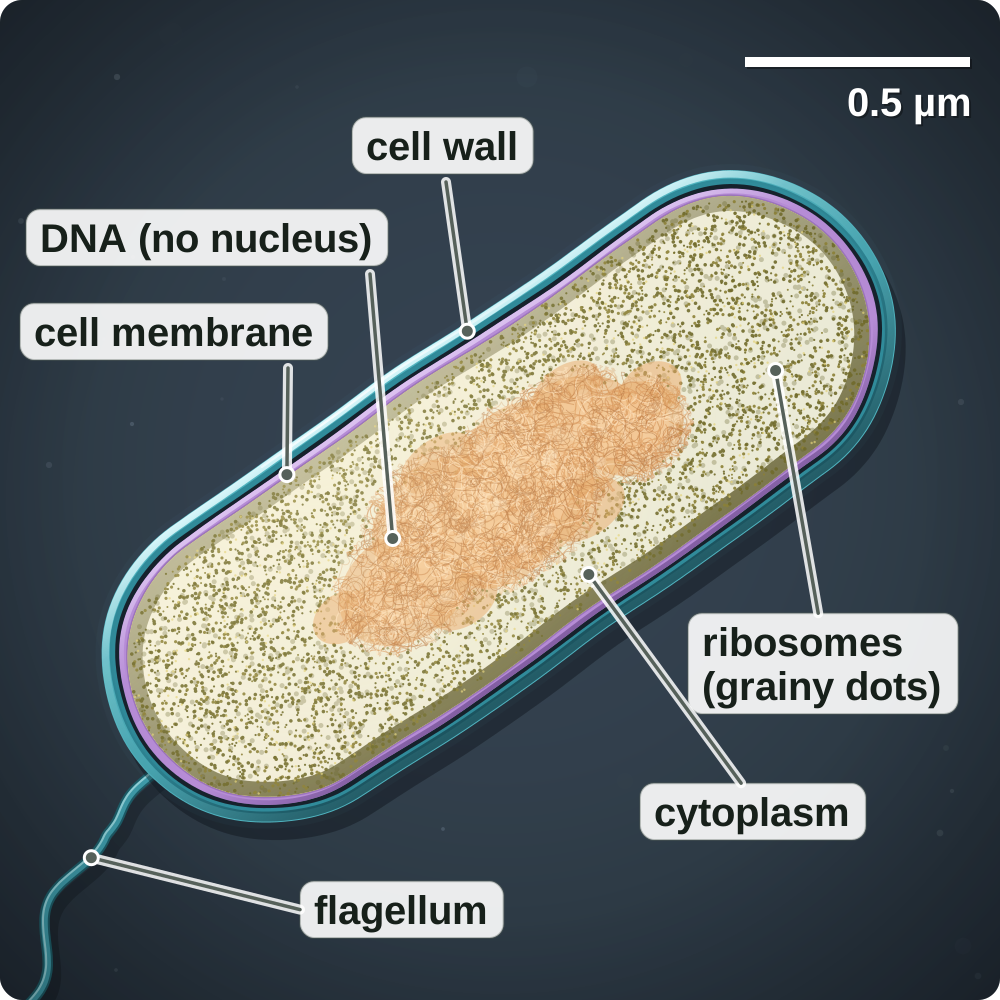
A bacterium up close
- A bacterium is a living thing made of just one cell.
- Bacterial cells are prokaryotic: their DNA is not enclosed in a nucleus.
- They are tiny: most bacteria are about 1 to 5 µm long.
Screen 2
A real bacterium and a diagram
- The painting is based on a coloured electron micrograph of a real bacterium, cut lengthways.
- An exam diagram is simplified on purpose: neat shapes, a few of each part, and its own colours.
- Electron micrographs are black and white: the colours are added.
Tap a difference to see it on both pictures.
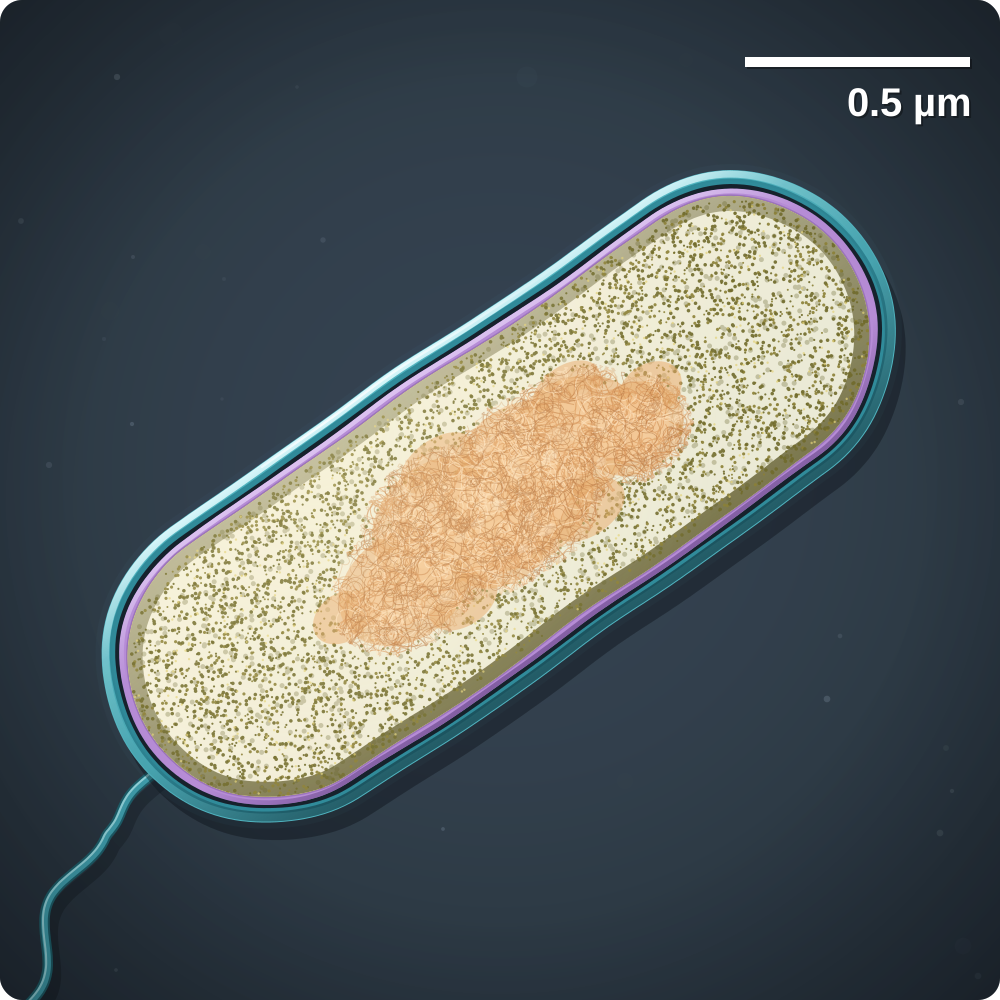
A real bacterium (painting)
cut lengthways · about 2 µm long
A diagram
not to scale
Screen 3
Inside a bacterial cell
- A bacterial cell has a cell wall, a cell membrane, cytoplasm and ribosomes.
- Its DNA is a single loop. Many bacteria also have plasmids.
- Some bacteria have a flagellum to move. Tap a part to see its job.
Tap a part to see its job.
Tap a numbered pin to see its name for 3 seconds.
Screen 4
DNA, but no nucleus
- In animal and plant cells, the DNA is enclosed in a nucleus. These cells are eukaryotic.
- A bacterial cell has no nucleus. Its DNA is a single loop, free in the cytoplasm.
- So bacterial cells are prokaryotic. Press Next step to see the difference.
Screen 5
Checkpoint 1 of 3
Quick check on screens 1 to 4. Tap an answer.
1.A coloured electron micrograph shows a golden-yellow bacterium. Where does the colour come from?
2.Which of these structures is found in a bacterial cell?
3.A bacterial cell has no nucleus. What is true about its DNA?
Screen 6
Prokaryotic and eukaryotic cells
- Eukaryotic cells, such as animal and plant cells, have a nucleus. Prokaryotic cells, such as bacteria, do not.
- All three kinds of cell have a cell membrane, cytoplasm, ribosomes and DNA.
- Tap a structure to see which cells have it.
Tap a structure to see which cells have it.
Screen 7
How small are bacteria?
- Cells are measured in micrometres (µm). 1 mm = 1000 µm.
- Most bacteria are about 1 to 5 µm long: about 10 times smaller than an animal cell.
- How many times bigger? Divide: an animal cell is 20 µm, a bacterium 2 µm, so 20 ÷ 2 = 10 times.
| Cell | Typical size | Compared with a bacterium (2 µm) |
|---|---|---|
| bacterium | about 2 µm long (most are 1 to 5 µm) | the same |
| animal cell | about 20 µm across | 20 ÷ 2 = 10 times bigger |
| plant cell | up to about 100 µm long | 100 ÷ 2 = 50 times bigger |
Screen 8
Checkpoint 2 of 3
Quick check on screens 6 and 7. Tap an answer.
1.Which structure do animal cells, plant cells and bacterial cells all have?
2.A plant cell is 60 µm long. A bacterium is 3 µm long. How many times longer is the plant cell?
3.Bacterial cells are prokaryotic. What does prokaryotic mean?
Screen 9
Plasmids: extra rings of DNA
- Plasmids are small rings of DNA, separate from the main loop.
- They carry a few extra genes, such as one that helps the bacterium survive an antibiotic.
- Not every bacterium has plasmids. Press Next step.
Screen 10
One cell, one whole organism
- A bacterium is a single-celled organism: its one cell does everything to stay alive.
- It has no mitochondria, but it still respires to release energy.
- Most bacteria are harmless or useful. A few are pathogens: they cause disease.
One cell does everything: it takes in substances, releases energy, makes proteins and, in some bacteria, moves.
Screen 11
Which type of cell is it?
- Look for a nucleus. No nucleus: prokaryotic. A nucleus: eukaryotic.
- Watch out: single-celled does not mean prokaryotic. Yeast is single-celled, but it has a nucleus.
- Tap a card, then choose its column.
Tap a card to start.
All eight cards are sorted. The nucleus decides.
Screen 12
Checkpoint 3 of 3
Quick check on screens 9 to 11. Tap an answer.
1.Which statement about plasmids is correct?
2.Bacteria have no mitochondria. Which statement is true?
3.A cell is 2 µm long. It has a cell wall and a single loop of DNA, but no nucleus. What is it?
Quiz
Quiz: B1 L2 Bacterial cells
10 questions. Tap an answer. Your first answer counts towards your score.
Which of these best describes a bacterium?
A diagram of a bacterium shows only a few ribosomes. What does a real electron micrograph show?
What is the job of the cell wall in a bacterial cell?
In a bacterial cell, what surrounds the main loop of DNA?
Which structure is found in some plant cells but never in bacterial cells?
Which statement about the cell wall of a bacterium is correct?
An animal cell is 30 µm across. A bacterium is 2.5 µm long. How many times bigger is the animal cell?
What do the plasmids in a bacterial cell carry?
Which structure do some bacteria use to swim?
Yeast is a single-celled fungus. Its DNA is enclosed in a nucleus. What type of cell does yeast have?
Exam questions
The same 5 questions as the B1 L2 Exam questions worksheet. 20 marks.
Write your answer, then open the mark scheme and tick each point you made.
01Figure 1 shows a bacterial cell.
01.1Complete Figure 1.
Choose answers from the box.
01.2What is the function of the flagellum?
Tick (✓) one box.
01.3Name one structure in Figure 1 that is also found in an animal cell.
Mark scheme
- (1)
- (1)
- (1)
- (1)
- (1)
01.1: 1 mark for each correct label. If more than one word from the box is written on one line, do not give that mark. allow "DNA" or "loop of DNA" for 2. do not accept "nucleus" for 2.
01.2: if more than one box is ticked, give 0 marks.
01.3: allow DNA. do not accept cell wall, plasmid, flagellum or nucleus.
Model answer01.1 1 plasmid; 2 single loop of DNA; 3 cell membrane. 01.2 To move the bacterium. 01.3 Ribosomes.
02Table 1 shows information about two cells.
| Cell | Does it have a nucleus? | Typical length |
|---|---|---|
| bacterium | no | 2 µm |
| onion epidermis cell | yes | 0.2 mm |
02.1Which cell in Table 1 is prokaryotic?
Give one reason from Table 1 for your answer.
02.21 mm = 1000 µm
Calculate the length of the onion epidermis cell in micrometres (µm).
02.3Calculate how many times longer the onion epidermis cell is than the bacterium.
Mark scheme
- (1)
- (1)
- (1)
- (1)
02.1: both the cell and the reason are needed for the mark. The reason must be about the nucleus. do not accept size on its own ("it is smaller"): prokaryotic is about the nucleus, not the size.
02.3: allow their 02.2 answer used correctly: their 02.2 ÷ 2. Correct answer with no working = 2 marks. ignore units. do not accept 198 (subtracted).
Model answer02.1 The bacterium, because it has no nucleus. 02.2 0.2 × 1000 = 200 µm. 02.3 200 ÷ 2 = 100 times.
03Bacterial cells contain a single loop of DNA. Many bacterial cells also contain plasmids.
Describe two ways plasmids are different from the single loop of DNA.
Mark scheme
- (1)
- (1)
- (1)
- (1)
- (1)
any two: max 2. do not accept "plasmids are not made of DNA" or "plasmids are in a nucleus".
Model answerPlasmids are much smaller than the main loop. Plasmids carry only a few extra genes, but the main loop carries most of the genes.
04Figure 2 is a drawing made from an electron micrograph of a bacterium.
A student looked at Figure 2. The student said:
"This cell has no nucleus, so it has no DNA."
Explain why the student is wrong.
Use the area labelled A in Figure 2 in your answer.
Mark scheme
- (1)
- (1)
- (1)
max 3. allow "bacteria may also have DNA in plasmids" for 1 mark. do not accept "A is the nucleus".
Model answerBacteria do have DNA. The pale tangled area A is the DNA. It is not enclosed in a nucleus: it is a single loop, free in the cytoplasm.
05Bacterial cells and plant cells both have a cell wall.
Compare the structure of a bacterial cell with the structure of a plant cell.
Mark scheme
Level of response. Read your answer, choose the level that fits best, then pick your mark.
| Level | Marks | Descriptor |
|---|---|---|
| 3 | 5–6 | A detailed and coherent comparison. At least two similarities and at least three differences are given, each difference saying clearly which cell has which feature (both cells named in each point), including the nucleus or the DNA. |
| 2 | 3–4 | At least one similarity and at least two differences, with some comparison, but some points describe only one cell. |
| 1 | 1–2 | Simple statements about one or both cells, such as "bacteria have no nucleus", with little or no comparison. |
| 0 | 0 | No relevant content. |
Indicative content
- Similarities: both have a cell membrane; both have cytoplasm; both have ribosomes; both have DNA; both have a cell wall.
- the plant cell wall is made of cellulose, but the bacterial cell wall is not
- a plant cell has a nucleus, but a bacterial cell does not
- the bacterial DNA is a single loop, free in the cytoplasm; the plant cell's DNA is enclosed in a nucleus
- a plant cell is eukaryotic; a bacterial cell is prokaryotic
- a bacterial cell may have plasmids (small rings of DNA); a plant cell does not
- a plant cell has mitochondria; a bacterial cell does not
- some plant cells have chloroplasts; a bacterial cell does not
- a plant cell has a permanent vacuole; a bacterial cell does not
- some bacteria have a flagellum; a plant cell does not
- a bacterial cell is much smaller (about 1 to 5 µm, against up to about 100 µm for a plant cell)
Your mark:
Model answer (Level 3)Both cells have a cell membrane, cytoplasm and ribosomes, and both have DNA. Both also have a cell wall, but the plant cell wall is made of cellulose, whereas the bacterial cell wall is not. The plant cell's DNA is enclosed in a nucleus, so it is eukaryotic, but the bacterial cell has no nucleus: its DNA is a single loop, free in the cytoplasm, so it is prokaryotic. A bacterial cell may also have plasmids, small rings of DNA, which a plant cell does not have. A plant cell has mitochondria, a permanent vacuole and, in some cells, chloroplasts, but a bacterial cell has none of these. A bacterial cell is also much smaller: about 2 µm long, compared with up to about 100 µm.
Total: 0 out of 20
Printable copy: the B1 L2 Exam questions worksheet and its mark scheme (PDF) are in Downloads.
Downloads
- PPTXB1 L2 PowerPointLesson with checkpoints, revision notes, all worksheets and answers in green. 7.4 MB.
- PDFB1 L2 Revision notes4 printable pages, 0.8 MB.
- PDFB1 L2 Mandatory worksheetThe main worksheet (Foundation). 2 pages, 0.3 MB.
- PDFB1 L2 Challenge worksheetHarder questions. 2 pages, 0.3 MB.
- PDFB1 L2 Alternative worksheetKey notes and simpler tasks. 2 pages, 0.4 MB.
- PDFB1 L2 Exam questionsExam-style, black and white, 5 questions, 20 marks: the same questions as the online exam questions. 4 pages, 0.1 MB.
- PDFB1 L2 Exam questions mark schemeThe mark scheme for the exam questions. 2 pages, 46 KB.
Worksheet answers are in the PowerPoint, in green, after each worksheet.