Screen 1 of 12
Welcome back
Screen 1
Blood under the microscope
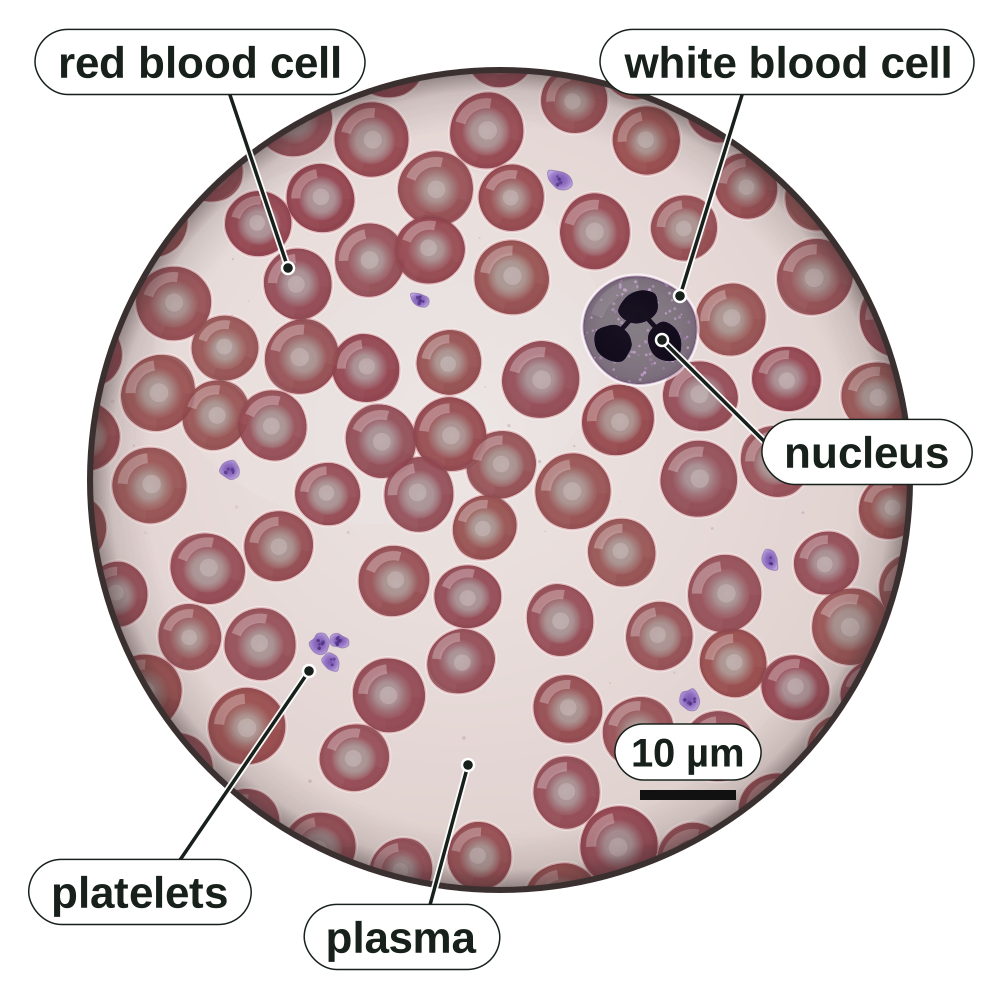
- Blood looks like a red liquid. Under a microscope you can see it is a liquid with cells and tiny fragments of cells in it.
- The liquid is plasma. In it are red blood cells, white blood cells and tiny platelets.
- So blood is a tissue, not an organ.
Screen 2
A real blood smear and a diagram
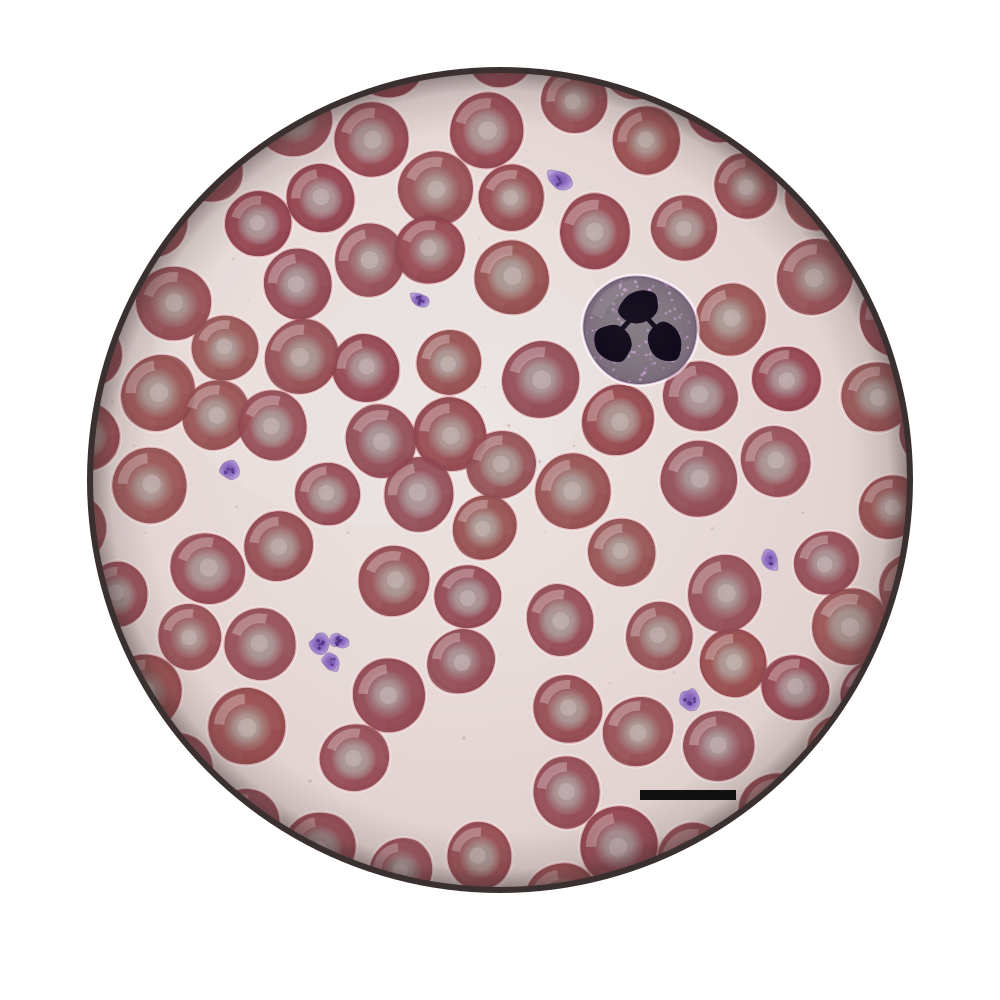
- A blood smear is a thin layer of blood on a slide, stained so the cells show up.
- A diagram is simplified on purpose: a few clear cells, a side view and flat colours.
Tap a difference to see it on both pictures.
A real blood smear
look for a nucleus
A diagram
look for a nucleus
Stained: real white blood cells are colourless. A diagram is simplified.
Screen 3
Spinning a tube of blood
- Spin a tube of blood very fast in a centrifuge and it separates into layers.
- Pale yellow plasma is on top: about 55%. Red blood cells sink to the bottom: about 45%.
- White blood cells and platelets make a thin layer in between: less than 1%.
Screen 4
Checkpoint 1 of 3
Quick check on screens 1 to 3. Tap an answer.
1.In a stained blood smear, how can you spot a white blood cell?
2.What colour are real white blood cells, without a stain?
3.A spun tube shows that blood has several parts. What is blood?
Screen 5
Plasma: the transport liquid
- Plasma is mostly water. Many substances dissolve in it.
- It carries glucose and amino acids from the small intestine, carbon dioxide to the lungs and urea to the kidneys.
- It also carries hormones, antibodies and the blood cells.
Plasma carries all of these at once, dissolved in its water.
Screen 6
Red blood cells: built to carry oxygen
- Red blood cells carry oxygen from the lungs to every cell in the body.
- They are packed with haemoglobin, have no nucleus and are biconcave.
Tap a feature to see how it helps the cell carry oxygen.
Screen 7
Picking up and dropping off oxygen
- In the lungs, oxygen diffuses into red blood cells and joins with haemoglobin.
- In the body's tissues, haemoglobin releases the oxygen. It diffuses into body cells for respiration.
- Almost all the oxygen is carried by haemoglobin, not the plasma.
Screen 8
Checkpoint 2 of 3
Quick check on screens 5 to 7. Tap an answer.
1.Which substance does plasma carry from the liver to the kidneys?
2.How does having no nucleus help a red blood cell?
3.How is most of the oxygen carried in the blood?
Screen 9
White blood cells and platelets
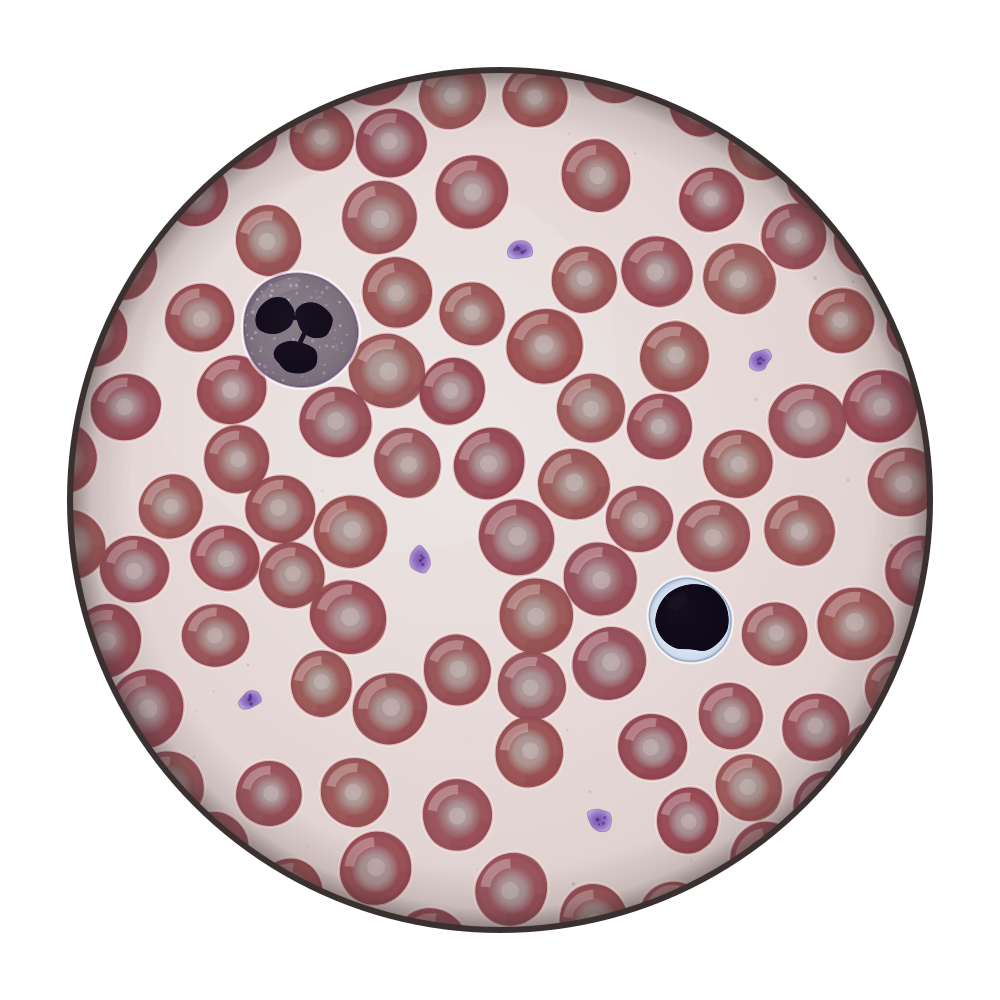
- White blood cells have a nucleus. They are part of the immune system: they help defend the body against pathogens.
- Platelets are tiny fragments of cells, with no nucleus. They help the blood to clot.
Choose a button, then tap the picture.
How white blood cells defend the body: B3 Infection and response.
Screen 10
How a blood clot forms
- When the skin is cut, platelets stick to the damaged vessel and to each other.
- A mesh of protein fibres forms and traps red blood cells. This is a clot.
- The clot stops blood loss and stops pathogens getting in. On the skin, it dries to a scab.
Screen 11
A drop of blood in numbers
- 1 mm³ of blood holds about 5 000 000 red blood cells, 250 000 platelets and 7 000 white blood cells.
- Divide the bigger number by the smaller one: there are about 700 red blood cells for every white blood cell.
- A scale bar shows a real length, such as 10 µm (micrometres).
| Part of blood | Number in 1 mm³ | For each white blood cell |
|---|---|---|
| Red blood cells | 5 000 000 | about 700 |
| Platelets | 250 000 | about 36 |
| White blood cells | 7 000 | 1 |
5 000 000 ÷ 7 000 = 714, so about 700 red blood cells for every white blood cell.
Screen 12
Checkpoint 3 of 3
Quick check on screens 9 to 11. Tap an answer.
1.What are platelets?
2.When blood clots at a cut, what traps the red blood cells?
3.1 mm³ of blood has 5 000 000 red blood cells and 5 000 white blood cells. How many red blood cells are there for each white blood cell?
Quiz
Quiz: B2 L8 Blood and its components
10 questions. Tap an answer. Your first answer counts towards your score.
In a stained blood smear, which are by far the most common?
Why is a blood smear stained before it is looked at?
A tube of blood is spun in a centrifuge. About what percentage of the blood is plasma?
Where does plasma carry carbon dioxide to?
Which list contains only substances that plasma carries?
How does the biconcave shape help a red blood cell?
Red blood cells reach the body's tissues. What happens to their oxygen?
Which of these is the job of white blood cells?
What do platelets do when the skin is cut?
1 mm³ of blood has 250 000 platelets and 5 000 white blood cells. How many platelets are there for each white blood cell?
Exam questions
The same five questions as the B2 L8 Exam questions worksheet. 20 marks.
Write your answer, then open the mark scheme and tick each point you made.
01Figure 1 shows a drawing of blood seen with a light microscope.
01.1Name the parts labelled A, B and C in Figure 1.
Choose answers from the box.
01.2Which part of the blood carries most of the oxygen around the body?
Tick (✓) one box.
01.3In Figure 1, the scale bar is 20 mm long. It represents 10 µm.
Cell B is 22 mm across in Figure 1.
Calculate the real diameter of cell B.
Mark scheme
- (1)
- (1)
- (1)
- (1)
- (1)
- (1)
01.1: 1 mark for each correct label. If more than one name from the box is written on one line, do not give that mark. allow "platelets" for C.
01.3: allow 1.1 × 10 for the first mark. Correct answer with no working = 2 marks. do not accept 9.1 (scale bar ÷ cell) for the second mark.
Model answer01.1 A red blood cell; B white blood cell; C platelet. 01.2 Red blood cells. 01.3 22 ÷ 20 × 10 = 11 µm.
02Plasma carries substances around the body.
Draw one line from each substance to what happens to it.
Online: choose what happens to each substance from its list.
Substance
What happens to it
- It is breathed out from the lungs.
- It is digested in the stomach.
- It is removed by the kidneys in urine.
- It is used by body cells for respiration.
Mark scheme
- (1)
- (1)
- (1)
If more than one line is drawn from a substance, that substance scores 0.
Model answercarbon dioxide: breathed out from the lungs; glucose: used by body cells for respiration; urea: removed by the kidneys in urine.
03A person feels tired all the time.
A doctor tests a sample of their blood.
Table 1 shows the results.
| Part of blood | Number in 1 mm³ of the person's blood | Normal number in 1 mm³ of blood |
|---|---|---|
| Red blood cells | 3 200 000 | 4 500 000 to 5 500 000 |
| White blood cells | 6 500 | 4 000 to 11 000 |
| Platelets | 280 000 | 150 000 to 400 000 |
03.1Which part of the person's blood is outside the normal range?
03.2Suggest why the person feels tired all the time.
Use information from Table 1.
Mark scheme
- (1)
- (1)
- (1)
03.1: allow "the red blood cell count is too low".
03.2: allow "the red blood cell count is low". do not accept "less energy is made / produced". ignore "not enough white blood cells".
Model answer03.1 Red blood cells. 03.2 The person has fewer red blood cells than normal, so their blood carries less oxygen to the body cells.
04When the skin is cut, the blood clots.
Explain why it is important that blood clots at a cut.
Mark scheme
- (1)
- (1)
allow "stops germs / bacteria / viruses getting in" for the second mark. allow "stops infection" for the second mark. ignore "protects the body" with no detail.
Model answerA clot stops the person losing too much blood, and it stops pathogens getting into the body through the cut.
05Blood is made of plasma, red blood cells, white blood cells and platelets.
Describe the function of each part of the blood.
Explain how red blood cells are adapted for their function.
Mark scheme
Level of response. Read your answer, choose the level that fits best, then pick your mark.
| Level | Marks | Descriptor |
|---|---|---|
| 3 | 5–6 | A detailed and coherent answer. The functions of all four parts of the blood are correctly described, and at least two features of red blood cells are each clearly linked to carrying oxygen, for example: no nucleus → more room for haemoglobin → carries more oxygen. |
| 2 | 3–4 | The functions of at least three parts of the blood are described, and at least one feature of red blood cells is given. The links to carrying oxygen may be missing or incomplete. |
| 1 | 1–2 | Simple statements, for example "red blood cells carry oxygen" or "platelets help blood clot", with little or no explanation of how red blood cells are adapted. |
| 0 | 0 | No relevant content. |
Indicative content
- plasma: the liquid part of the blood; carries dissolved substances: carbon dioxide (to the lungs), glucose and amino acids (from the small intestine to body cells), urea (from the liver to the kidneys), hormones, antibodies; carries the blood cells and platelets
- red blood cells: carry oxygen (from the lungs to the body's tissues)
- white blood cells: part of the immune system; help defend the body against pathogens (allow: engulf pathogens / make antibodies)
- platelets: fragments of cells; help the blood to clot (at a wound), stopping blood loss and keeping pathogens out
- red blood cells contain haemoglobin, which joins with oxygen (in the lungs) and releases it (in the tissues)
- red blood cells have no nucleus, so there is more room for haemoglobin, so they carry more oxygen
- red blood cells are biconcave, so they have a large surface area, so oxygen diffuses in and out quickly
- red blood cells have a thin centre, so the diffusion distance is short
- red blood cells are small and flexible, so they can squeeze through capillaries, close to body cells
Your mark:
Model answer (Level 3)Plasma is the liquid part of the blood. It carries dissolved substances such as glucose, carbon dioxide and urea, and it carries the blood cells. Red blood cells carry oxygen from the lungs to the body's tissues. White blood cells help defend the body against pathogens. Platelets help the blood to clot at a wound. Red blood cells contain haemoglobin, which joins with oxygen in the lungs and releases it in the tissues. They have no nucleus, so there is more room for haemoglobin and they can carry more oxygen. They are biconcave, which gives a large surface area, so oxygen diffuses in and out quickly.
Total: 0 out of 20
Printable copy: the B2 L8 Exam questions worksheet and its mark scheme (PDF) are in .